Clear Sky Science · en
Chitosan-poly(3,4-ethylenedioxythiophene)-poly(styrenesulfonate)-AuNPs composite for acetone detection using plasmonic image sensor
Breath Clues and Safer Workplaces
Acetone is best known as a nail-polish remover, but it also wafts through factories, laboratories, and even our own breath. Its level in exhaled air can hint at diseases such as diabetes, while too much in the workplace can threaten health and safety. This study introduces a new optical sensor coating that can spot acetone quickly and selectively, even when other common alcohol vapors are present, opening a path toward portable breath testers and simple industrial monitors.
Why We Care About a Solvent’s Smell
Acetone is a small, highly flammable liquid used as a powerful cleaner and solvent in pharmaceuticals, cosmetics, textiles, paints, and research labs. Because it evaporates easily, people are often exposed to its vapor. Doctors are interested in it for a different reason: acetone in breath is a key “biomarker” for diabetes and a dangerous condition called diabetic ketoacidosis. Measuring it normally requires complex lab equipment. A compact, simple device that can sense tiny amounts of acetone in real time could help track disease without blood draws and keep industrial spaces safer.
How Light is Used to Smell Chemicals
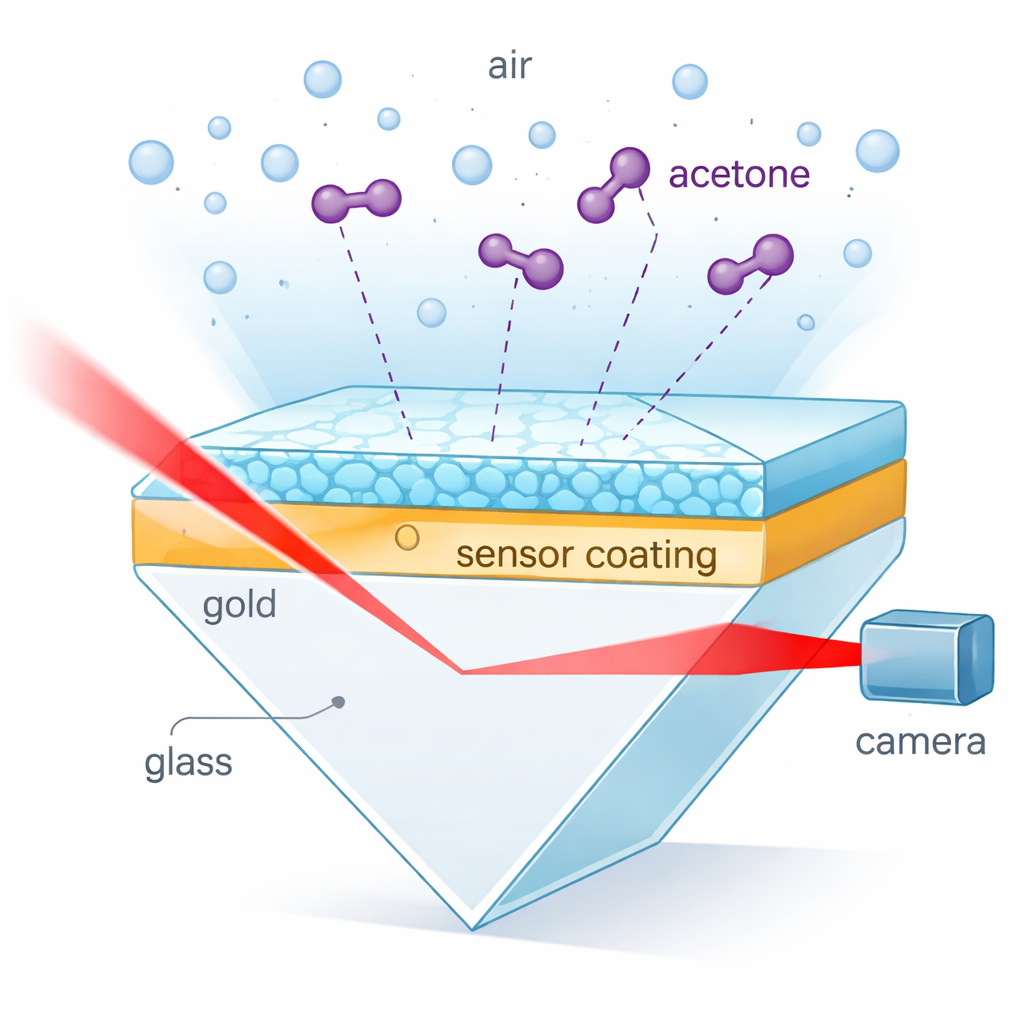
The heart of the device in this work is a surface plasmon resonance imaging (SPRi) sensor. In simple terms, a red laser shines through a glass block onto a thin gold film. At a specific angle, the light couples to ripples of electrons on the metal surface, making the reflected beam unusually dark. This dark point is extremely sensitive to what coats the gold and to any vapor that touches it. When acetone molecules land on a special coating placed over the gold, they subtly change how light is reflected. A camera records small changes in the brightness pattern over time, and computer analysis turns those changes into a measure of how strongly the vapor is interacting with the surface.
A Smart Coating Built from Crustacean Shells and Gold
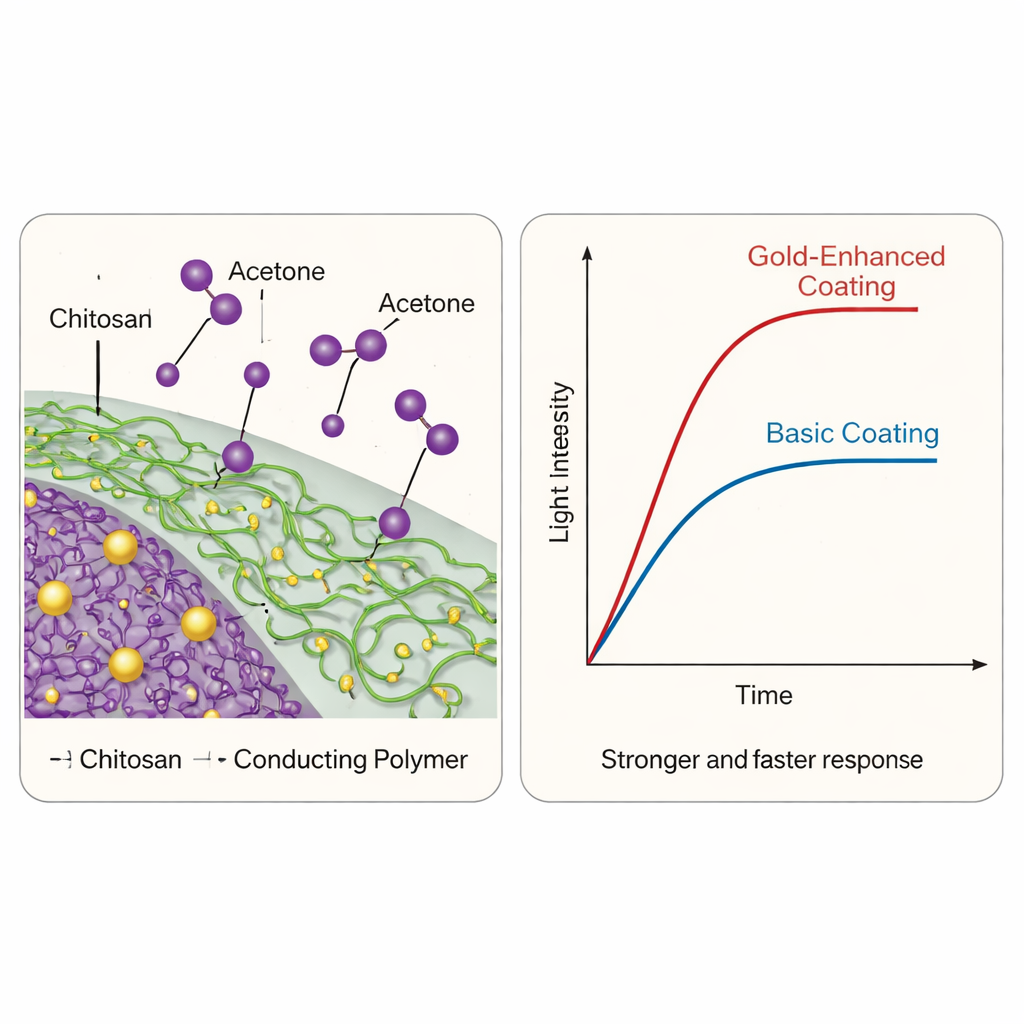
The researchers created two versions of the sensitive coating. Both are based on chitosan, a sugar-like material often derived from shrimp shells, mixed with a conductive plastic known as PEDOT:PSS. Chitosan brings many sites that can form temporary bonds with acetone, while the plastic helps communicate those interactions to the light-sensitive gold below. In the enhanced version, the team added tiny gold nanoparticles produced by blasting a gold target with laser pulses in liquid. Microscopy and spectroscopic tests confirmed that these particles were roughly spherical, well dispersed in the film, and tightly linked to the surrounding polymer and chitosan network.
Watching Acetone Bind in Real Time
To test performance, the team exposed both coatings to pure acetone vapor and to mixtures of acetone with methanol or ethanol, two common alcohols that might confuse many sensors. At the angle where the reflected image is darkest, they tracked how the average brightness changed over seconds. For both coatings, the signal rose as acetone was taken up and then fell as it was released. But the gold‑nanoparticle version responded faster and with a much larger intensity shift—about 1.6 times more sensitive than the basic film, with a very low detection limit. When acetone was diluted with ethanol or methanol, the signal became smaller, roughly matching the lower acetone content. Strikingly, when the coating was exposed to pure ethanol or methanol alone, the signal barely changed at all.
Why Gold Nanoparticles Make a Difference
The improved behavior of the advanced coating comes from both chemistry and physics. Chitosan contains amine and hydroxyl groups that attract acetone’s strongly polarized carbonyl group through hydrogen bonds and electrical interactions. The conducting plastic and chitosan together present many such binding sites. Adding gold nanoparticles boosts the local electric field at the surface and increases the density of mobile charges, making the optical signal more responsive to any binding event. As a result, acetone molecules cause a much bigger change in the reflected light pattern than methanol or ethanol, which interact more weakly with the surface.
From Lab Setup to Practical Detectors
The study shows that a thin film made from chitosan, conducting polymer, and gold nanoparticles can act as a highly selective “nose” for acetone when combined with an SPR imaging setup. The method is label‑free, relies only on light and image processing, and works at room temperature with simple hardware. Because the sensor responds strongly to acetone but barely notices similar alcohol vapors, it could be adapted for breath analyzers to monitor metabolic health or for compact monitors that watch for solvent leaks in factories and labs, providing an accessible and sensitive way to detect this important chemical.
Citation: Sadrolhosseini, A.R., Bizhanifar, A., Akbari, L. et al. Chitosan-poly(3,4-ethylenedioxythiophene)-poly(styrenesulfonate)-AuNPs composite for acetone detection using plasmonic image sensor. Sci Rep 16, 7069 (2026). https://doi.org/10.1038/s41598-026-38050-4
Keywords: acetone sensor, breath analysis, plasmonic imaging, gold nanoparticles, chitosan composite