Clear Sky Science · en
Development of a novel dismantlable adhesive for orthodontic use triggered by thermal stimulation
Gentler Braces for Sensitive Teeth
For many people, the worst part of braces is not wearing them, but taking them off. Popping metal brackets off teeth can be painful and may even chip tooth enamel. This study describes a new kind of glue for orthodontic brackets that stays strong during treatment but weakens on command when warmed slightly, offering a future in which getting braces removed could be quicker, safer, and far less uncomfortable.
The Problem with Today’s Braces Glue
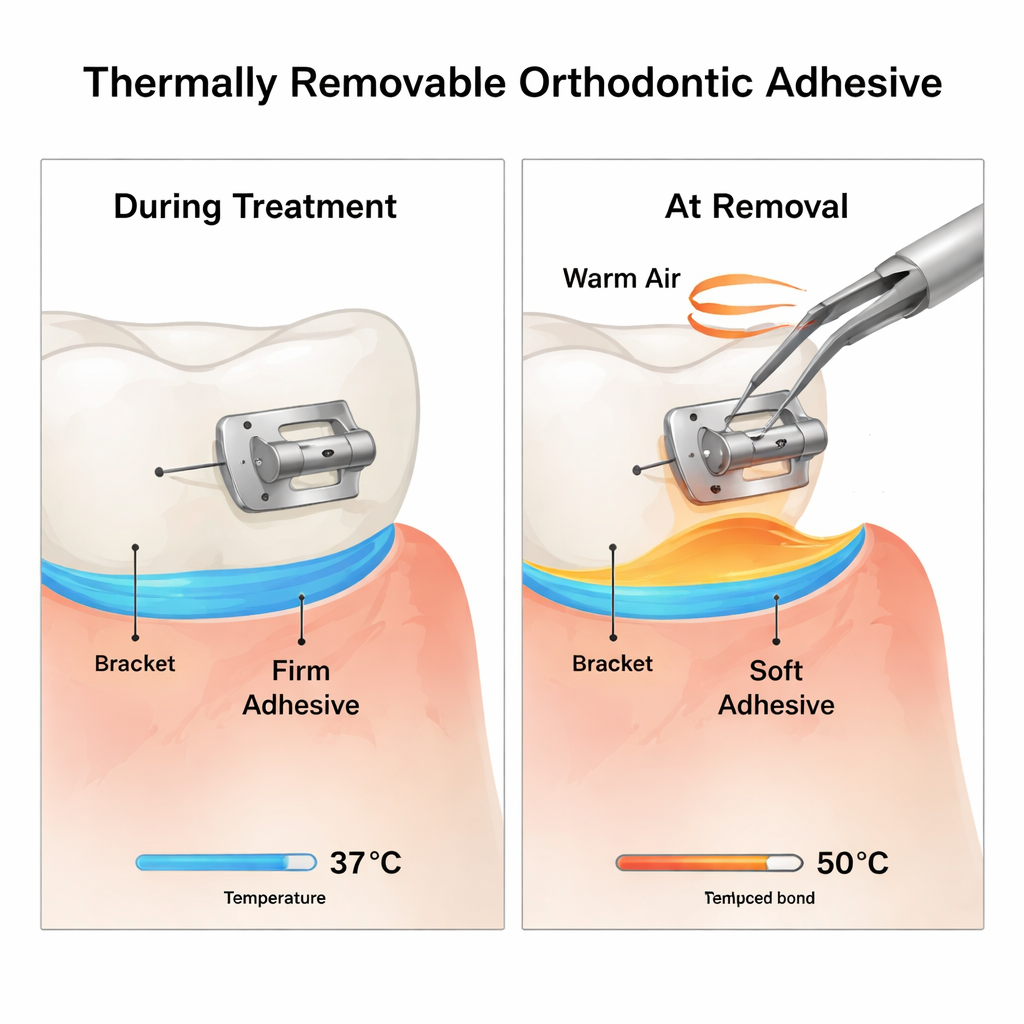
Modern orthodontic treatment relies on powerful adhesives to keep brackets firmly attached to teeth while they are being moved into better positions. That strength is essential for months or years of chewing and orthodontic forces, but it becomes a drawback on the day of removal. Dentists must apply considerable force to break the glue free, which many patients experience as sharp pain. Studies have shown that up to about 40% of patients report high pain levels during debonding, and the forces involved can create tiny cracks in tooth enamel. Simply using a weaker glue is not an option, because brackets could pop off during treatment. The ideal solution is a smart adhesive that behaves like a strong glue most of the time, but can be switched to a weaker state when the orthodontist is ready to remove the brackets.
A Glue That Responds to Warmth
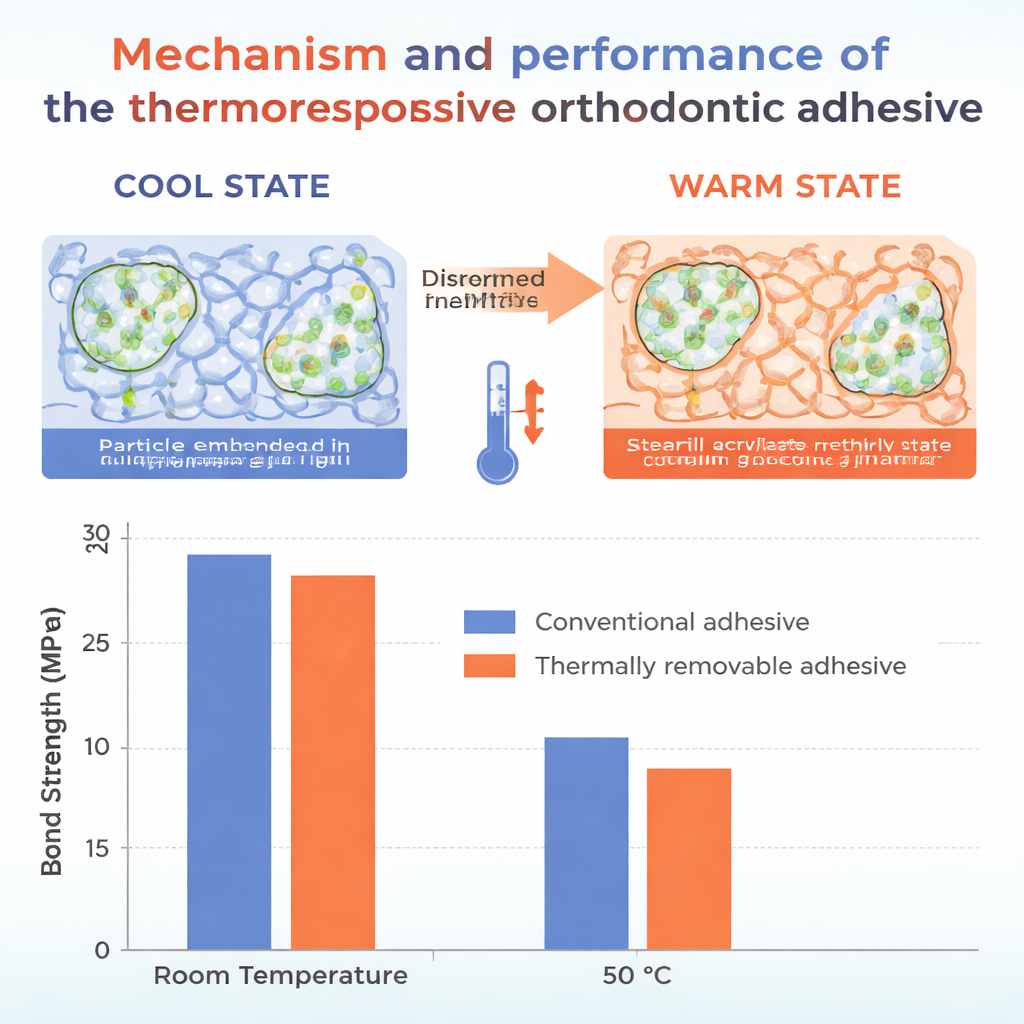
The researchers focused on temperature as a safe trigger that could be used inside the mouth. They built their design around a special polymer gel made from stearyl acrylate and methyl acrylate. This gel behaves a bit like a shape-memory plastic: at normal temperatures it is firm, but above a certain threshold it quickly softens and becomes rubbery. By changing the ratio of the two building blocks, the team could tune the temperature at which this transition occurs. They ground the gel into tiny particles and mixed them into a common dental adhesive resin, known as 4META resin, at 30% by weight. Two versions were created, one with a 1:1 ratio of the two components and another with a 3:1 ratio, then cured into solid adhesive samples and examined under microscopes to confirm that the gel particles were reasonably well dispersed.
Testing How the Smart Glue Behaves
To understand when the gel-rich adhesive would soften, the team used a thermal analysis technique that measures how materials absorb heat. The plain resin showed no special changes with temperature, but the gel-containing versions displayed clear transitions. The 1:1 gel mixture softened at about 38 °C, close to normal mouth temperature, which would risk unwanted weakening during everyday life. The 3:1 mixture softened at about 42 °C, high enough that casual hot drinks are unlikely to heat the hidden adhesive layer long enough to cause trouble. Next, the researchers tested mechanical strength. They pulled and sheared the materials at room temperature and at 50 °C, a temperature chosen as both safe for patients and high enough to fully activate softening. At room temperature, the new adhesives held brackets on cattle teeth with strengths similar to the conventional resin and within the range considered safe for orthodontic use.
Switching from Strong to Gentle on Demand
When the temperature was raised to 50 °C, the behavior changed dramatically. In the plain resin, stiffness, tensile strength, and shear bond strength dropped only slightly. In contrast, in the adhesives filled with the temperature-responsive gel, all these measures fell sharply. The internal gel domains softened to almost zero stiffness, dragging down the overall rigidity and strength of the adhesive layer. For the 3:1 gel adhesive, the bond strength to teeth fell from about 8.4 megapascals at room temperature to about 3.9 megapascals when warm—less than half its original value and well below the level at which enamel damage is a concern. Microscopic images of the tooth–bracket interface suggested a rougher, more porous structure in the gel-containing adhesives, consistent with soft regions that lose firmness when heated.
What This Could Mean at the Dentist
If this type of material can be refined and proven durable in long-term use, it could change how braces are removed. An orthodontist might warm the brackets for a short time with a specialized heating tool that raises the adhesive just a few degrees above body temperature. The smart glue would then soften, its grip on the tooth would drop by more than half, and the bracket could be eased off with much less force. That should reduce both the risk of enamel damage and the discomfort patients feel. Although this study used a small number of samples and did not yet test years of wear in the mouth, it demonstrates a promising concept: a dismantlable orthodontic adhesive whose strength can be dialed down on command simply by adding a little warmth.
Citation: Shundo, A., Nakanishi, K., Kurokawa, T. et al. Development of a novel dismantlable adhesive for orthodontic use triggered by thermal stimulation. Sci Rep 16, 7041 (2026). https://doi.org/10.1038/s41598-026-38044-2
Keywords: orthodontic adhesive, braces removal, thermoresponsive polymer, dental materials, smart glue