Clear Sky Science · en
A new anti-soiling approach based on oleic acid-modified Al₂O₃ nanocoatings for photovoltaic panels
Why Cleaner Solar Panels Matter
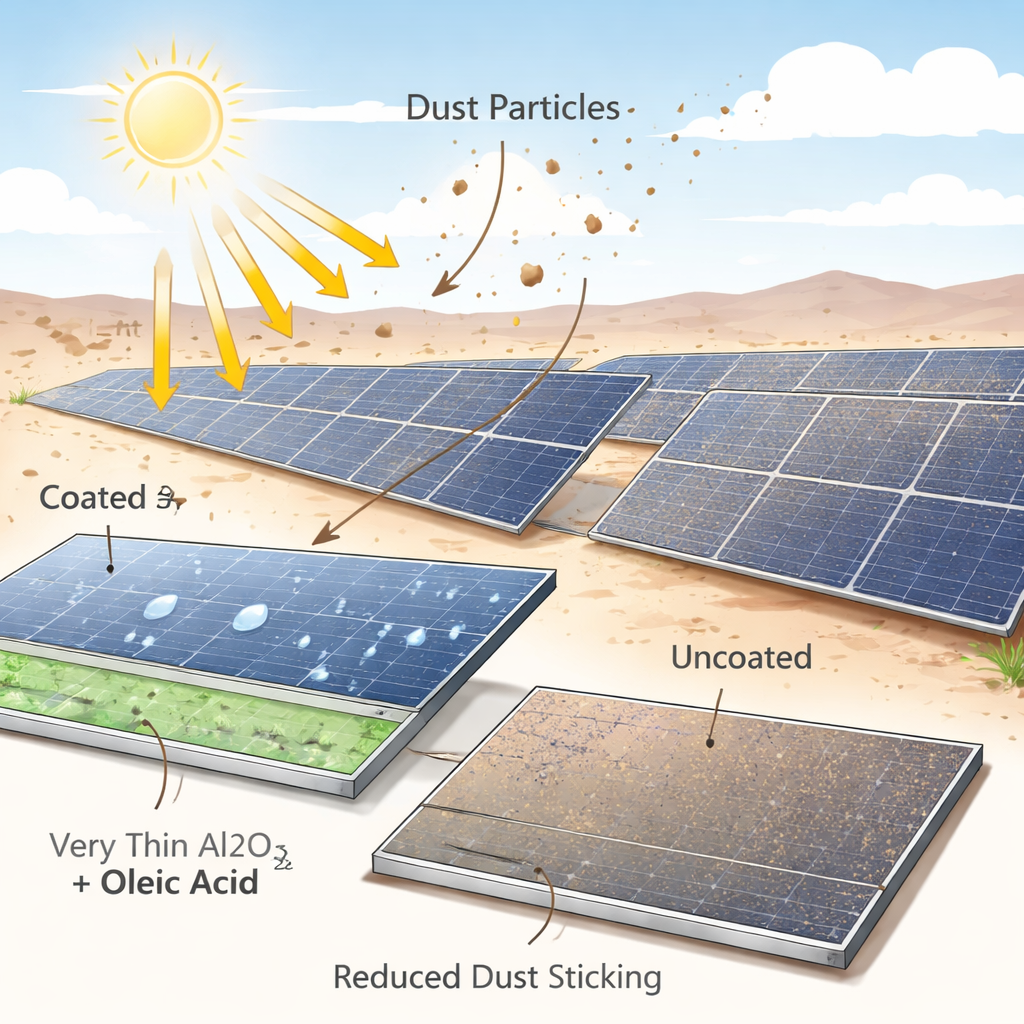
Solar panels work best when sunlight can reach them without anything in the way. In dusty, dry regions, however, windblown particles quickly coat their glass surfaces, blocking light and cutting power output. This paper explores a new ultra-thin coating for solar panel glass, designed to make dust less likely to stick in the first place. By tweaking both the chemistry and texture of the glass surface, the researchers aimed to keep panels cleaner for longer, without needing extra energy or water for washing.
A Thin Shield Against Dust
The team focused on creating a nearly invisible film made from aluminum oxide, a hard, transparent ceramic often used on glass. They applied this film using a spray technique that deposits a nanometer-scale layer onto hot glass. To tune how the surface interacts with dust and water, they then treated the film with oleic acid, a common fatty acid. This treatment changes the way the surface "feels" to tiny particles, making their grip weaker. After testing different spray times and oleic acid concentrations, they found that a 40-second spray plus a moderate amount of oleic acid produced a smooth, uniform coating with good light transmission and a contact angle that indicated reduced surface stickiness rather than extreme water repellence.
Looking Closely at the New Surface
To understand what they had made, the researchers used powerful imaging and measurement tools. Electron and atomic force microscopes showed how the coating’s tiny bumps and clusters changed with different recipes, while X-ray tests confirmed that the layer stayed amorphous, like frozen glass rather than a crystal. By carefully measuring how water droplets spread on the surface, they found that the coating consistently made the glass less eager to hold onto liquids and, by extension, dust. At the same time, optical tests revealed that the best version of the film let more than 80% of visible light through. This balance—less dust-friendly without noticeably dimming the panel—is crucial for any practical solar coating.
Testing Dust Buildup in a Controlled Chamber
Next, the team built a one-cubic-meter test chamber that mimicked harsh summer conditions: blowing air, controlled temperature and humidity, and carefully measured amounts of real dust collected from a nearby solar plant. Inside, they compared plain glass to glass with the optimized coating. Across many test runs, and over a wide range of temperatures, wind speeds, and dust loads, the coated surfaces consistently ended up with less dust stuck to them—on average 6.9 milligrams per square centimeter less than uncoated glass. That translated into preventing about 0.6% to 3.0% of the energy losses typically caused by soiling. Statistical analysis showed that the coating’s benefit was strongest when dust loads were high and wind speeds were low, conditions where natural “self-cleaning” by the environment offers little help.
Real-World Trials on Mini Solar Panels
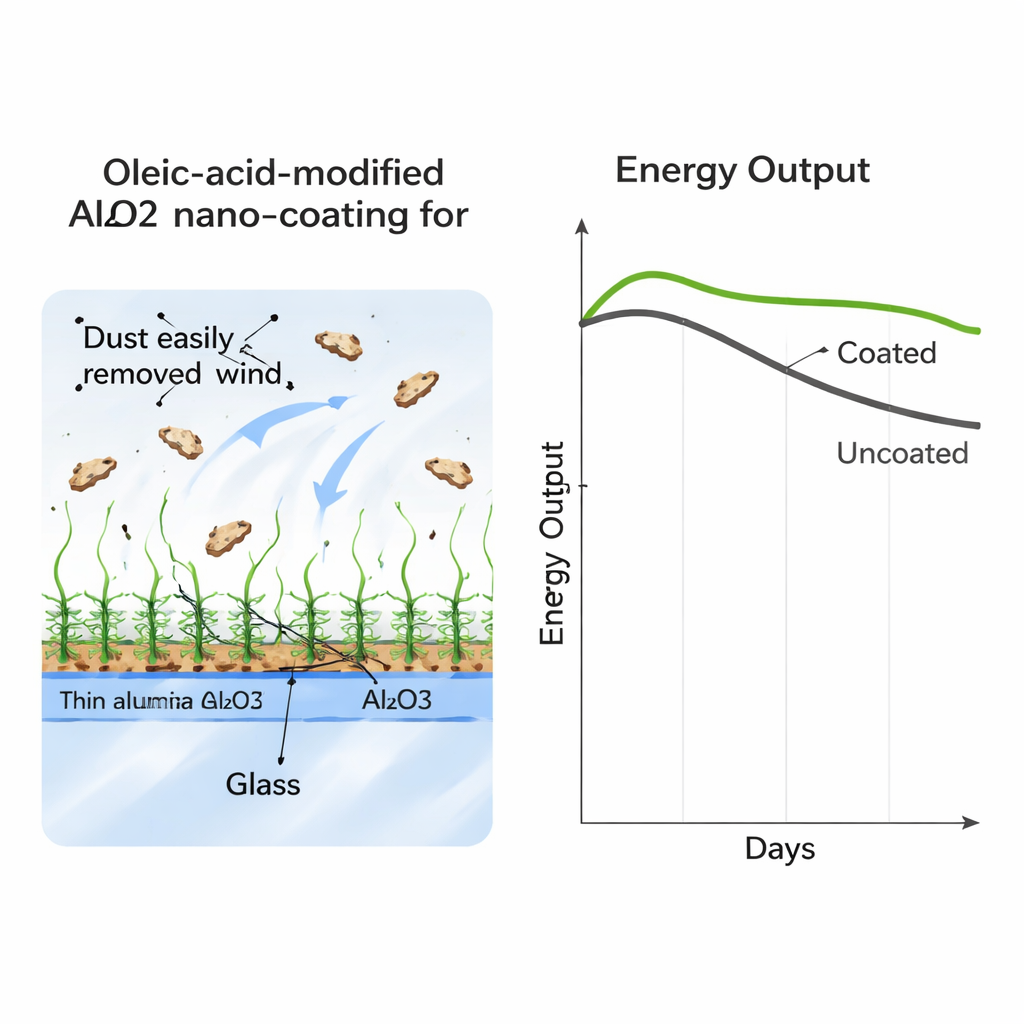
Laboratory success does not always survive the outdoors, so the researchers laminated their coated glass into small, fully wired photovoltaic modules and mounted them outside on a test rack. Over several weeks in summer, they tracked current, voltage, temperature, and sunlight every few seconds for both coated and uncoated mini-panels. Early in the test period, the coated modules produced more power each day—typically about 0.5 to 0.8 watts more—confirming that the cleaner glass helped under real sunlight and real dust. However, as temperatures rose above about 35 °C and the air carried more oily or soot-like pollutants, the coated panels gradually lost their advantage. These sticky contaminants bonded strongly to the modified surface, reducing light transmission and power output until the coated panels fell behind their uncoated neighbors.
Lessons for Future Solar Coatings
The study shows that an oleic-acid-modified aluminum oxide film can act as a passive, energy-free way to reduce dust buildup on solar panels, especially in dry, dusty areas with limited water for cleaning. The coating is thin, transparent, and initially boosts performance, but it is not a permanent fix: in hot, polluted conditions, grime still accumulates and must occasionally be washed away. For a lay reader, the takeaway is that smart surface engineering can help solar panels stay cleaner and more efficient, but real-world environments are complex. The best solutions will likely combine such coatings with practical cleaning schedules and possibly next-generation materials that better resist both dust and oily pollution over many seasons.
Citation: Arslan, M., Deveci, İ., Arslan, C. et al. A new anti-soiling approach based on oleic acid-modified Al₂O₃ nanocoatings for photovoltaic panels. Sci Rep 16, 7615 (2026). https://doi.org/10.1038/s41598-026-38041-5
Keywords: solar panels, dust and soiling, nano coatings, renewable energy, surface engineering