Clear Sky Science · en
Engineering polyethylenimine–metal functionalized cryogels for superior catalase binding, activity, and long-term durability
Why holding enzymes in place matters
Hydrogen peroxide is a common chemical by-product in everything from food processing to medical treatments, and living cells rely on the enzyme catalase to break it down into harmless water and oxygen. In industry, however, catalase is usually used in a free, dissolved form that quickly loses power, cannot be easily recovered, and must be replaced often. This study explores a way to "park" catalase inside a sponge-like material so it stays active longer, can be reused many times, and works more efficiently—all of which could lower costs and make enzyme-based processes cleaner and more sustainable.
Building a smart sponge
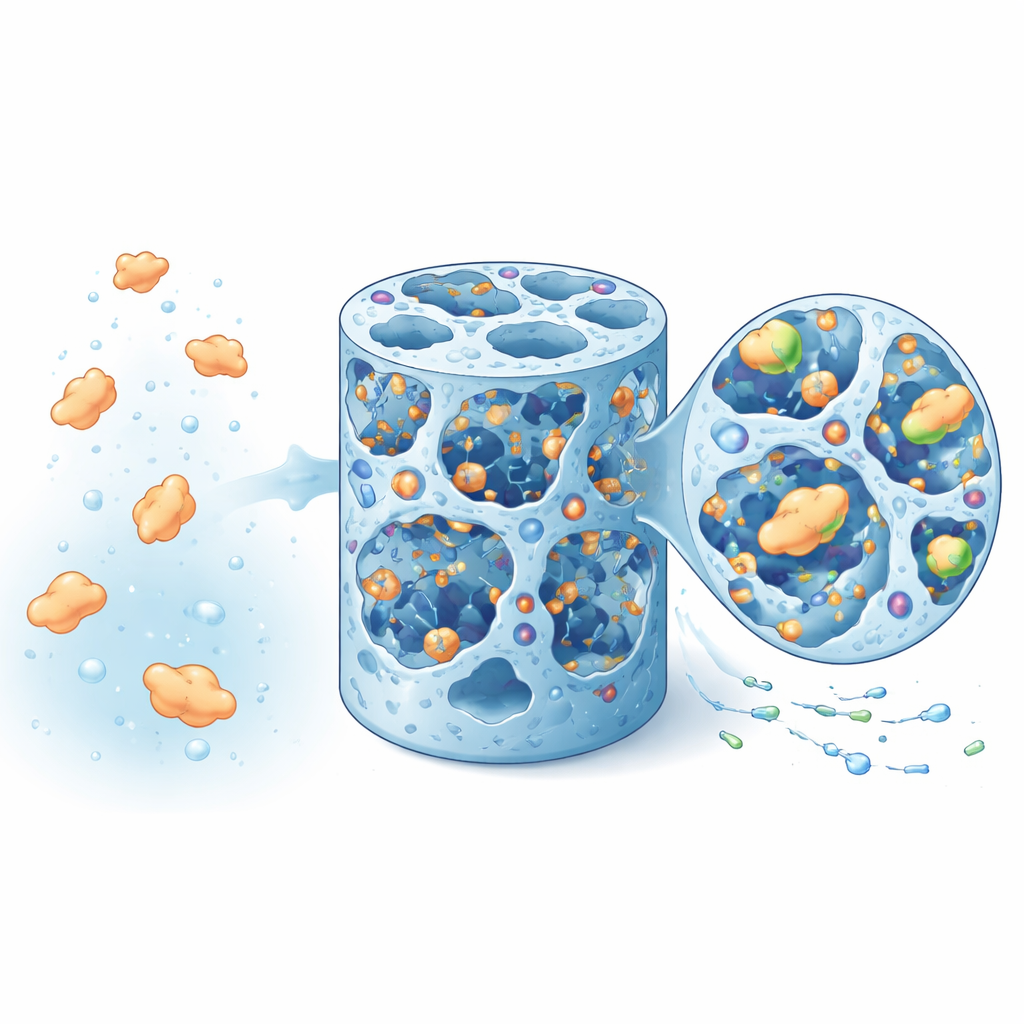
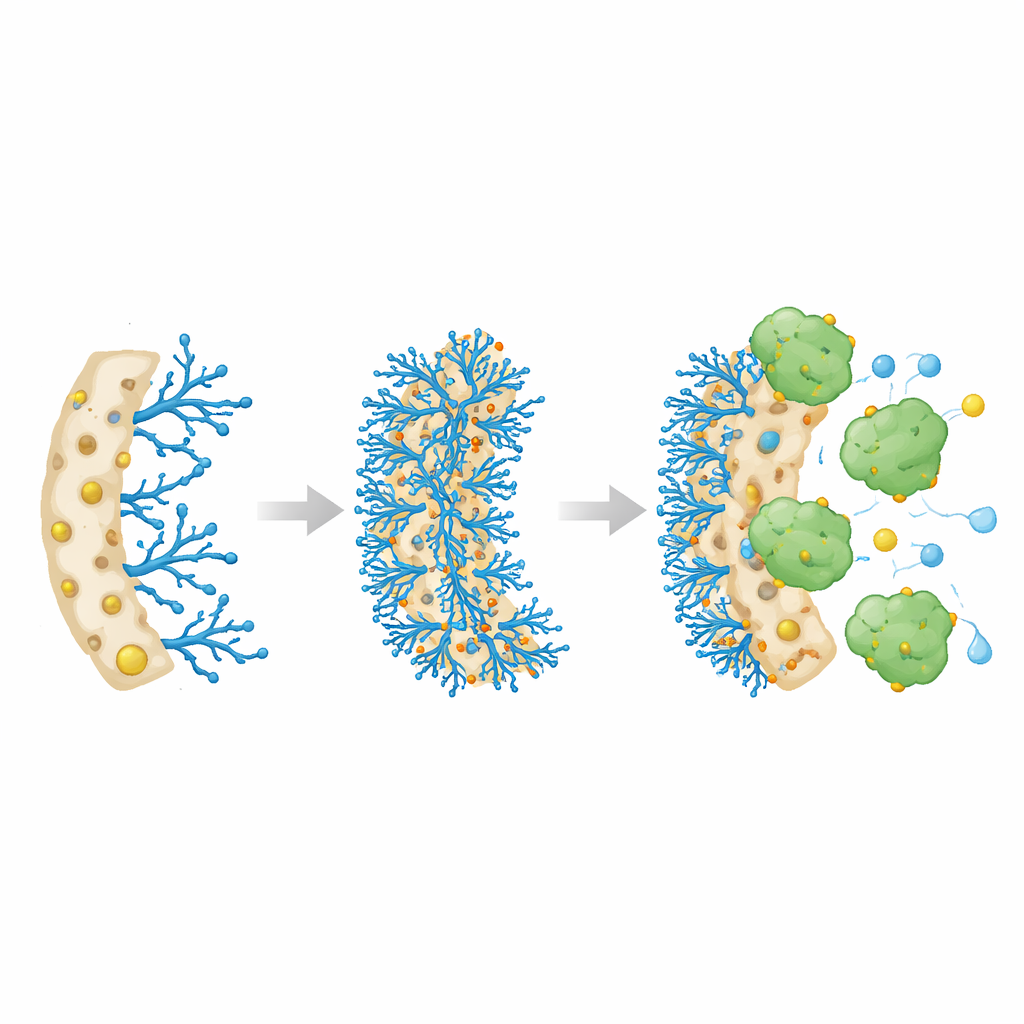
The researchers designed a special polymer sponge, called a cryogel, formed by freezing and thawing a liquid mixture so that ice crystals carve out large, interconnected pores. These pores let liquids flow freely, like water through a loofah, while the solid framework remains tough and elastic. The team used a base material called Poly(HEMA-co-GMA), then chemically grafted onto it a branched molecule rich in nitrogen groups, polyethylenimine (PEI). Finally, they attached metal ions—copper, nickel, or cobalt—to these nitrogen sites. The idea was that the metal ions would act like docking points that strongly attract and hold catalase molecules in place without blocking the flow of liquid through the sponge.
Tuning the material for best performance
To understand how each step of this design changed the material, the team used several laboratory techniques to probe its structure, chemistry, and stability. They showed that adding PEI and then metals did not collapse the porous network but actually increased the sponge’s ability to hold water, which is good for keeping enzymes comfortable and active. Among the three metals, copper produced the most hydrated and well-organized environment. Microscopy images revealed that the original material looked like packed granules, while the PEI- and metal-treated versions opened into a cleaner, more continuous network of large pores. Measurements of metal content confirmed that copper bound more strongly and in higher amounts than nickel or cobalt, suggesting it would provide the most effective docking sites for catalase.
Locking catalase into place
When catalase was introduced to the different metal-bearing sponges, all three grabbed the enzyme quickly, but the copper version stood out. It loaded the highest amount of catalase—about 392 milligrams per gram of dry sponge—and reached a steady level within about eight hours. The researchers then examined how well the immobilized enzyme worked compared with free catalase in solution. Although the maximum reaction speed per gram of enzyme decreased somewhat, the immobilized catalase showed a much stronger apparent attraction for its substrate, hydrogen peroxide. In practical terms, this means the bound enzyme did its job more efficiently at lower substrate levels, likely because the porous, water-filled copper sponge concentrated the substrate near the enzyme and helped maintain its active shape.
Enzyme that endures
One of the biggest advantages of immobilizing enzymes is the promise of reusability and long shelf life. Here, catalase attached to the copper-based cryogel proved far more durable than its free counterpart. After 15 repeated use cycles, the immobilized enzyme still retained about one-third of its initial activity, while free catalase would typically be discarded after a single use. In storage tests at refrigerator temperature over 70 days, the immobilized catalase kept more than 60% of its activity, roughly double that of the free enzyme. The sponge also allowed the enzyme to be detached and reloaded multiple times using a simple salt solution, showing that the material itself can be reused without major loss of capacity.
What this means for real-world use
For a non-specialist, the main takeaway is that the researchers have built a kind of reusable "enzyme sponge" that holds catalase firmly yet gently, helping it work better at lower chemical levels and last much longer in use and in storage. By pairing a highly porous cryogel with PEI and copper ions, they created a platform that combines high enzyme loading, improved efficiency, and strong long-term stability. Such materials could be plugged into industrial or environmental systems to break down hydrogen peroxide and related substances more reliably and with less waste, offering a practical step toward greener, enzyme-driven technologies.
Citation: Erol, K., Alkan, M.H. & Alacabey, İ. Engineering polyethylenimine–metal functionalized cryogels for superior catalase binding, activity, and long-term durability. Sci Rep 16, 7880 (2026). https://doi.org/10.1038/s41598-026-38040-6
Keywords: enzyme immobilization, catalase, cryogel, copper-functionalized polymers, biocatalysis