Clear Sky Science · en
Psychometric properties of the schizotypal personality questionnaire-brief revised (SPQ-BR) in a German-speaking sample
Why subtle personality quirks matter
Many people occasionally feel suspicious, see meaning in coincidences, or prefer to keep to themselves. For most, these quirks are harmless. But when such traits become stronger and more persistent, they can signal a higher risk for conditions on the schizophrenia spectrum. This study tested whether a short, updated questionnaire can reliably measure these traits in German-speaking adults, helping researchers better understand early warning signs and the broader landscape of mental health.
A short checklist for unusual experiences
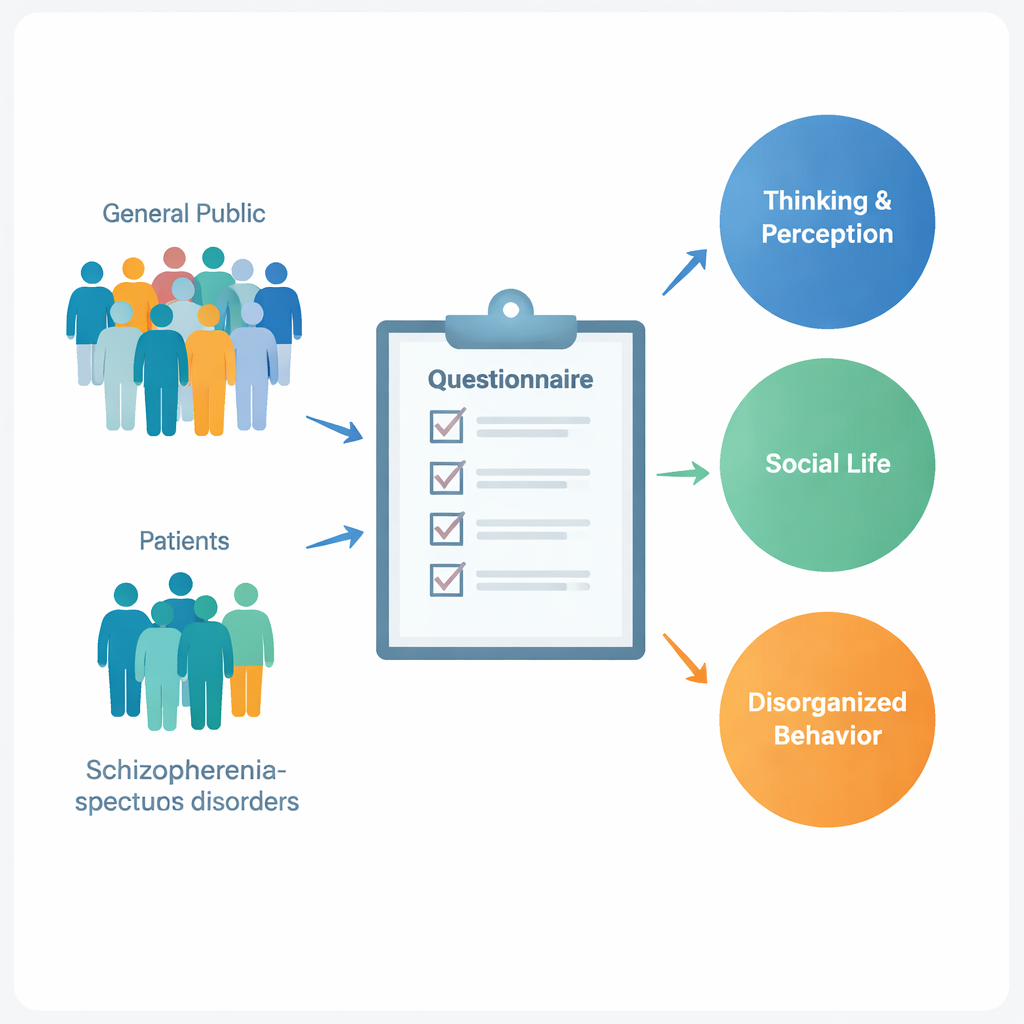
The researchers focused on the Schizotypal Personality Questionnaire–Brief Revised (SPQ-BR), a 32‑item checklist that asks people how strongly they agree with statements about their thoughts, feelings, and behavior. It is designed to capture three broad areas: unusual perceptions and beliefs, difficulties in relationships, and disorganized or odd behavior. While this tool had already been studied in several languages, its performance in German-speaking populations was largely unknown. The team translated and refined the German version (SPQ-BR-G) and set out to determine whether it works as well as the original.
How the study was carried out
More than 700 adults from the general population completed an online survey, and a smaller group of 33 people with diagnosed schizophrenia or schizoaffective disorder took part as a clinical comparison group. Participants answered the SPQ-BR-G along with other standard questionnaires measuring related traits, such as broader schizotypy, personality style, depression and anxiety, and overall life satisfaction. By comparing patterns of answers across these tools, the researchers could test whether the SPQ-BR-G was consistent, captured more than one underlying dimension, and related to mental health in meaningful ways.
Strong and stable measurement
The German version of the questionnaire proved highly reliable: people’s answers across the 32 items “hung together” very well, indicating that the scale consistently measures schizotypal traits. Statistical modeling showed that the questions clustered best into three or four related groups, rather than a single vague score. These groups reflected unusual thoughts and perceptions, social and emotional difficulties, and disorganized or eccentric behavior. The SPQ-BR-G scores lined up strongly with other established measures of similar traits and psychotic-like experiences, while showing weaker links to less related personality features. This pattern suggests that the tool is measuring what it is supposed to measure, rather than simply picking up general distress.
Links to mental health and everyday life
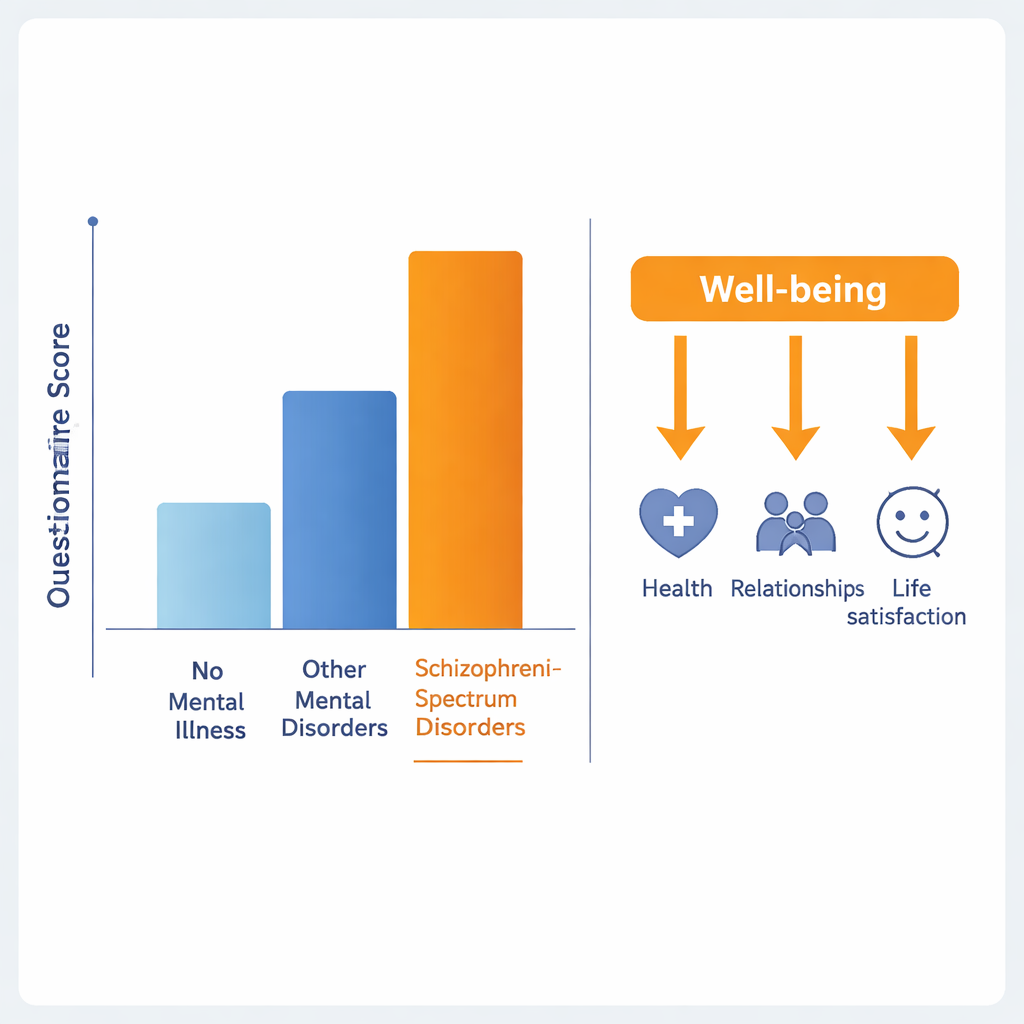
People with schizophrenia-spectrum diagnoses scored markedly higher on the SPQ-BR-G than those without any mental illness, and higher than those with other mental disorders. Around one third of patients fell into the top tenth of scores in the whole sample. Higher scores were also tied to more intense current symptoms on a widely used clinical rating scale. Beyond formal diagnoses, individuals with more pronounced schizotypal traits reported poorer well-being across many areas of life, including health, relationships, and participation in the community. Interestingly, having a family history of psychosis or other mental disorders did not clearly translate into higher scores in this sample, possibly because such relatives were relatively rare or defined broadly.
What this means for understanding risk
For lay readers, the main takeaway is that a brief, self-administered German questionnaire can reliably capture a constellation of subtle traits linked to psychosis risk. Most people who score higher will never develop a schizophrenia-spectrum disorder, but their responses can still offer valuable clues about how personality, everyday functioning, and mental health are connected along a spectrum rather than in all-or-nothing categories. By providing a solid, culturally adapted tool, this work lays the groundwork for future research on early warning signs, protective factors, and the biological underpinnings of psychosis, ultimately aiming to support earlier, more targeted help for those who need it.
Citation: Gajic, V., Fitzner, M., Schulze, T. et al. Psychometric properties of the schizotypal personality questionnaire-brief revised (SPQ-BR) in a German-speaking sample. Sci Rep 16, 7176 (2026). https://doi.org/10.1038/s41598-026-38037-1
Keywords: schizotypy, schizophrenia-spectrum, personality questionnaire, psychosis risk, mental health assessment