Clear Sky Science · en
MPA-based pointing calibration for Q/V band LEO canted antennas
Why satellite dishes need a smarter aim
As satellite internet races to deliver high-speed connections around the globe, ground antennas must keep an almost pinpoint-perfect lock on fast-moving spacecraft. This is especially true for new high-frequency Q/V band systems, whose radio beams are so narrow that even tiny mis-aims can drop a connection. This paper describes a new way to quickly and accurately "teach" large ground antennas how to aim themselves, using a nature-inspired optimization method drawn from how marine predators hunt for prey.
The challenge of hitting a moving target in the sky
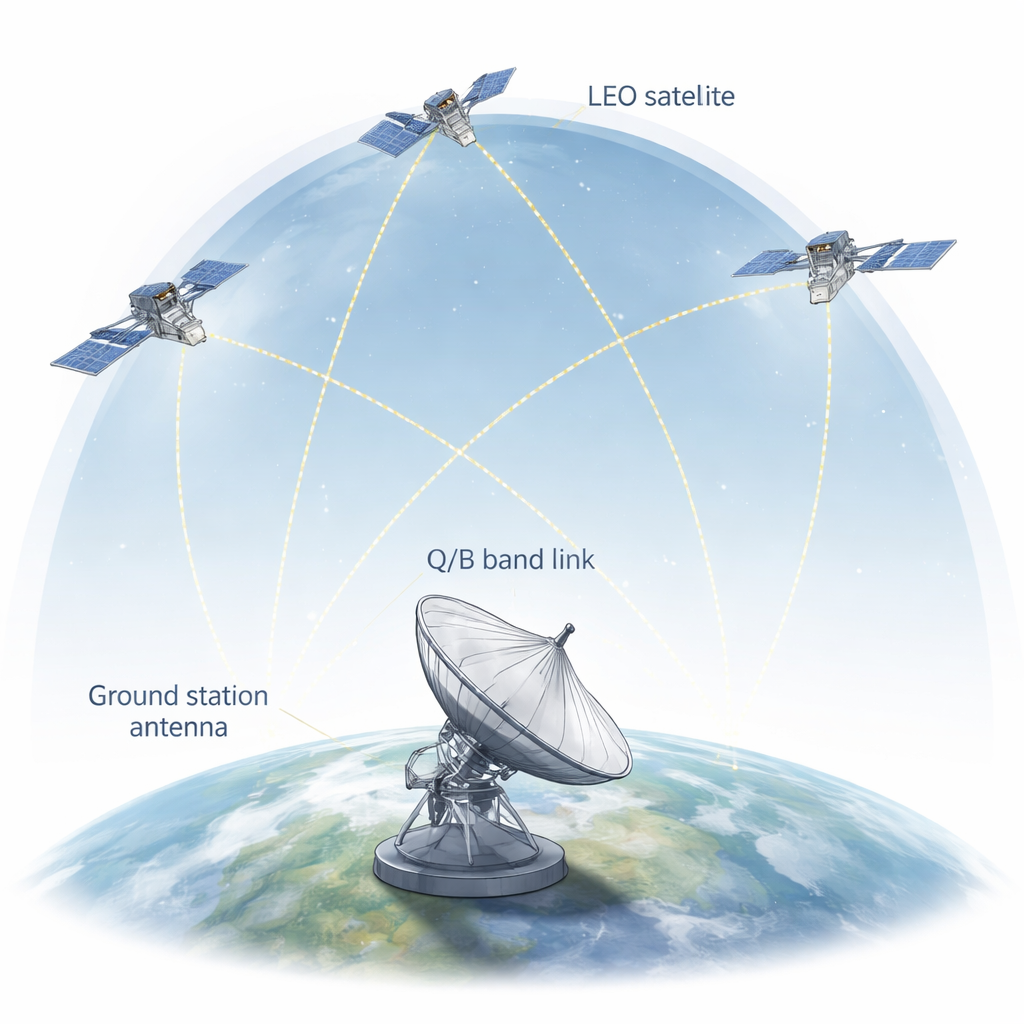
Modern low Earth orbit (LEO) internet satellites zip overhead in minutes, forcing ground antennas to swivel rapidly to keep up. At Q/V band frequencies, a 4.5-meter dish has a beam only about a tenth of a degree wide; the antenna’s pointing error must be roughly one-tenth of that beamwidth. Small construction imperfections, slight misalignments, gravity sag, wind, and even the way the antenna is bolted to its base all nudge the beam off target. Traditional calibration for large radio telescopes can take weeks and often relies on special celestial sources or extra optical hardware, an approach that does not scale when hundreds of gateway stations must be rolled out quickly.
A new twist: three-axis canted antennas
Conventional two-axis antennas suffer from a “blind zone” directly overhead. Near the zenith, the azimuth axis must spin extremely fast, risking loss of lock just when the satellite is passing almost straight above the station. To avoid this, engineers use three-axis canted antennas, where the whole turntable is slightly tilted—here by 7 degrees. This clever mechanical design smooths out the motion through the overhead region, but it also introduces new geometric complications. The antenna’s raw angle readouts no longer line up neatly with standard horizontal coordinates, and extra error sources appear, such as small offsets in the tilt axis. Accurately modeling and correcting all of these effects is a mathematical and computational challenge.
Borrowing from radio astronomy and ocean predators
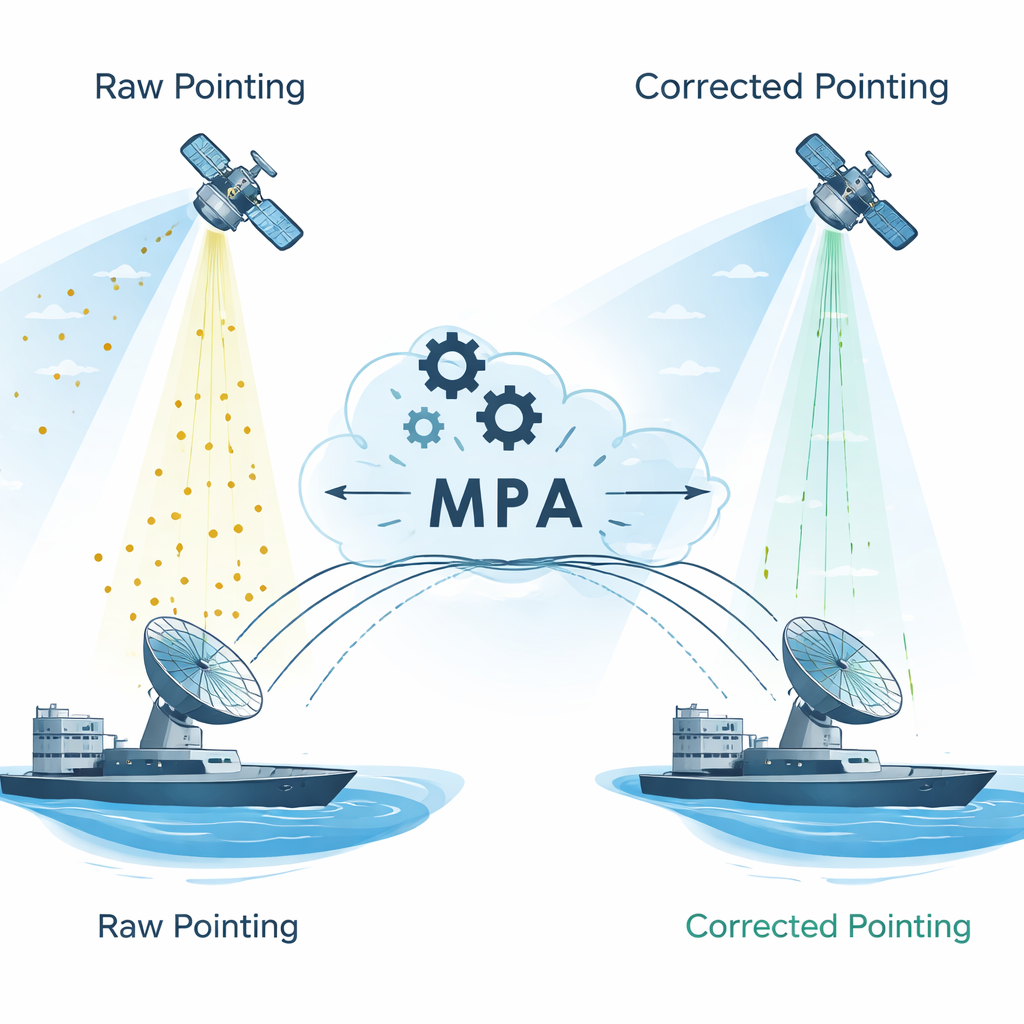
The authors tackle this by blending two ideas. First, they extend the well-known eight-parameter pointing model used for giant radio telescopes, adding terms that describe the special three-axis, tilted geometry. This model translates between what the antenna thinks its angles are and where it is truly pointing on the sky, accounting for zero-offsets, non-orthogonal axes, leveling errors, gravity effects, and atmospheric refraction. Second, instead of solving for the model’s parameters by slow, hand-tuned methods, they unleash the Marine Predators Algorithm (MPA)—a population-based search inspired by how predators and prey move in the ocean. MPA iteratively “hunts” through the parameter space, using random but structured steps to avoid getting trapped in poor solutions while homing in on those that minimize the mismatch between predicted and measured satellite positions.
Learning from just a few satellite passes
To train and test the method, the team used real tracking data from a 4.5-meter Q/V band antenna following several LEO satellites along different paths, including demanding overhead passes. Instead of requiring full-sky observations over many days, their framework can reach useful calibration using data from just one or two orbits. Even with a single track, the spread in pointing errors drops sharply, and after using data from multiple passes, the residual errors in azimuth and elevation shrink to about one hundredth of a degree—well inside the antenna’s half-power beamwidth. Crucially, the algorithm explicitly includes high-elevation data and cancels out the special “secant compensation” normally used to stabilize motion near the zenith, ensuring that the model really understands and corrects behavior in this most difficult region.
Outperforming other smart search methods
The researchers compared MPA against several popular optimization techniques, including Particle Swarm Optimization, Genetic Algorithms, and other bio-inspired methods. On the same dataset and with similar settings, MPA converged faster and reached better solutions, yielding the smallest remaining pointing errors. In practical terms, that means gateway stations can be calibrated more quickly, with higher confidence, and without extensive manual tweaking. Once the optimized parameters are loaded into the antenna control unit, the system can automatically keep the narrow Q/V band beam centered on the satellite’s beacon as it races across the sky.
What this means for future satellite internet
For non-specialists, the bottom line is that this work makes satellite ground stations both smarter and easier to deploy. By combining a detailed geometric model of a tilted, three-axis antenna with a predator-inspired search algorithm, the authors show that large Q/V band dishes can tune themselves using only a small amount of live satellite tracking data. The result is rapid, precise, and robust pointing—especially during overhead passes—dramatically improving the odds of maintaining a stable, high-capacity link. As massive LEO constellations roll out, such self-calibrating techniques will be key to building dense, reliable gateway networks without prohibitive time and cost.
Citation: Ren, P., Zhou, G., Li, X. et al. MPA-based pointing calibration for Q/V band LEO canted antennas. Sci Rep 16, 7093 (2026). https://doi.org/10.1038/s41598-026-38031-7
Keywords: satellite internet, antenna calibration, LEO satellites, Q/V band communications, optimization algorithms