Clear Sky Science · en
Developing a culturally grounded mental health literacy framework for the United Arab Emirates using Grounded Theory and Delphi consensus
Why Mental Health Knowledge Matters Here and Now
Mental health problems touch nearly every family, but the way people understand and respond to them is shaped by culture, religion, and community life. In the United Arab Emirates—a young, fast‑changing, and highly diverse country—health professionals have long relied on mental health ideas developed in Western countries. This study asks a simple but powerful question: what does it mean to be “mentally health literate” in the UAE, and how can that understanding better fit local values, family structures, and everyday realities?
A Fresh Look at Mental Health Understanding
The researchers focused on mental health literacy, a term that covers what people know, feel, and do about mental health problems. It includes recognizing warning signs, knowing where to seek help, holding less judgmental attitudes, and having the confidence to take action for oneself and others. Existing models of mental health literacy were mostly created in individualistic societies, where decisions are thought of as personal and private. In contrast, the UAE is strongly family‑oriented and multicultural, with faith, community expectations, and workplace rules all shaping how people talk about distress and whether they seek professional care. That mismatch raised concerns that imported models may overlook crucial influences in the Emirati context.
Listening to Professionals on the Front Lines
To build a framework rooted in local experience, the authors first interviewed and held focus groups with 61 healthcare professionals across Abu Dhabi, Dubai, and Al Ain, including nurses, doctors, midwives, and mental health specialists. These conversations, conducted online and analyzed using a systematic qualitative approach, invited participants to define mental health literacy in their own words. The team then compared what they heard to international theories, identifying areas of overlap and important differences. A second phase brought in 10 seasoned mental health experts, who reviewed and refined the definitions through a structured consensus process known as the Delphi method. This step ensured that the emerging framework was not only grounded in real‑world practice but also clear, consistent, and usable for training and policy.
Four Building Blocks Across Everyday Life
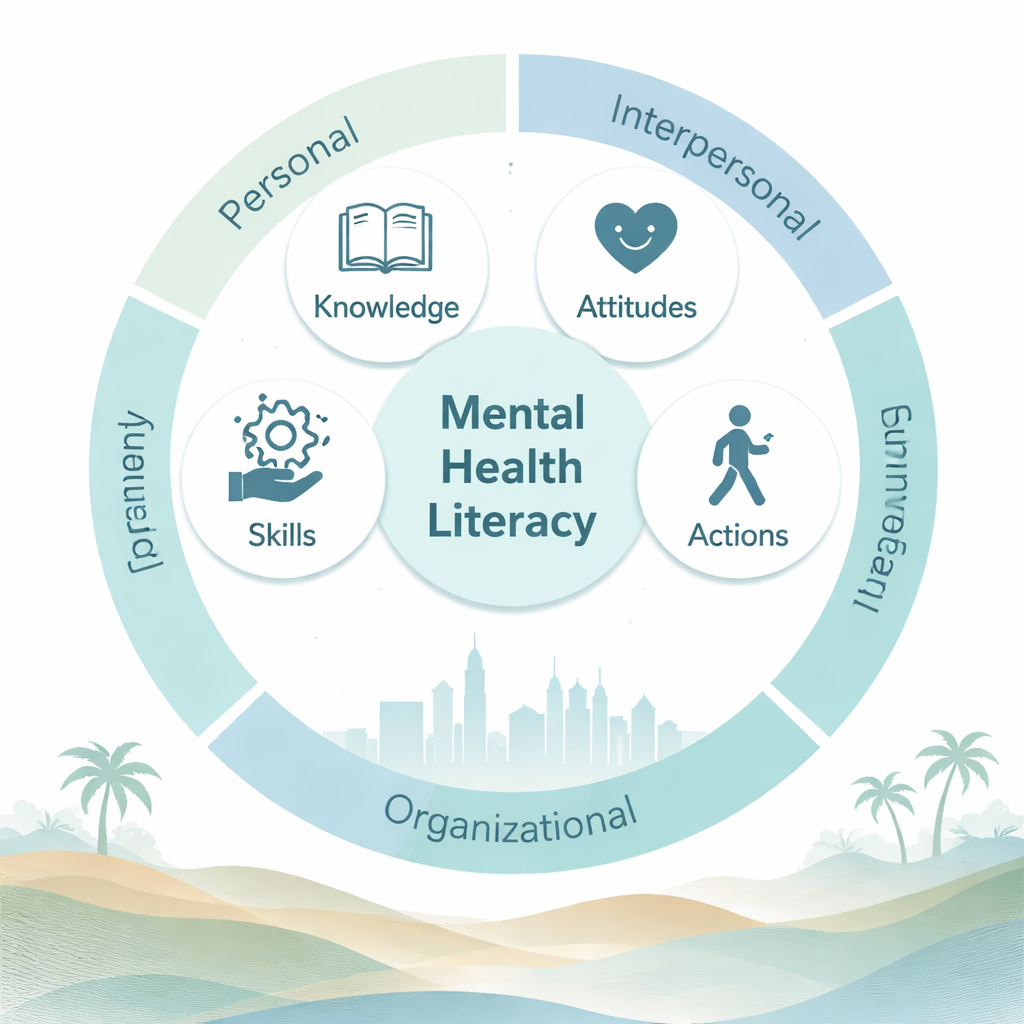
The study found that mental health literacy is made up of four closely connected elements: knowledge, attitudes, skills, and actions. Knowledge includes understanding different mental health conditions, their causes, how they are treated, and ways to promote well‑being. Attitudes cover empathy and openness, as well as reduced stigma—seeing the person rather than the label. Skills involve practical abilities such as spotting signs of trouble, knowing when and where to get help, and weighing options to make good decisions. Actions bring everything together: seeking help for oneself, supporting others, and using everyday strategies to manage stress and protect mental health. Importantly, the professionals spoke about mental health literacy in active terms—what people actually do—rather than as a bundle of facts stored in the mind.
Shaped by Family, Workplaces, and Communities
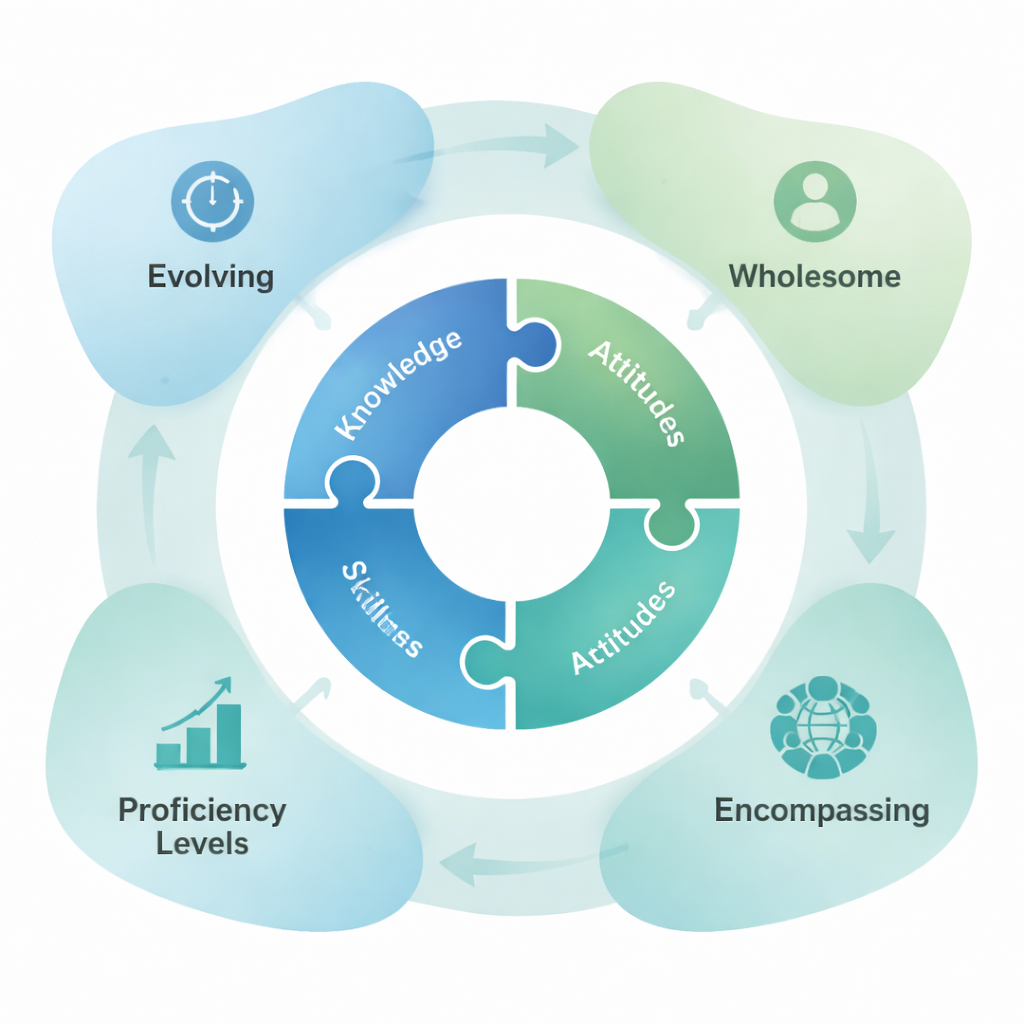
The framework also shows that mental health literacy does not live only inside individuals. It unfolds across four social levels. At the personal level, it is about self‑awareness and caring for one’s own well‑being. At the interpersonal level, it involves family members, friends, and colleagues noticing when someone is struggling and responding with nonjudgmental support. At the organizational level, workplaces, schools, and health facilities play a role by offering clear information, supportive policies, and easy‑to‑reach services. Finally, at the community level, shared beliefs, religious and cultural norms, and public campaigns can either encourage or discourage open conversation and fair access to care. The authors describe mental health literacy as evolving over time, encompassing many parts of life—physical, emotional, social, and spiritual—and existing at different levels of proficiency, from basic awareness to advanced understanding.
What This Means for People and Policy
For a layperson, the core message is that good mental health literacy is much more than knowing the names of diagnoses. It means being able to recognize when something is wrong, feeling safe enough to talk about it, knowing what kind of help is available, and taking concrete steps—either for oneself or for others. In the UAE, where family bonds are strong and communities are diverse, these skills need to be nurtured not just in individuals but also in homes, workplaces, and public institutions. By offering a model tailored to this setting, the study provides a roadmap for training healthcare staff, designing awareness campaigns, and shaping policies that respect local culture while encouraging timely, compassionate action on mental health.
Citation: ElKhalil, R., Adam, H., Bayoumi, R. et al. Developing a culturally grounded mental health literacy framework for the United Arab Emirates using Grounded Theory and Delphi consensus. Sci Rep 16, 7800 (2026). https://doi.org/10.1038/s41598-026-38017-5
Keywords: mental health literacy, United Arab Emirates, cultural context, healthcare professionals, community mental health