Clear Sky Science · en
A novel ecological approach to assess theory of Mind and social norm understanding for social cognition phenotyping in multiple sclerosis
Why Understanding Social Thinking in MS Matters
Multiple sclerosis (MS) is widely known for causing problems with movement, fatigue, and vision. Less obvious—but just as important—are its effects on how people read others’ thoughts, feelings, and social rules. These “social thinking” skills shape friendships, family life, and work. This study asked whether a new, more life-like test of social thinking can better reveal these hidden difficulties in people with MS, and in turn help doctors understand and treat the social side of the disease.
A New Way to Look at Everyday Interactions
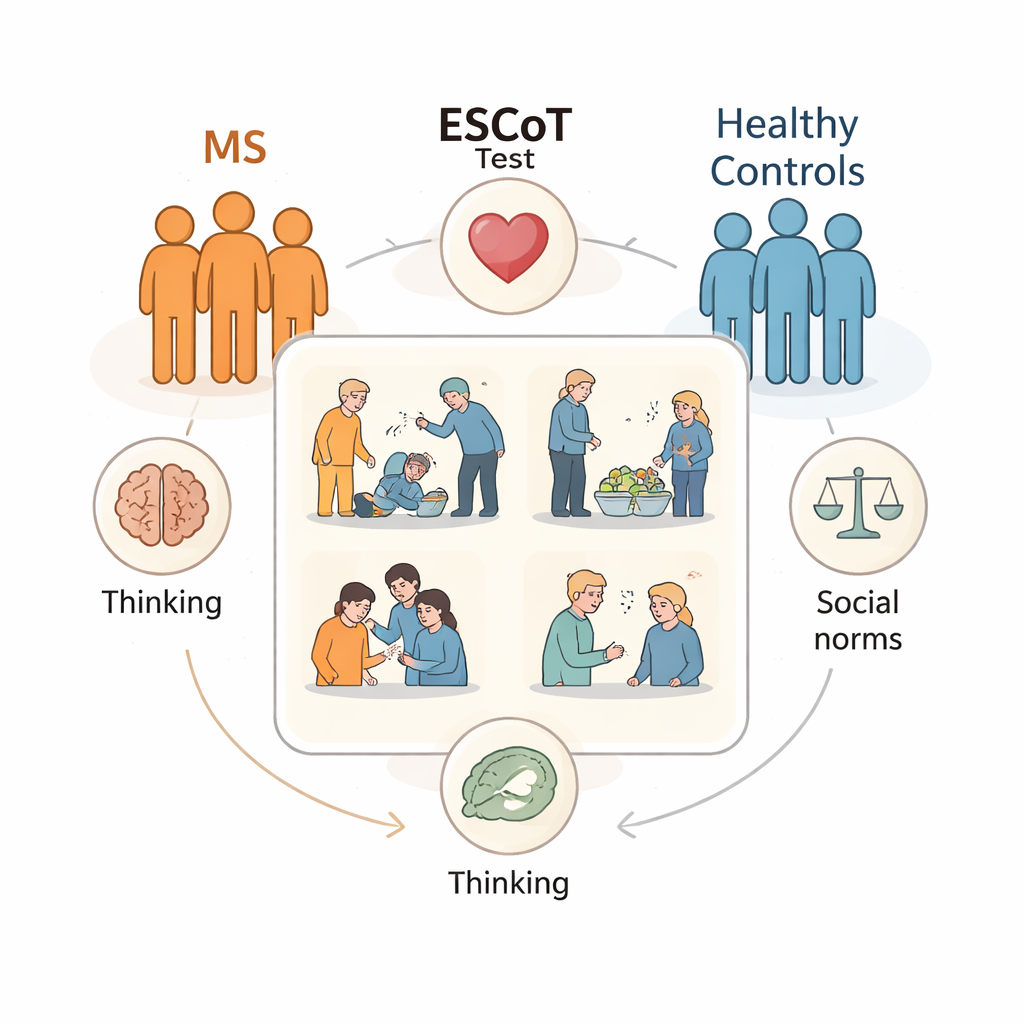
Traditional tests of social thinking often rely on static pictures or written stories that only loosely resemble real life. The researchers instead used the Edinburgh Social Cognition Test (ESCoT), which shows short, silent cartoon-style videos of everyday situations—such as someone deciding whether or not to help a stranger. After each clip, participants answer open questions about what the characters are thinking and feeling, and whether their behavior fits common social expectations. This single tool captures several dimensions at once: understanding others’ emotions (affective theory of mind), understanding their thoughts and intentions (cognitive theory of mind), and knowing what people in general should do (social norms), both for others and for oneself.
Comparing People With and Without MS
The team tested 39 adults with MS and 32 healthy adults of similar age, education, and sex. Everyone completed standard memory and attention tests, a widely used social test based only on looking at people’s eyes, and the ESCoT. As expected, the MS group had somewhat weaker working memory and executive skills, the mental tools we use to hold information in mind and control our behavior. On social tasks, they did worse than healthy participants on the eyes-based test—but the ESCoT revealed a richer and more specific pattern of differences, suggesting it may be more sensitive to the subtle social changes that accompany MS.
Feelings and Social Rules Do Not Decline Evenly
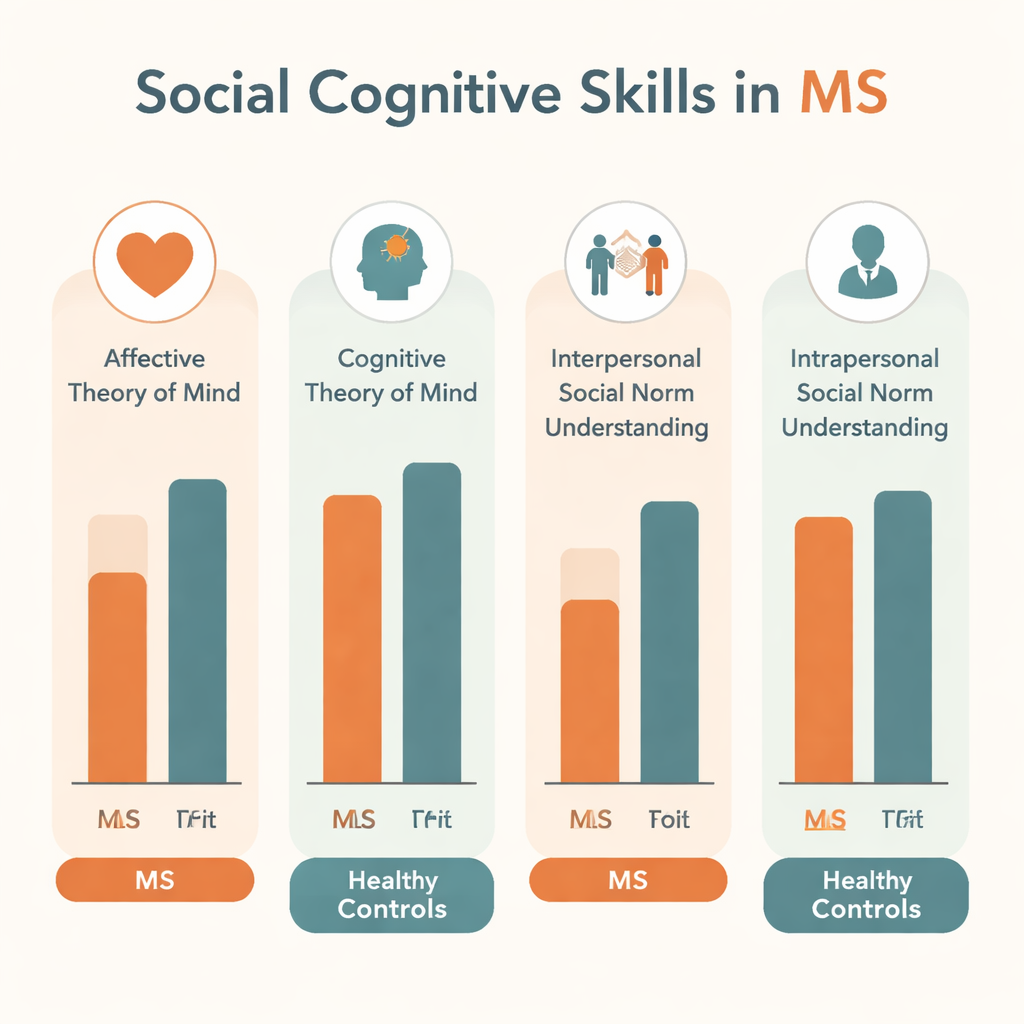
By breaking down ESCoT scores, the researchers found that not all social abilities are equally affected. People with MS showed a clear drop in reading others’ feelings, while their ability to reason about others’ thoughts was relatively spared. In other words, emotional understanding was hit harder than logical perspective-taking. A similar split emerged for social rules: participants with MS struggled more when judging what others should do in a situation (interpersonal norms) than when imagining what they themselves would do (intrapersonal norms. They often explained a character’s behavior using personality traits or circumstances rather than referring to shared social expectations, suggesting a shift in how they interpret everyday interactions.
How Brain Resources and Social Skills Connect
The study also explored how these social difficulties relate to more basic thinking skills. In the MS group, better performance on the ESCoT’s feeling and thinking questions was linked to stronger working memory, while better understanding of one’s own social rules was tied to stronger executive control, such as resisting distraction in a color-word task. This supports the idea that social thinking in MS depends partly on the same mental resources that support complex reasoning and self-control. At the same time, ESCoT scores did not closely match the eyes-based test, hinting that the new tool taps richer, more real-world aspects of social life than a single snapshot of facial expression can capture.
What This Means for People Living With MS
Overall, the ESCoT distinguished people with MS from healthy adults with good accuracy, especially through emotional understanding and judgments about how others should behave. For patients and clinicians, this suggests that some of the social strain felt in MS may stem not only from physical limits, but from subtle changes in how emotions and social rules are processed. Because ESCoT mirrors real-life situations more closely than traditional tests, it may become a practical tool to identify those at risk of social difficulties, guide counseling or rehabilitation, and track whether treatments are helping people maintain satisfying, connected lives despite the challenges of MS.
Citation: Sara, I., Giulia, S., Federica, R. et al. A novel ecological approach to assess theory of Mind and social norm understanding for social cognition phenotyping in multiple sclerosis. Sci Rep 16, 6907 (2026). https://doi.org/10.1038/s41598-026-38016-6
Keywords: multiple sclerosis, social cognition, theory of mind, social norms, neuropsychology