Clear Sky Science · en
Nonlinear model reduction for large-scale structures via dual substructuring
Why shrinking big digital buildings matters
Engineers often simulate how large structures such as factories, bridges, or aircraft frames shake and sway under wind, earthquakes, or machinery. These digital tests can contain hundreds of thousands of moving points and can take hours or days to run on powerful computers. This paper introduces a way to shrink such huge models into much smaller ones that still behave like the original, even when the structure has tricky, strongly nonlinear joints and realistic, messy forms of damping.
Breaking a giant structure into smaller pieces
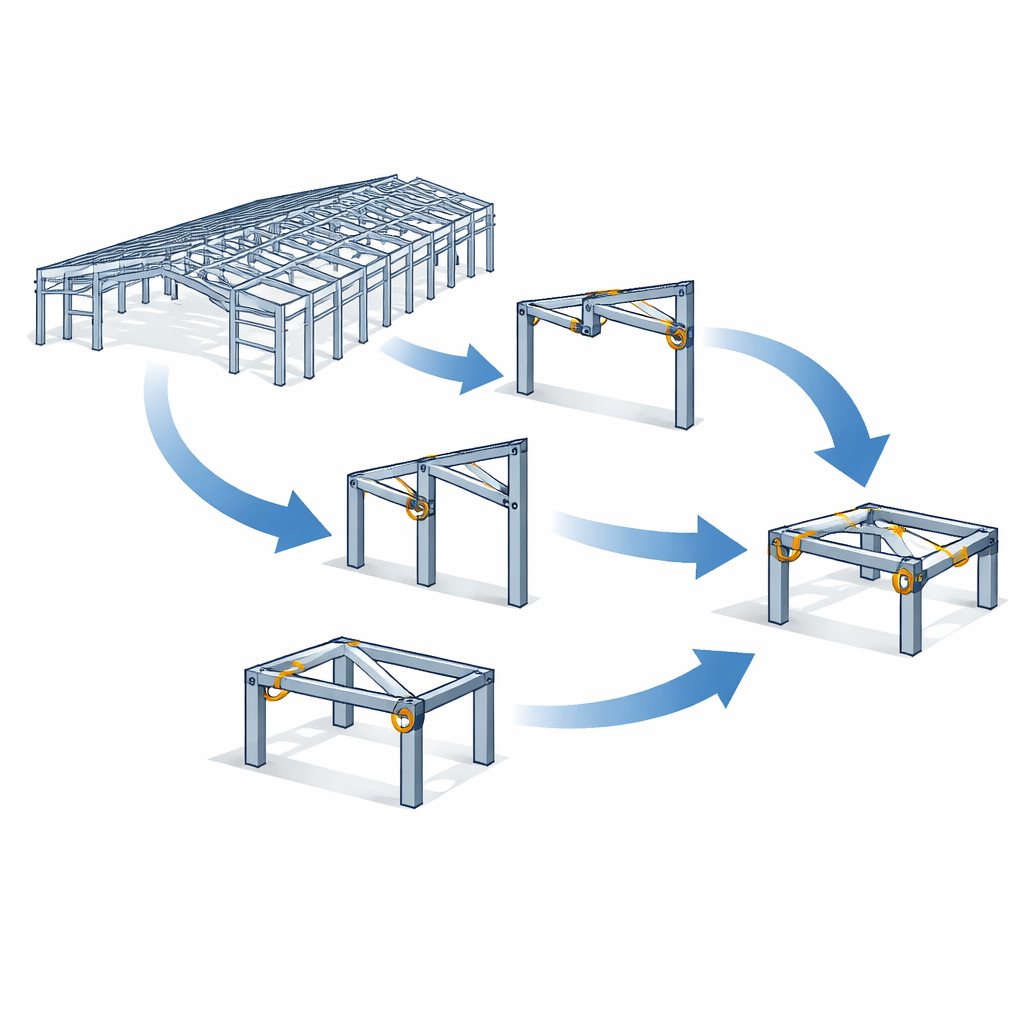
The starting point is the observation that big structures are usually made from repeating parts: similar frames, floors, or panels. Instead of treating the whole building at once, the method divides it into substructures. Each substructure is analyzed on its own and then reconnected through forces at their shared boundaries. This philosophy, known as substructuring, has long been used for simpler, linear systems, where the response is directly proportional to the applied loads. What this work adds is a way to handle more realistic behavior, in which certain joints or connections behave nonlinearly and the energy lost to damping does not follow simplified textbook patterns.
Capturing complex motion with simple patterns
To reduce the size of each substructure without losing important physics, the author uses a concept called nonlinear normal modes. In spirit, a mode is a characteristic way in which the structure prefers to vibrate. For linear systems these modes are straight, well-behaved patterns. When motion becomes large or joints behave like stiff springs that respond in a cubic rather than a simple linear way, these patterns bend and warp. The paper follows a mathematical recipe that represents each nonlinear mode as a smooth curved surface in the space of all possible motions. The motion of every point of the substructure is expressed as a polynomial in only a few key displacements and velocities located at the interfaces, where substructures meet. This turns an enormous set of variables into a very compact description that still reflects the nonlinear character of the joints.
Keeping static balance and realistic damping
The method separates the response of each substructure into a dynamic part, where the nonlinear modes live, and a static part, which takes care of slow deformations caused by forces at the interfaces. For the static part, the approach borrows ideas from an existing framework called the dual Craig–Bampton method. There, compatibility between substructures is enforced through interface forces rather than by directly gluing boundary displacements together. This leads to smaller matrices and more flexibility in how pieces are combined. An important improvement of the present work is that it keeps general forms of damping directly in the equations, instead of assuming that damping is simply proportional to mass or stiffness. As a result, the reduced model can faithfully mimic structures equipped with extra dampers or materials that dissipate energy in a non-uniform way.
Testing the idea on a digital industrial building
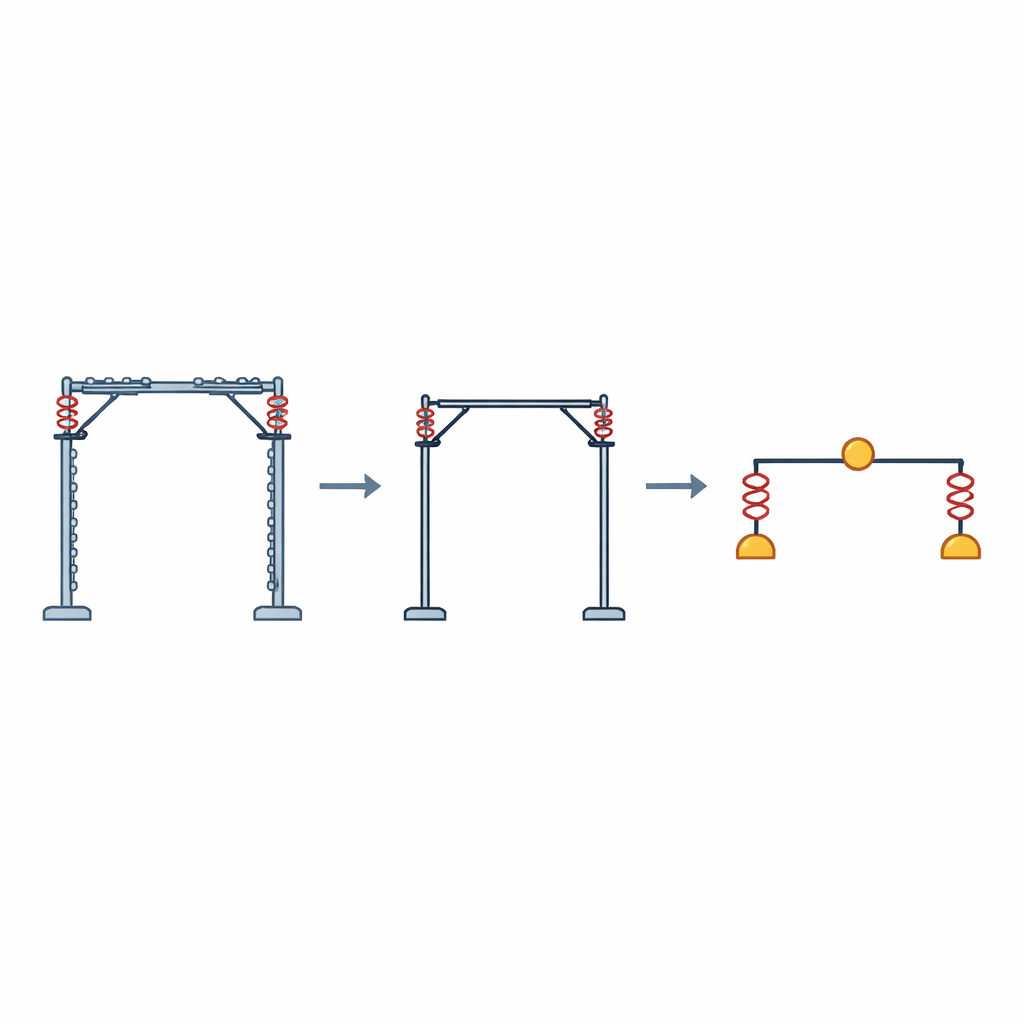
To show that the method is practical, the author applies it to a detailed model of a steel industrial building. The frames of the building include joints modeled as torsional springs whose resistance grows with the cube of the rotation, a strong form of nonlinearity. The building is shaken laterally with a sinusoidal force tuned near one of its natural vibration frequencies. First, the full finite element model is solved using a standard time-stepping algorithm, consuming several hundred seconds of computing time and hundreds of megabytes of memory. Then, the building is split into repeated frame substructures and a remaining part. For the frames, only four nonlinear modes are kept, focused on the horizontal motion and twisting of the most critical nodes. Solving this reduced system produces displacement histories that almost perfectly overlap those of the full model, while cutting computing time by roughly two thirds and slashing memory use.
How fewer modes still give trustworthy answers
The study also explores how the accuracy depends on the number and choice of nonlinear modes. When only one mode is used, the error in the predicted motion is larger. Adding a second mode that directly involves the joint with cubic behavior leads to a sharp drop in error, highlighting the importance of including the degrees of freedom where the nonlinearity is strongest. With three and four modes, the error continues to fall to levels considered very small in engineering design, all while the model remains compact. A second set of simulations adds external dampers that create a highly non-proportional damping pattern. Even in this more demanding case, the reduced model tracks the full solution closely and still offers substantial savings in time and memory.
What this means for future digital structures
In everyday terms, the paper shows how to turn an unwieldy digital building into a nimble stand-in that reacts almost exactly the same way to shaking, even when its joints behave in complicated, nonlinear ways and its energy loss is irregular. By combining substructuring, nonlinear vibration patterns, and a damping-aware formulation, the method opens the door to fast yet reliable simulations of very large structures. This could help engineers run many more what-if scenarios, optimize designs, and explore new materials and devices without being held back by excessive computational cost.
Citation: Flores, P.A. Nonlinear model reduction for large-scale structures via dual substructuring. Sci Rep 16, 9286 (2026). https://doi.org/10.1038/s41598-026-38015-7
Keywords: structural dynamics, model reduction, nonlinear vibrations, finite element analysis, substructuring