Clear Sky Science · en
Strength and microstructural behaviour of sand Kaolin mixtures stabilized with terrazyme and Xanthan gum
Building on safer, greener ground
Every house, road and bridge ultimately depends on the soil beneath it. When that soil is weak or unstable, the result can be cracks, settlement or even catastrophic failure. This study explores whether two nature-derived products—an enzyme mixture called TerraZyme and a plant-based thickener called Xanthan gum—can make sandy soils stronger and more reliable, while avoiding the high carbon footprint of traditional cement and lime treatments. 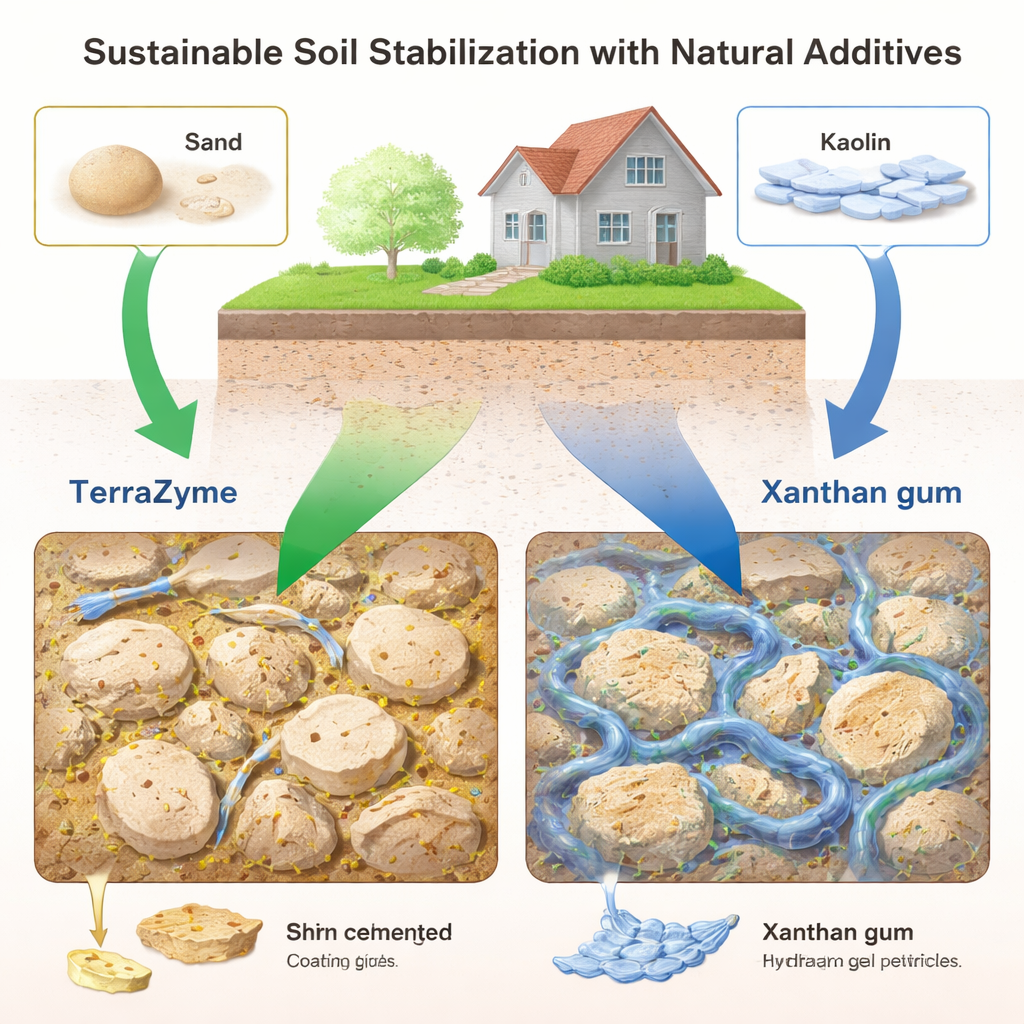
Why sand alone is not enough
Sandy soils are common construction materials because they drain quickly and are easy to compact. But sand grains are like tiny marbles: smooth, hard and poor at sticking together. To improve their behavior, the researchers first blended the sand with 15% kaolin, a fine white clay whose tiny plate-like particles can lodge between sand grains and offer extra contact points. This sand–kaolin mix better represents real foundations, which usually contain both coarse and fine particles, and it also provides more reactive surfaces for the bio-based additives to latch onto.
Natural helpers: an enzyme and a biopolymer
The team then treated this sand–kaolin mixture with varying amounts of TerraZyme (a fermented plant extract) or Xanthan gum (a sugar-based biopolymer widely used as a food thickener). TerraZyme works mainly by changing the chemistry of particle surfaces and the thin films of water around them. Under the right conditions, it helps form cement-like gels that coat grains and tighten the soil structure. Xanthan gum behaves differently: when it hydrates, it becomes a slippery gel that wraps grains and stretches between them, forming a flexible network. Together, the clay’s aluminum-rich surfaces and these natural additives create more ways for grains to interlock and bond.
Putting treated soils under pressure
To see how much stronger these treatments made the soil, the researchers molded cylindrical samples and squeezed them in a standard laboratory device called a triaxial cell, which simulates how soil is loaded underground. They focused on short-term behavior under undrained conditions, similar to what might happen during rapid construction or an earthquake. Carefully chosen “optimum” doses—0.075 mL of TerraZyme per kilogram of soil, and 1% Xanthan gum by dry weight—raised the maximum shear strength of the sand–kaolin mix by roughly two and a half times after 30 days of curing. TerraZyme-treated samples reached high peak strengths but then softened somewhat as internal bonds broke, behaving more stiffly and somewhat more brittle. Xanthan gum-treated samples showed high strength too, but with a smoother, more ductile response: they continued to carry substantial loads even at larger deformations. 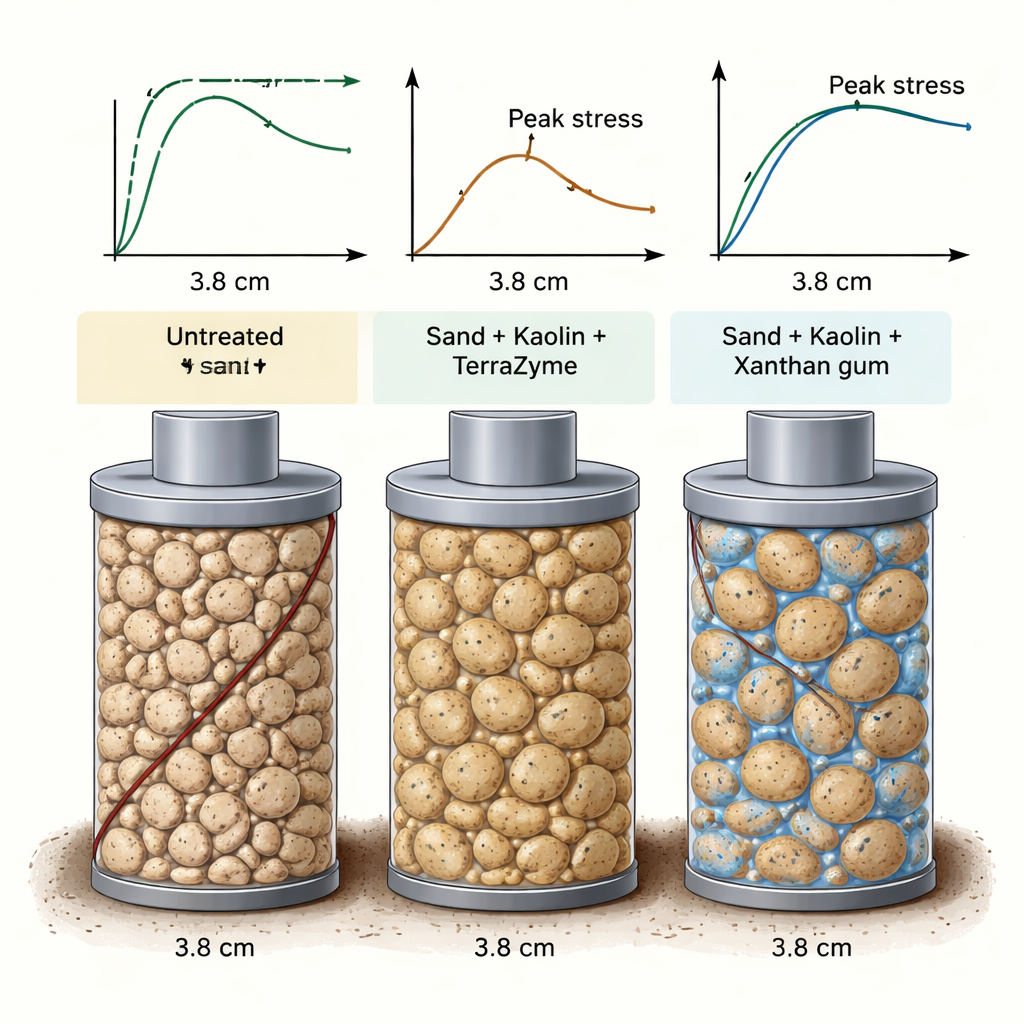
Seeing the hidden glue between grains
To move beyond numbers and understand how these changes arise, the authors used a suite of advanced microscopes and spectroscopic tools more familiar from materials science than from everyday soil testing. Electron microscopy images revealed that Xanthan gum created a smooth, fibrous gel coating that bridged the pores between grains, while TerraZyme produced flake-like, tightly packed structures, particularly around the kaolin clay. Chemical analyses (including X-ray diffraction, infrared spectroscopy, X-ray photoelectron spectroscopy and solid-state NMR) showed that TerraZyme helped form cementing gels similar to those in concrete, and shifted how aluminum and oxygen were bonded in the clay. Xanthan gum, by contrast, mainly formed physical hydrogel bridges without drastically changing the underlying minerals, yet still increased the connectivity between particles.
What this means for future construction
For a non-specialist, the key message is that a modest amount of clay plus carefully dosed natural additives can turn loose, easily deformed sand into a much stronger and more resilient foundation material. TerraZyme tends to deliver higher peak strength through more rigid, cement-like bonds, making it attractive where high loads and rapid loading may occur. Xanthan gum offers a gentler, more flexible strengthening, which may be advantageous where the soil must tolerate larger movements without cracking. Both approaches avoid the heavy carbon emissions and groundwater impacts associated with cement and lime, pointing toward a future in which stabilizing the ground beneath our feet can be both safer and significantly greener.
Citation: Thomas, G., Nayak, R.R., Gupta, N.K. et al. Strength and microstructural behaviour of sand Kaolin mixtures stabilized with terrazyme and Xanthan gum. Sci Rep 16, 7451 (2026). https://doi.org/10.1038/s41598-026-38011-x
Keywords: soil stabilization, biopolymer, bioenzyme, sand kaolin mixture, sustainable geotechnics