Clear Sky Science · en
Modeling of conductivity for carbon black nanocomposites incorporating network concentration, interphase conductivity and tunneling dimensions
Plastics That Can Carry Electricity
Most plastics are excellent insulators, which makes them useful for keeping us safe from electric shocks—but it also limits their use in electronics, sensors, and energy devices. This study looks at how adding tiny particles of carbon black to plastics can turn them into materials that conduct electricity, and it introduces a simple yet powerful way to predict just how conductive these new materials will be.
Building a Pathway for Charge
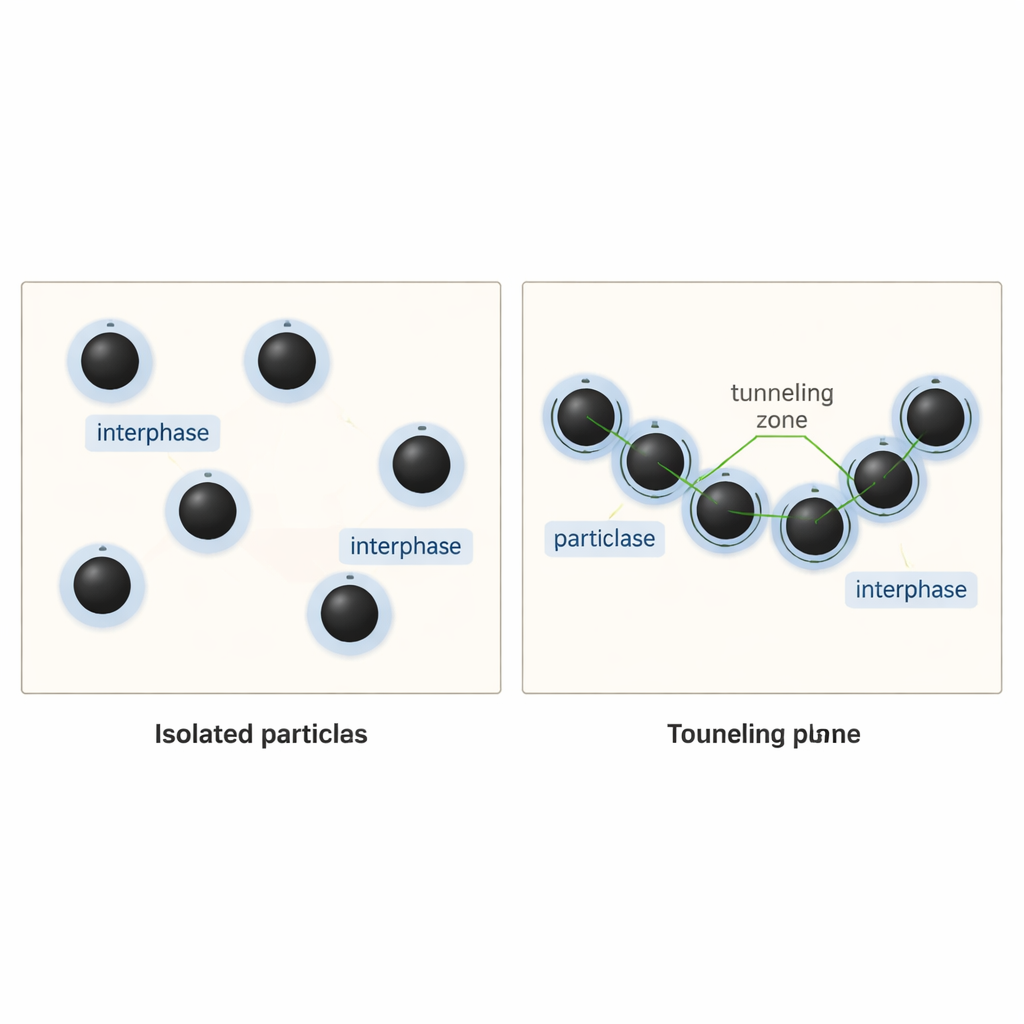
When carbon black nanoparticles are mixed into a plastic, they do not automatically form a continuous path for electrons to travel. At low amounts, the particles are scattered and the material still behaves like an insulator. Once their concentration passes a critical level, called the percolation onset, many particles touch or come close enough to one another to form a three-dimensional network. That network is what allows charges to move through the material and turns the plastic into a conductor suitable for things like flexible sensors, antistatic coatings, or lightweight wiring.
The Hidden Layer Around Each Particle
Surrounding every carbon black particle is a thin shell of polymer whose properties differ from both the pure plastic and the pure carbon. This shell, known as the interphase, can be more or less conductive depending on how strongly the polymer chains interact with the particle surface. The authors show that this interphase is not just a side detail: its thickness and conductivity can swing the overall conductivity of the composite from almost zero to several siemens per meter, comparable to some semiconductors. A thicker, better-conducting interphase creates more overlapping regions between neighboring particles, effectively enlarging the conductive network and making it much easier for electrons to find a path across the material.
Electrons Jumping Across Tiny Gaps
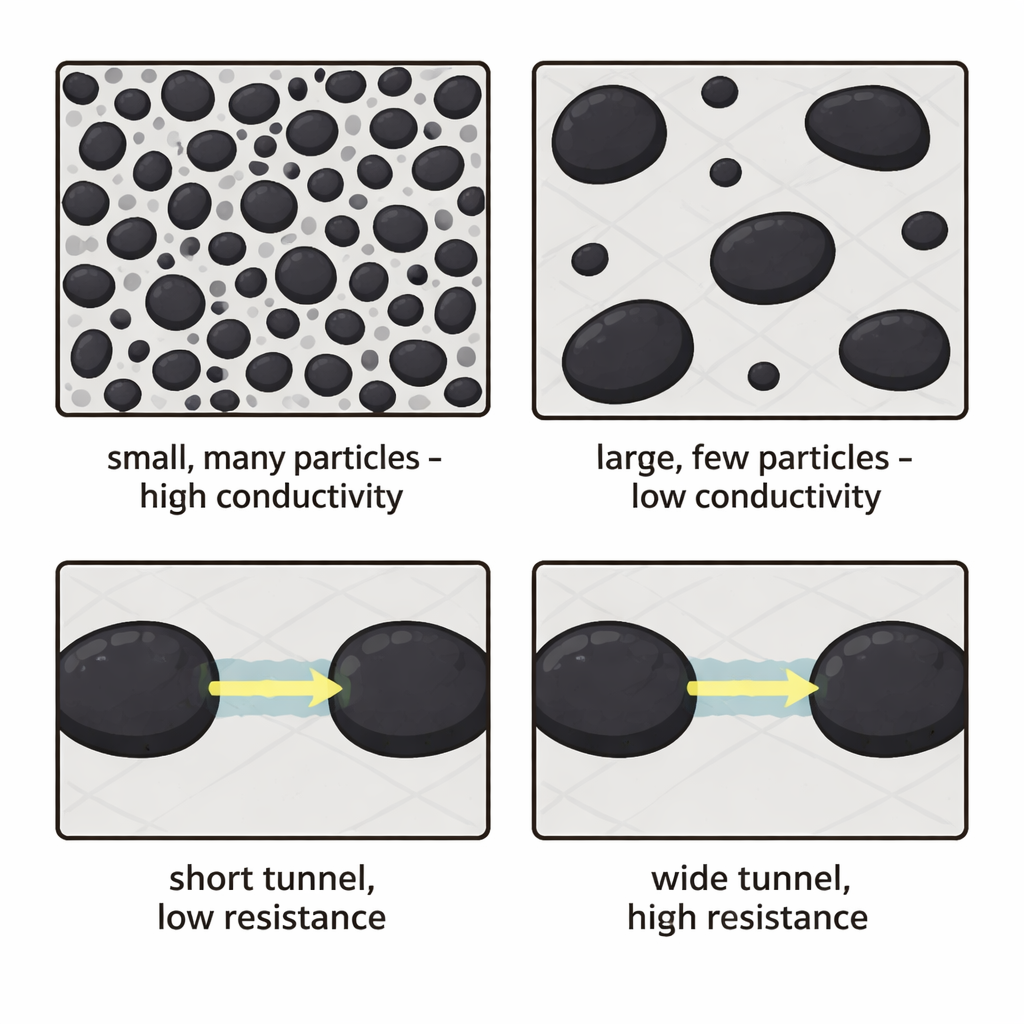
Even when particles do not quite touch, electrons can still move between them by a quantum process called tunneling—essentially jumping across an ultra-thin layer of plastic. The study captures this effect by focusing on two key features of these tiny gaps: the tunneling distance (how wide the gap is) and the contact diameter (how broad the facing surfaces are). Narrow, wide-area gaps act like low-resistance bridges, while wider or poorly matched contacts act like bottlenecks. The electrical resistivity of the polymer in these gaps also matters: a more resistive polymer makes it much harder for electrons to tunnel. By combining these factors into a single term, the model links microscopic gap geometry directly to the macroscopic conductivity that engineers measure.
From Measured Data to a Predictive Recipe
To test their model, the researchers compared its predictions with experimental data from several different plastic–carbon black systems, including common polymers such as poly(vinyl acetate), poly(vinylidene fluoride), high-density polyethylene, and polystyrene. Using only measurable quantities—particle size, particle and polymer surface tensions, interphase thickness, carbon black content, and tunneling dimensions—they reproduced the observed conductivities to within about five percent. The model also allowed them to tease apart which factors matter most. They found that a thicker, more-conductive interphase and smaller, more numerous particles with higher loading levels are especially effective at boosting conductivity, while overly large tunneling gaps or highly resistive polymer in those gaps quickly degrade performance.
A Design Map for Conductive Plastics
For non-specialists, the key message is that turning plastics into reliable conductors is not just a matter of dumping in more carbon powder. The way particles pack, the special layer of polymer wrapped around them, and the nanometer-scale gaps between neighbors all work together to create or block pathways for electrons. This new model gathers those influences into a clear, testable framework, offering material designers a practical guide: tailor particle size and amount, strengthen the interphase, and minimize the width and resistance of the gaps between particles. With these knobs to turn, engineers can more efficiently design polymer–carbon black materials for flexible electronics, smart sensors, and energy devices without relying solely on trial and error.
Citation: Zare, Y., Gharib, N., Choi, JH. et al. Modeling of conductivity for carbon black nanocomposites incorporating network concentration, interphase conductivity and tunneling dimensions. Sci Rep 16, 6706 (2026). https://doi.org/10.1038/s41598-026-38008-6
Keywords: conductive polymers, carbon black nanocomposites, electrical percolation, electron tunneling, interphase effects