Clear Sky Science · en
Median Raphe projection into the dorsal dentate gyrus modulates anxiety behavior and coping with learning under stress
How a Tiny Brain Pathway Shapes Fear and Resilience
Why do some people crumble under stress while others keep learning and adapting? This study zooms in on a tiny communication line deep in the rat brain that links a mood-related center to a memory hub. By dialing this pathway up or down, the researchers asked a basic question with big implications: can changing one small circuit ease anxiety and help the brain learn better under pressure?
A Stress Gate Between Mood and Memory
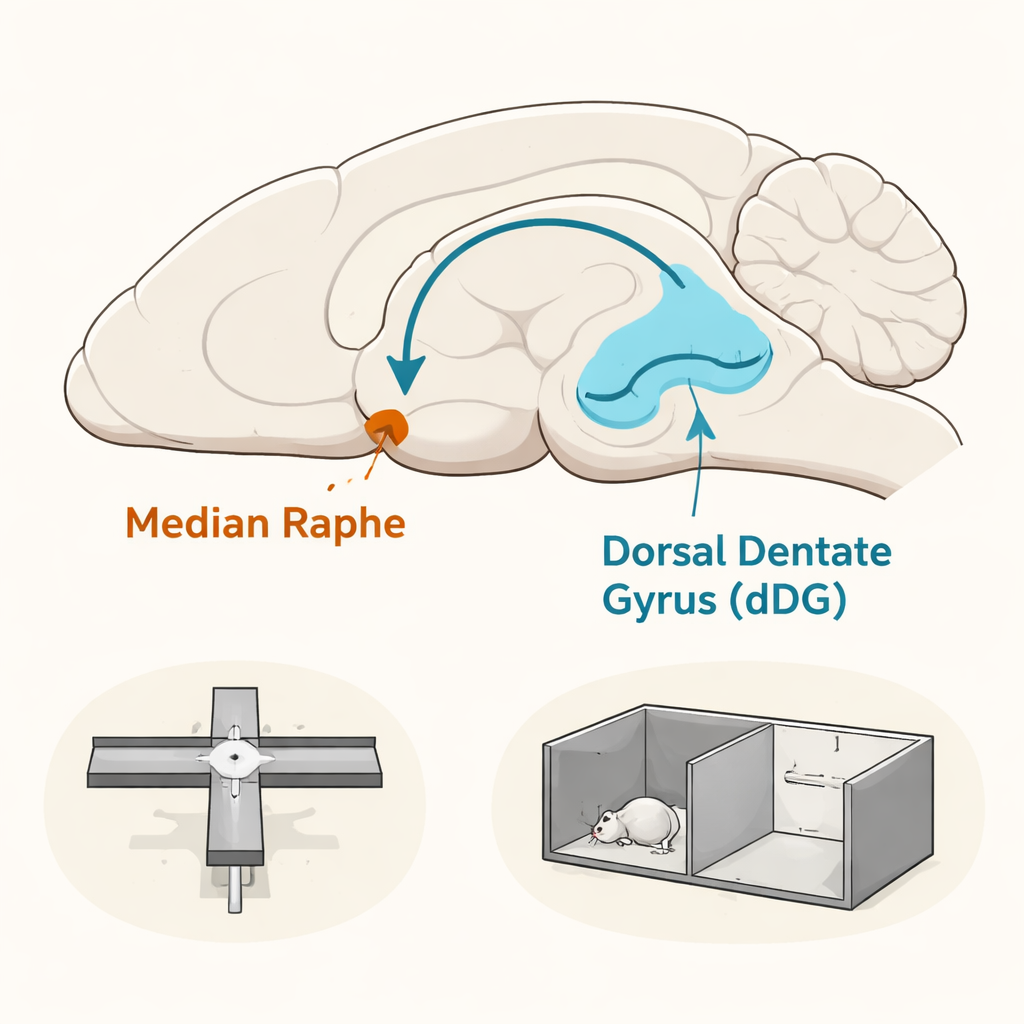
The team focused on two brain regions: the median raphe, a cluster of cells that releases the chemical messenger serotonin, and the dorsal dentate gyrus, a doorway into the hippocampus, which is crucial for memory. The median raphe sends strong signals to this doorway, especially to local “brake” cells that calm nearby neurons. Because both regions are known to react strongly to stress, the researchers suspected this pathway might help decide whether a stressful experience becomes overwhelming or manageable.
High Gear: Turning the Pathway Up Changes Little
To test this, scientists used a genetic switch that lets them control only those median raphe neurons that project to the dorsal dentate gyrus. In one group of rats, they made this pathway more active whenever the animals received a harmless drug. The rats were then tested in common anxiety and stress-learning tasks, including open arenas, a plus-shaped elevated maze, and a shuttle box where they could learn to avoid mild foot-shocks. Surprisingly, boosting this pathway did not make rats more anxious, nor did it change how quickly they learned to avoid the shocks. Even when the researchers looked carefully at individual differences, they saw no clear shift in behavior.
Low Gear: Turning the Pathway Down Calms Fear and Aids Learning
In another group, the same pathway was silenced instead of activated. Here, the picture changed sharply. When the pathway was turned down, rats spent more time exploring the open, exposed arms of the elevated maze—behavior interpreted as lower anxiety—without simply becoming hyperactive. In the stressful shuttle-box task, these animals also learned faster to avoid shocks, especially among those individuals whose behavior was most strongly altered by the manipulation. The timing of their responses did not change, suggesting that their basic reactions were intact, but their ability to learn under stress was enhanced.
Uncoupling Fear From Flexible Learning
The researchers then asked whether the same local wiring in the dorsal dentate gyrus drives both the calmer behavior and the better learning. They reduced a molecule called EphA7, which helps stabilize the connections that median-raphe-driven “brake” cells make onto dentate gyrus neurons. When EphA7 was knocked down while the pathway was silenced, the anxiety-reducing effect largely faded: rats no longer showed as strong a willingness to explore the open arms of the maze. Yet the boost in learning under stress remained. This showed that the mechanisms easing anxiety and those improving learning flexibility can be separated within the very same small brain region.
What It Means for Understanding Stress Resilience
To a non-specialist, the main message is that a single, well-defined pathway from a mood-related brainstem area into a memory gateway can shape both how anxious an animal feels and how well it learns during stressful events—but through partly different local circuits. Tuning the serotonin-rich input onto specific “brake” cells appears key for anxiety, while other components of the same pathway support flexible learning under pressure. These findings hint that future treatments might one day target narrow brain circuits to reduce anxiety without dulling the ability to learn from challenging experiences—a hallmark of true resilience.
Citation: Quan, J., Kriebel, M., Anunu, R. et al. Median Raphe projection into the dorsal dentate gyrus modulates anxiety behavior and coping with learning under stress. Sci Rep 16, 6913 (2026). https://doi.org/10.1038/s41598-026-38004-w
Keywords: anxiety, stress resilience, hippocampus, serotonin, learning under stress