Clear Sky Science · en
Electrochemical noise-based data mining to environmental Cl− concentration measurement of reinforced concrete structure under stray current interference
Why subway tunnels quietly rust
Modern cities rely on underground subway tunnels to move millions of people every day. Hidden inside those concrete tubes are steel bars that keep the tunnels strong for decades. But invisible electric currents from the trains, together with salty groundwater, can quietly eat away at this steel much faster than expected. This paper explores a new, non‑destructive way to “listen” to tiny electrical signals from the steel and use them to estimate how much corrosive salt is in the surrounding environment—before serious damage occurs.
Hidden currents and salty water
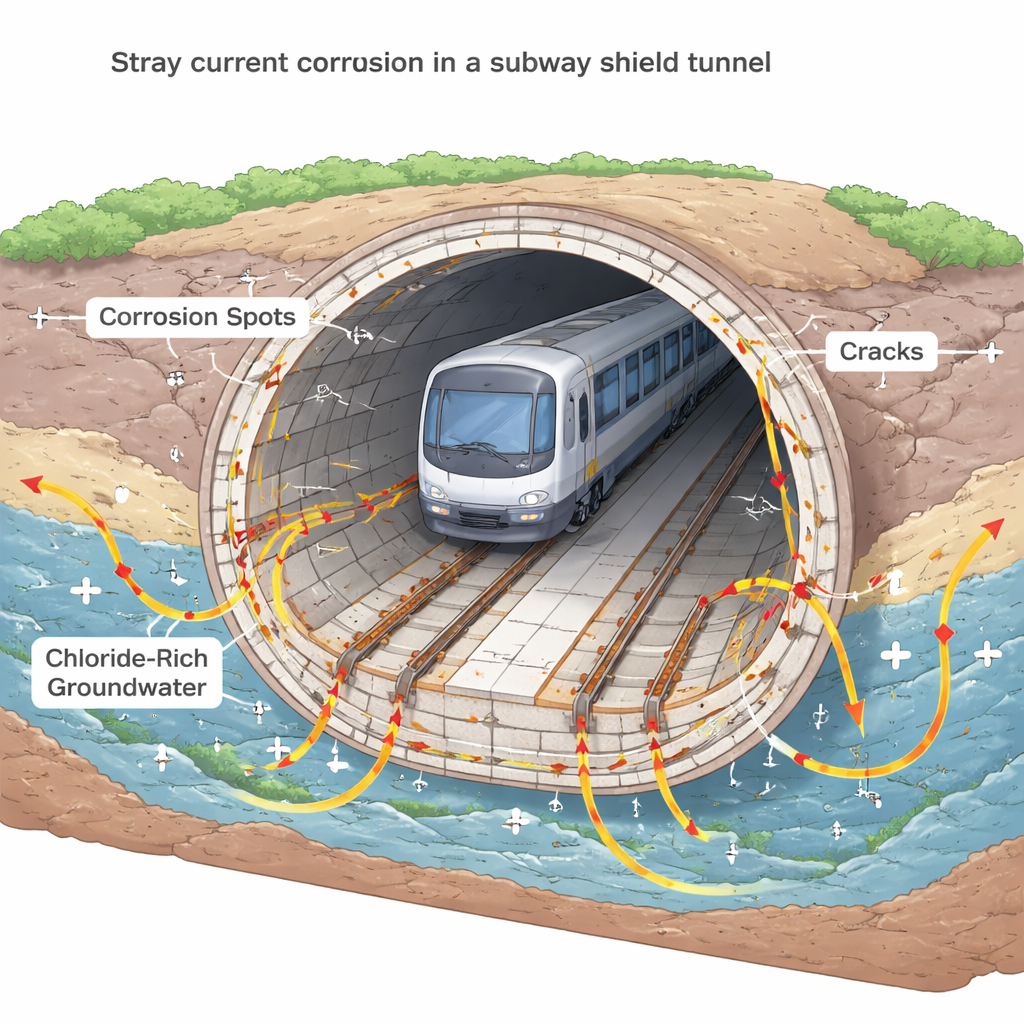
Subway shield tunnels are built as permanent structures meant to last 50 to 100 years. Steel bars embedded in concrete carry the loads, while the concrete protects the steel from corrosion. In reality, the tunnels are bathed in groundwater that often contains chloride ions, the same type of salt that corrodes cars in winter. At the same time, train traction systems use direct current, and a portion of this current leaks from the rails into the surrounding soil as “stray current.” Where the leaked electricity and chloride‑rich water meet the steel, corrosion can be accelerated by a factor of 10 to 100 compared with natural conditions. As rust builds up, it creates pressure inside the concrete, leading to cracking, spalling, and a loss of strength that threatens long‑term tunnel safety.
Why traditional tests fall short underground
Engineers know that corrosion becomes dangerous once chloride levels around the steel pass a critical threshold, destroying the protective film on the metal. However, directly measuring chloride concentration underground is difficult. Common laboratory methods—such as spraying chemical indicators, taking core samples, or using ion chromatography—require drilling into structures, bringing materials to the surface, or placing fragile sensors in hostile soil. In a working subway tunnel, these approaches are costly, disruptive, and often impossible in the tight space between the tunnel lining and surrounding ground. As a result, operators lack a simple way to monitor how close their structures are to corrosion “tipping points.”
Listening to electrochemical noise
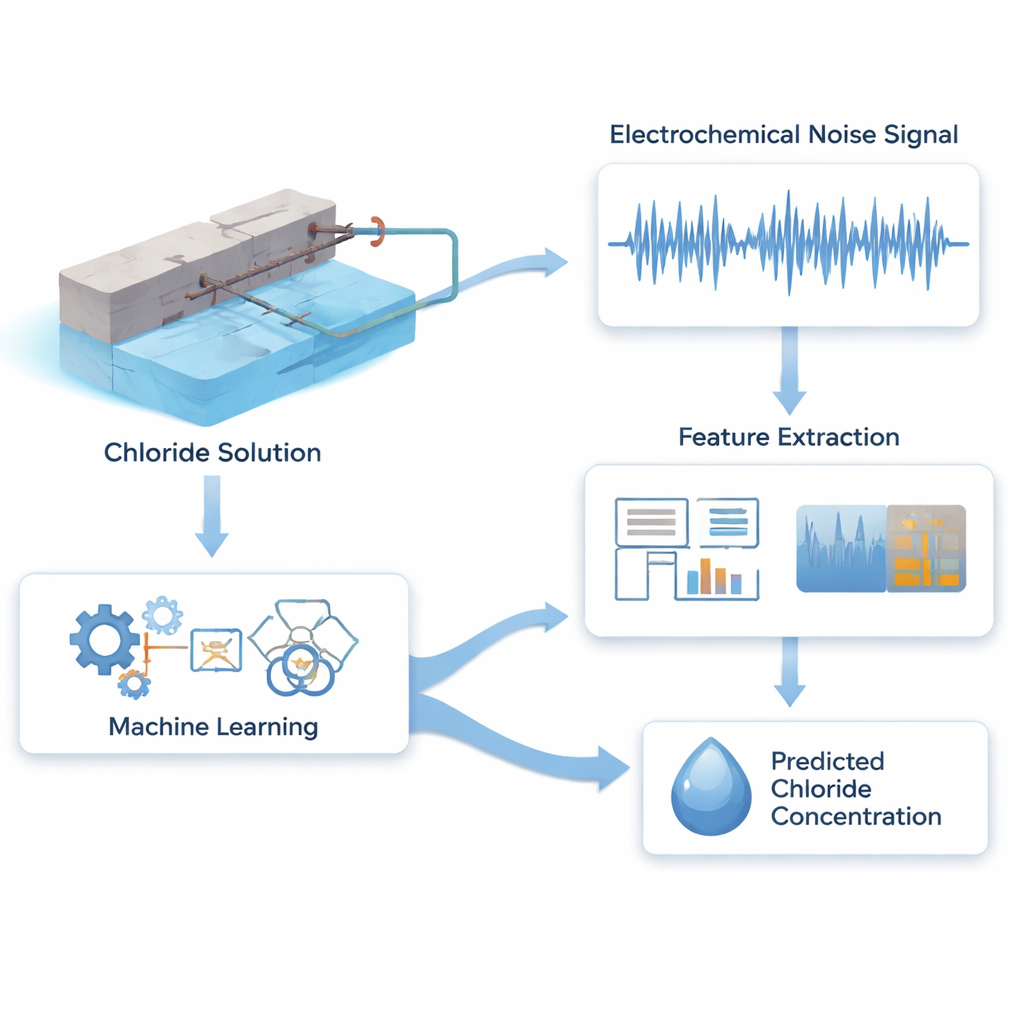
The authors turn to electrochemical noise, the tiny random fluctuations in voltage and current that naturally arise as metal corrodes in an electrolyte. In carefully designed laboratory tests, they embedded steel bars in mortar blocks, partially submerged them in salt solutions of different chloride concentrations, and applied controlled stray currents using titanium mesh electrodes. An electrochemical workstation recorded the noise signals for an hour at a time. Instead of looking for simple trends in the raw data, the team treated each noisy trace as a rich fingerprint of the corrosion environment. They cleaned the signals to remove slow drifts, then calculated many statistical measures in time and frequency, including how energy was distributed across different wavelet bands—essentially breaking the noise into components from fast to slow fluctuations.
Teaching machines to read the fingerprints
To turn these fingerprints into a practical chloride “meter,” the researchers built an intelligent regression model that links noise features to chloride concentration. At its core is XGBoost, a powerful decision‑tree‑based machine‑learning method. They enhanced it in two ways. First, a Whale Optimization Algorithm—a nature‑inspired search method that mimics how humpback whales hunt—automatically tuned key model settings, such as tree depth and learning rate, to avoid tedious trial‑and‑error. Second, an attention mechanism learned which features of the noise mattered most, giving higher weight to the most informative time‑frequency indicators and down‑weighting those that added little value. By combining these elements, their WOA‑XGBoost‑Attention model was trained on most of the data and tested on unseen samples to evaluate reliability.
How well the method performs
The optimized model proved remarkably accurate. Across a range of chloride concentrations (0.05–0.9 mol/L) and stray current densities (0.05–0.1 A/cm²), it predicted the salt level with an average accuracy of about 95% and a correlation of 0.9929 between predicted and true values. Compared with other popular approaches—including plain XGBoost, Random Forests, Gradient Boosting, linear regression, and a neural‑network model—this hybrid method produced the lowest prediction errors and avoided large outliers. The most useful inputs turned out to be noise features related to signal spread, white‑noise level, power‑law behavior of the spectrum, and specific bands of wavelet energy, confirming that subtle patterns in the noise carry detailed information about the surrounding environment.
What this means for real tunnels
For a non‑specialist, the bottom line is that the authors have shown it is possible to estimate how much corrosive salt surrounds buried steel simply by monitoring its natural electrical "chatter" and letting an advanced algorithm decode the pattern. Although this work was done under controlled laboratory conditions, it points toward future systems in which rugged electrodes mounted on tunnel linings feed electrochemical noise data into smart software that raises alarms when chloride levels approach dangerous thresholds. Such a non‑invasive early‑warning tool could help subway operators plan maintenance, extend tunnel life, and reduce the risk of sudden structural problems caused by hidden corrosion.
Citation: Xing, F., Xu, S., Wang, Y. et al. Electrochemical noise-based data mining to environmental Cl− concentration measurement of reinforced concrete structure under stray current interference. Sci Rep 16, 7522 (2026). https://doi.org/10.1038/s41598-026-38003-x
Keywords: subway tunnel corrosion, stray current, chloride ions, electrochemical noise, machine learning monitoring