Clear Sky Science · en
Optimization of laser, irrigation and suction settings for automated ureteroscopic lithotripsy in impacted stones ex vivo study part II
Why this matters for people with kidney stones
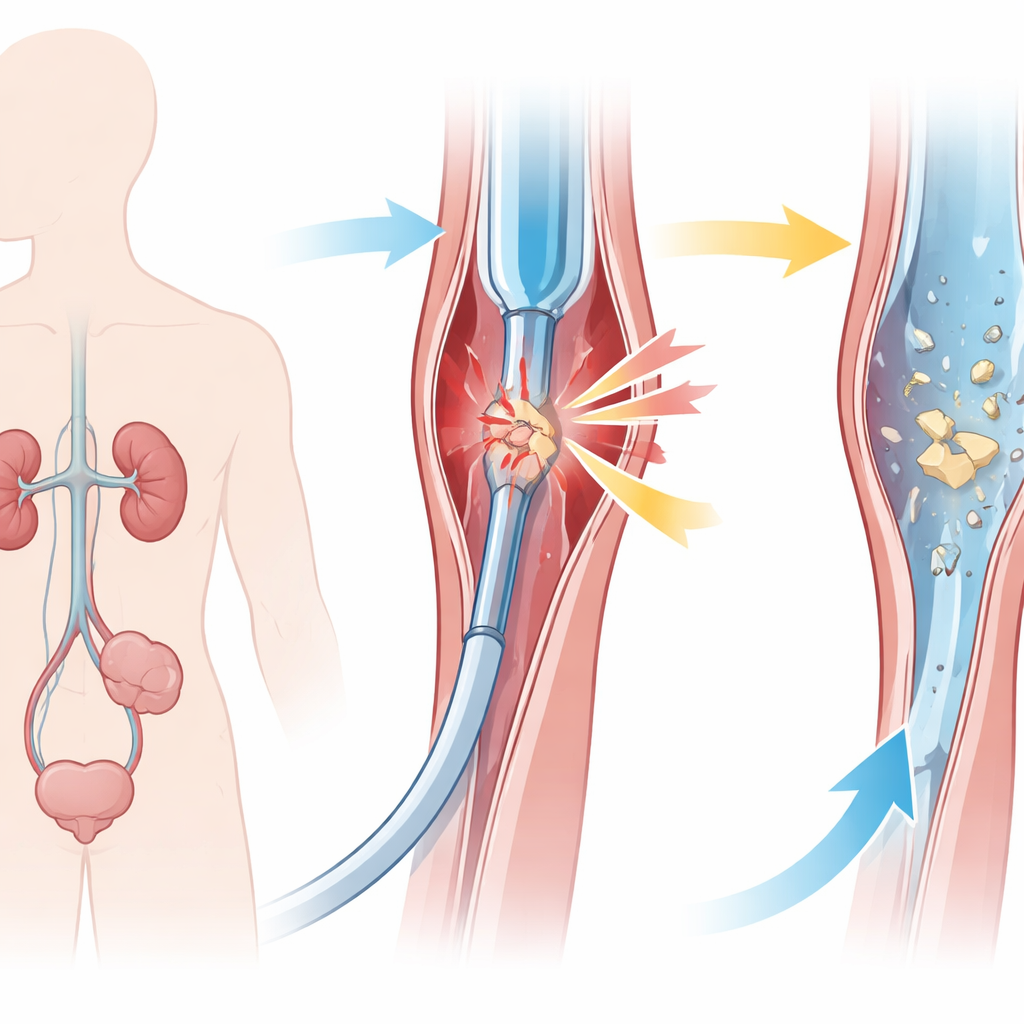
When a kidney stone gets stuck in the thin tube that drains urine from the kidney to the bladder, it can be extremely painful and dangerous. Doctors can now use tiny cameras and lasers to break these stones apart, but the laser’s heat and the pressure of the flushing fluid can sometimes damage the delicate lining of the urinary tract. This study explores how to tune laser power, water flow, and suction so that stones can be treated efficiently while keeping temperatures and pressures inside the ureter in a safe range, paving the way for safer, more automated stone surgery.
A closer look at stuck stones
Stones that stay lodged in the ureter for months can block urine, stretch the kidney, and in severe cases lead to infection, blood poisoning, or kidney failure. The standard treatment uses a thin flexible scope passed through the bladder into the ureter, combined with a powerful laser to break the stone. A newer technique called “pop-dusting” uses rapid, repeated laser pulses to gently chip a stone into fine dust. However, in the cramped space around an impacted stone, water cannot circulate freely, so heat from the laser and pressure from irrigation fluid can build up. Understanding how different laser settings and water flows affect temperature and pressure is essential for avoiding burns or pressure-related injury.
Designing a safe test system
To study these effects in detail, the researchers used kidneys and ureters from pigs, which closely resemble human anatomy. They placed an artificial 1 cm stone in the upper ureter and passed a flexible scope and laser through a hollow plastic tube known as a ureteral access sheath. Two commonly used surgical lasers were tested: a holmium laser and a newer thulium fiber laser, each at two different energy–frequency combinations that delivered the same overall power. Water was pumped through the scope at two pressure levels, roughly representing lower and higher irrigation. In some experiments, a special access sheath that can also provide suction was added to remove warm fluid and stone debris.
Timing the laser like a heartbeat
In real surgery, surgeons do not keep the laser on continuously; they tap a foot pedal in short bursts, pausing to restore visibility and cooling. To mimic and refine this pattern, the team introduced a simple timing rule they call the Laser: Stop (LS) ratio. For example, a ratio of 2 seconds on and 6 seconds off spreads out laser energy more gently than 2 seconds on and 2 seconds off. The researchers systematically tested several LS ratios while recording temperature and pressure inside the ureter every 30 seconds for five minutes. They defined danger zones based on how long tissue was exposed above 50 °C and whether it ever exceeded 56 °C, levels known from previous work to cause cell death in short periods.
How water flow and suction changed the game
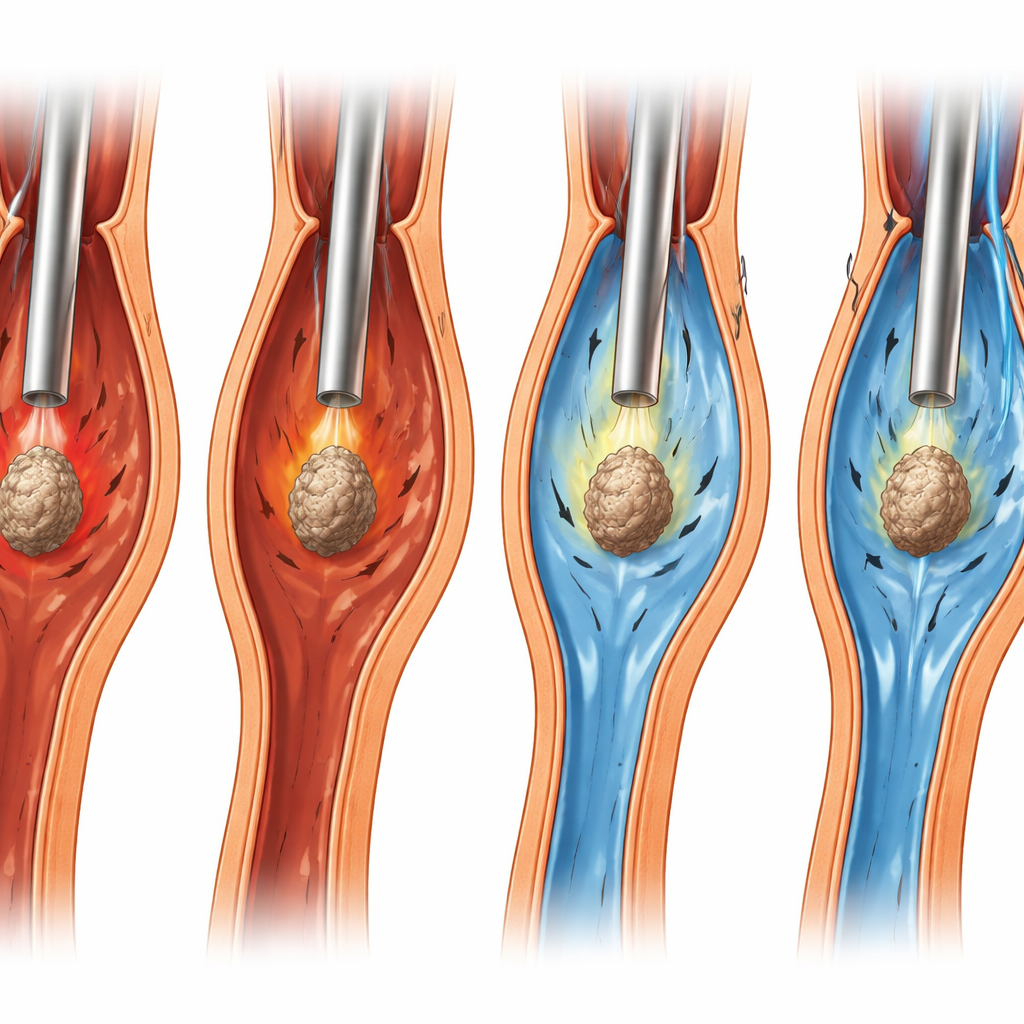
The experiments showed that with low irrigation pressure and no suction, pop-dusting could only be continued for a few seconds to a few minutes before temperatures crossed the safety line, even with longer pauses between laser bursts. Using lower pulse energy with higher frequency allowed longer safe pop-dusting than using higher energy pulses, despite identical total power, indicating that how the power is delivered matters as much as how much power is used. Raising irrigation pressure increased water flow around the laser tip, which effectively carried heat away. At the higher irrigation setting, continuous pop-dusting became safe across all tested laser modes. Adding the suction sheath provided further protection: in most settings it kept temperatures lower and pressures extremely low, while still allowing continuous dusting when irrigation was strong enough and laser power was moderate.
What this means for future stone surgery
Overall, the study suggests that a simple on–off timing rule for laser firing, combined with attention to water flow and suction, can guide safer and more efficient stone treatment. In tight ureters with poor fluid circulation, the findings caution against prolonged high-power pop-dusting and instead favor more conservative “fragmentation” strategies that break the stone into larger pieces. When stronger irrigation and suction are available, however, continuous pop-dusting appears both safe and effective, keeping temperatures and pressures well within acceptable limits. These results offer practical guidance for human surgeons today and provide a blueprint for tomorrow’s robot-assisted systems, which will need clear, physics-based rules to fire lasers automatically without harming the urinary tract.
Citation: Lee, H., Elises, J.C.R., Kang, D.H. et al. Optimization of laser, irrigation and suction settings for automated ureteroscopic lithotripsy in impacted stones ex vivo study part II. Sci Rep 16, 8287 (2026). https://doi.org/10.1038/s41598-026-37999-6
Keywords: ureteral stones, laser lithotripsy, irrigation and suction, thermal safety, robotic ureteroscopy