Clear Sky Science · en
Loss-of-function mutations in the melanocortin-2-receptor (mc2r) lead to skin hyperpigmentation in teleost fish
Why fish color can reveal hidden biology
From tropical reefs to home aquariums, many fish wear bold stripes and spots. These colors are not just decoration; they help animals hide from predators, protect their skin from sunlight, and communicate with each other. This study uses the tiny zebrafish—famous for its dark-and-gold stripes—to uncover how a single hormone receptor, better known for controlling stress hormones, also shapes skin color. The work shows that when this receptor fails, fish become unusually dark and yellow, revealing an unexpected link between the stress system and pigmentation.
A stress hormone switch with a second job
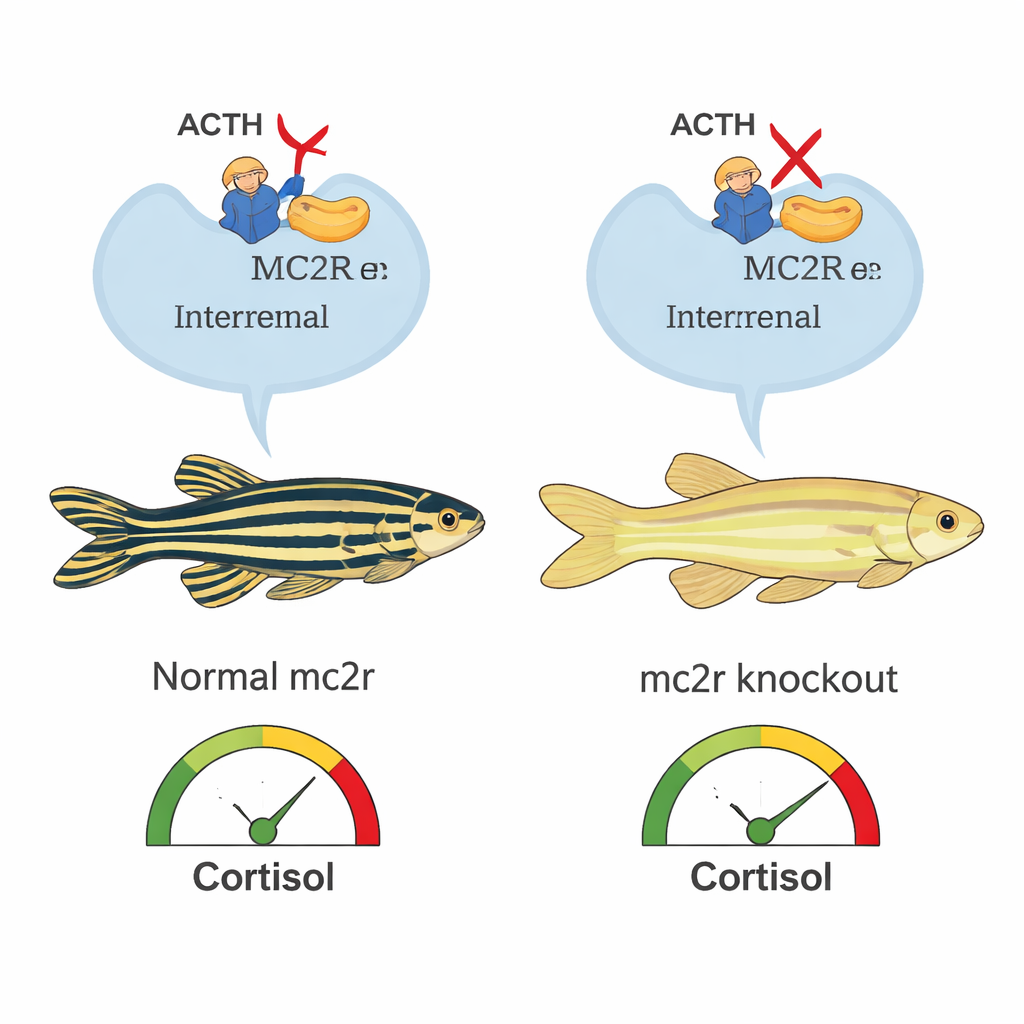
In vertebrates, a family of hormones called melanocortins helps control both skin color and stress responses. These hormones act through several closely related receptors. One of them, called MC2R, sits in the adrenal-like gland and is switched on by the hormone ACTH to trigger production of cortisol, the main stress hormone in fish and humans. While other melanocortin receptors are known to influence pigmentation, MC2R’s role in skin color has been much less clear, especially in fish. The authors set out to test whether MC2R in zebrafish does more than just manage the stress response.
Editing a gene to change stripes, not the pattern
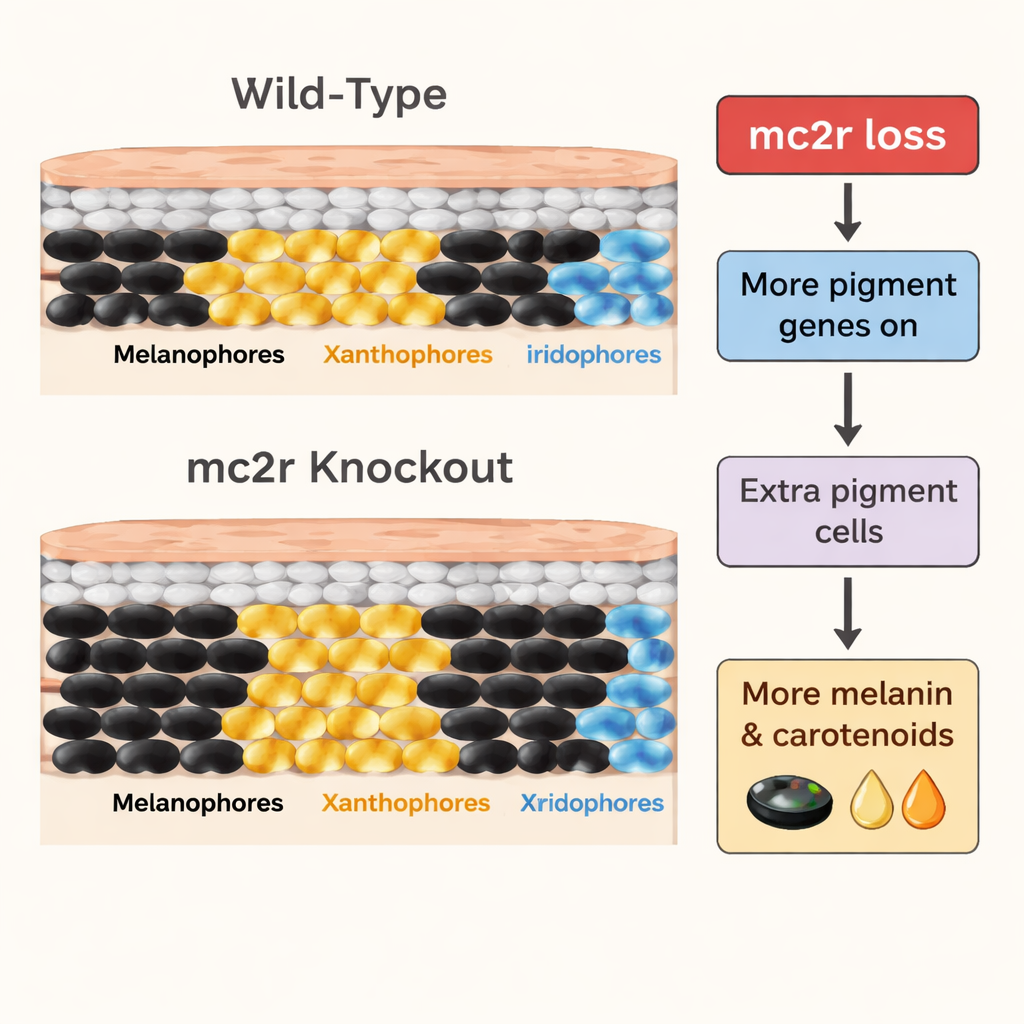
Using CRISPR/Cas9 gene editing, the team created zebrafish in which the mc2r gene was disabled, producing truncated, nonfunctional versions of the receptor. These “knockout” fish survived and kept the familiar striped layout of dark and light bands, but their appearance changed dramatically. Compared with normal siblings, the mutants looked more intensely colored overall, with a stronger yellow tone and dark stripes that shifted to a bluish‑green shade. Dark pigment cells (melanophores) appeared in unusual places, like around the jaws, and yellow pigment cells (xanthophores) became more abundant along the belly and in the pale bands between stripes. Careful cell counts confirmed that both melanophores and xanthophores were more numerous, even though the overall stripe pattern stayed intact.
Stress response that falls flat
Because MC2R normally drives cortisol production, the researchers tested how the knockout fish handled stress. Under calm conditions, cortisol levels were similar in normal and mutant zebrafish. After an acute stress challenge, however, normal fish showed a strong surge in cortisol, while the mutants mounted only a weak response. When ACTH was injected directly, normal fish again showed a large rise in cortisol, but knockout animals produced only a small fraction of that amount. These experiments confirm that MC2R is essential for a full stress-hormone response, and that the striking color changes appear alongside an impaired ability to make cortisol under pressure.
Color changes written in the genes
To understand how a broken stress receptor could reshape coloration, the team examined which genes were turned on or off in the skin. They sequenced RNA from the skin of normal and mutant fish and compared the activity of thousands of genes. In mutants, they found higher activity in genes involved in building pigment granules and making the dark pigment melanin, as well as genes tied to yellow carotenoid storage and lipid (fat) metabolism. By combining these bulk measurements with single-cell data from specific pigment cells, they showed that key melanophore genes and xanthophore genes were more active in the knockouts. Interestingly, genes that help organize the stripe layout, especially those tied to reflective iridophore cells, were not substantially altered. This suggests that MC2R mainly affects how many pigment cells develop and how much pigment they carry, rather than the blueprint that positions stripes on the body.
What this means for color, stress, and beyond
The study shows that MC2R has a dual role in zebrafish: it is crucial for producing stress hormones during sudden challenges, and it helps keep pigment cell numbers and pigment production in balance. When mc2r is lost, fish still form normal stripes, but they pack in more dark and yellow cells and store more pigment, leading to a clear hyperpigmented, yellowish look. For a lay observer, the message is simple: a gene long viewed as a stress switch also acts as a color tuner. This insight may help explain certain human pigmentation disorders linked to adrenal problems and illustrates how tightly intertwined our hormone systems and visible traits can be.
Citation: Barreiro-Docío, E., Guerrero-Peña, L., Soni, P. et al. Loss-of-function mutations in the melanocortin-2-receptor (mc2r) lead to skin hyperpigmentation in teleost fish. Sci Rep 16, 7261 (2026). https://doi.org/10.1038/s41598-026-37998-7
Keywords: zebrafish pigmentation, stress hormones, melanocortin receptor, cortisol, fish coloration