Clear Sky Science · en
Utilization of quartz quarry dust as a sustainable partial sand replacement in cement mortar
Turning Stone Dust into a Building Resource
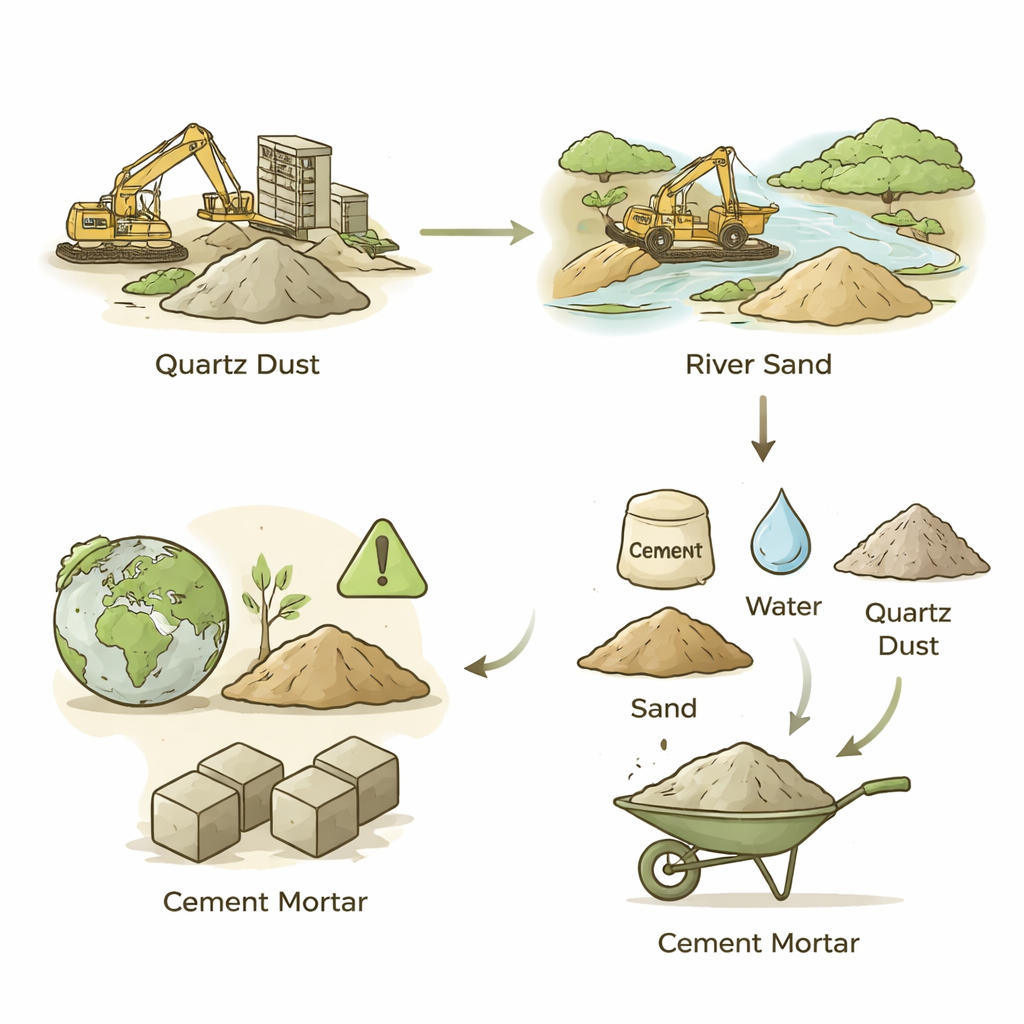
Modern cities run on sand. It’s a key ingredient in the concrete and mortar that hold our buildings, bridges, and roads together. But the world is running into a sand shortage, and digging sand from rivers is damaging ecosystems. This study explores an appealing idea: can we turn quartz quarry dust – a fine powder usually treated as industrial waste – into a useful ingredient that replaces part of the sand in common cement mortar?
From Waste Pile to Useful Material
Quartz quarry dust forms when blocks of quartz-rich rock are crushed and cut. Instead of being dumped, the dust could become a raw material. The researchers collected natural river sand and quartz dust from quarries in Tanzania and carefully measured their size, shape, and chemistry. Tests confirmed that the dust is almost pure quartz (about 99.6% silica), with very few impurities and no reactive minerals that might cause the mortar to crack or swell later. Under an electron microscope, the dust particles looked sharp, angular, and rough – quite different from the smoother grains of river sand. These rough edges, while demanding more mixing water, can help the particles lock tightly into the cement paste.
Designing Stronger, Greener Mortar
To see how much quarry dust could be used without hurting performance, the team made a series of mortar mixes. All contained the same amount of cement and water, but the sand was gradually replaced with 0%, 5%, 10%, 15%, or 20% quartz dust by weight. The mixtures were cast into small cubes and cured in water for up to 28 days, then tested for how easy they were to work with when fresh, how dense they became when hardened, how much water they absorbed, and how much pressure they could withstand before crushing. Microscopic images of the hardened mortar helped link what was happening at the tiny scale to the visible behavior of the material.
Finding the Sweet Spot
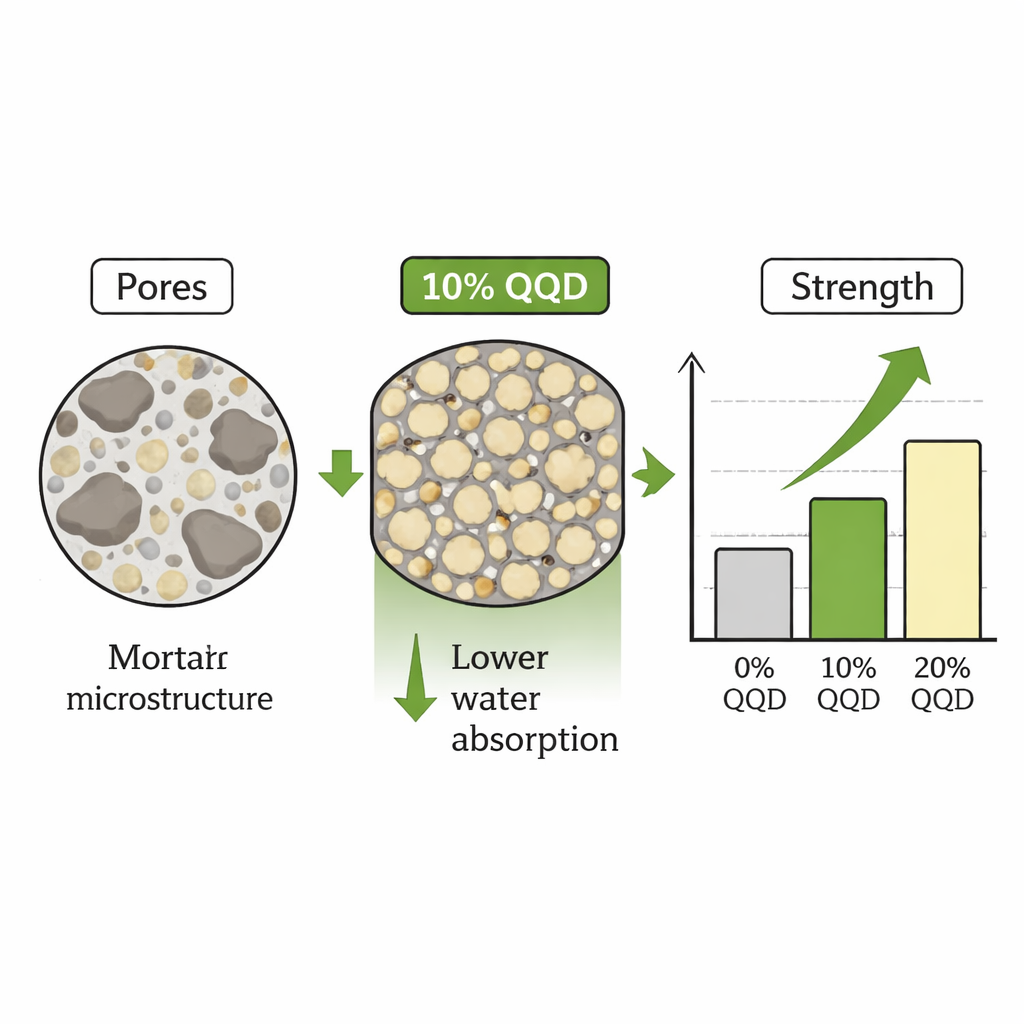
As more dust was added, the fresh mortar became noticeably stiffer: the slump, a standard measure of flow, dropped from about 74 millimeters with no dust to about 56 millimeters at 20% dust. Up to 15% replacement, however, workers would still find the mix usable. The real surprise came in strength and durability. When 10% of the sand was replaced by quarry dust, the 28-day compressive strength jumped from 10.8 megapascals in the control mix to 18.5 megapascals – roughly a 70% increase, comfortably within the range for typical structural mortars. Water absorption, a sign of how porous and therefore vulnerable to damage a material is, fell from 6.4% to 5.7% at this same 10% level. Beyond 10%, the benefits faded: higher dust contents began to introduce extra voids and disrupted the smooth cement–sand contact, causing strength to drop slightly and water uptake to rise again.
What Happens Inside the Mix
Microscope images of the hardened mortar revealed why 10% quarry dust worked so well. In the regular mix with only river sand, the structure showed more empty spaces and a looser network of hardened cement. When a modest amount of quartz dust was added, its fine, angular grains nestled between the sand particles, filling gaps and helping create a more continuous, rock-like network of cement products. At about 10% replacement, this inner structure looked the most compact and uniform, with fewer visible pores and better contact between particles. When even more dust was used, the sharp grains started to clump and were not fully coated by paste, producing weak spots and scattered voids that undermined the gains.
What This Means for Everyday Building
For a non-specialist, the takeaway is simple: a small dose of quarry dust – about one-tenth of the sand in a standard mortar mix – can make the material stronger and slightly less absorbent, while reusing a waste product and easing pressure on river sand supplies. Go much beyond that, and the mix gets harder to work with and offers diminishing returns. Although longer-term field trials and durability studies are still needed, this research shows a practical path toward turning a dusty by-product into a reliable ingredient for greener, more resource-efficient construction.
Citation: Ngayakamo, B.H., Ikotun, B.D. Utilization of quartz quarry dust as a sustainable partial sand replacement in cement mortar. Sci Rep 16, 7031 (2026). https://doi.org/10.1038/s41598-026-37993-y
Keywords: sustainable construction, cement mortar, quarry dust, sand replacement, quartz