Clear Sky Science · en
Effects of afforestation on Technosol properties in reclaimed hard coal deep mining spoil heaps
Why old mining piles still matter
Across the world, coal mining has left behind huge piles of rock and soil that look lifeless and gray. Yet these spoil heaps are not just scars on the landscape—they are potential new forests that could store carbon, clean water, and support wildlife. This study from southern Poland asks a practical question: when we try to turn these barren piles into green spaces, which kind of tree-based restoration does the most to rebuild healthy soil?
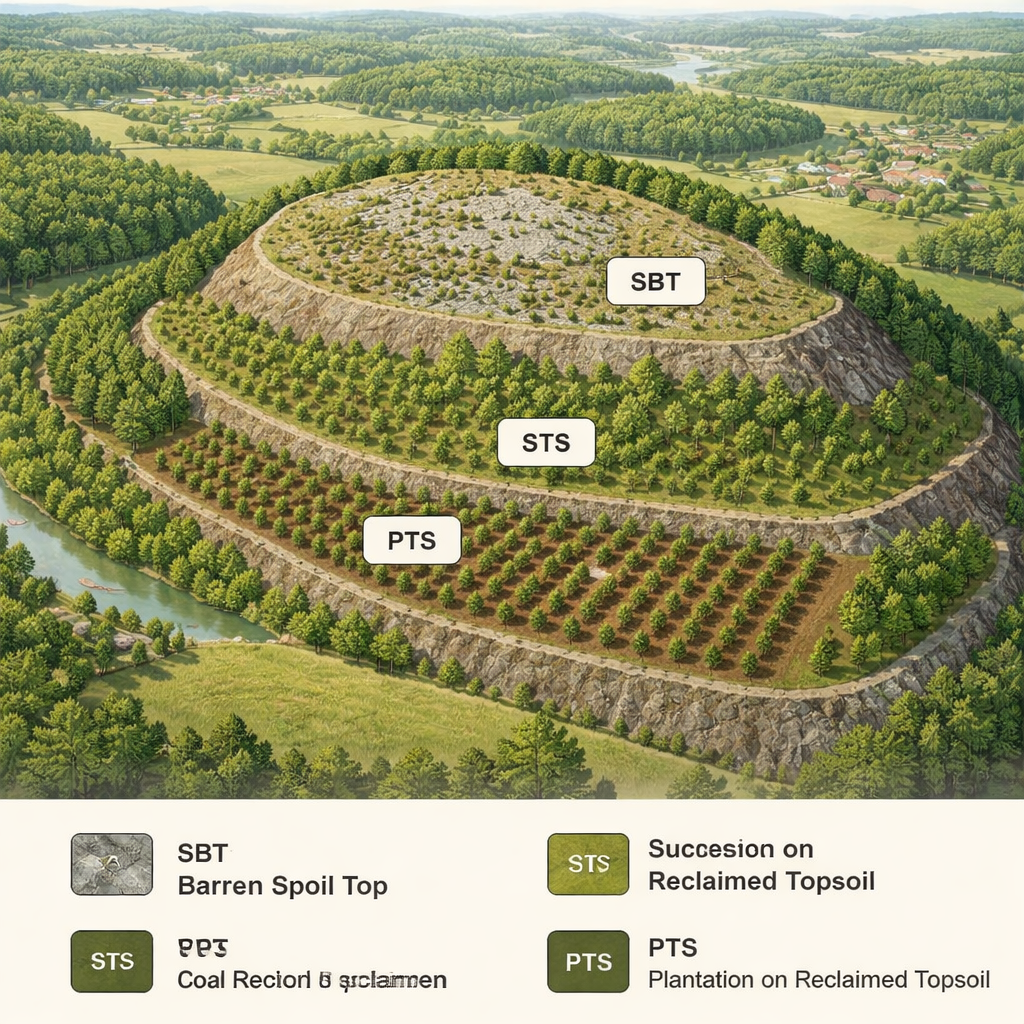
Three ways to grow a new forest
The researchers focused on a large coal spoil heap in the Upper Silesian Coal Basin, where mining waste forms steep, dry, stony slopes with very poor soil. Over the past few decades, different parts of the heap have followed different paths. In some areas, plants have slowly colonized bare rock on their own, a process called natural succession on barren spoil top. Other sections were first covered with a layer of imported topsoil and then left for nature to take its course. A third set of areas received topsoil and were actively planted with chosen tree species. By comparing these three approaches side by side, the team could see how each one changed the soil just beneath the surface.
Taking a close look underfoot
To measure soil recovery, the scientists collected samples from the top 10 centimeters in 30 small plots spread across the heap. They checked how compact or airy the soil was, how much water it could hold, and how much sand, silt, and clay it contained. They also analyzed nutrients important for plant growth, such as nitrogen, calcium, magnesium, potassium, and sulfur. Finally, they looked not only at the total amount of organic carbon in the soil, but also at how that carbon was stored—either as loose, easily decomposed bits, or in more stable forms attached to minerals or protected inside tiny soil clumps.
Soil structure, water, and nutrients
The three restoration paths produced noticeably different soils. Where plants colonized bare spoil without added topsoil, the ground remained sandy and acidic but was surprisingly porous, meaning it had a lot of open space between particles. That porosity helped air move through the soil, but the loose material did not hold much water. Where topsoil was added and trees were actively planted, the soil became denser yet better at holding water—thanks to finer particles and more organic matter. These planted areas also held more nitrogen, calcium, and potassium, all key nutrients for robust plant growth. In contrast, the bare-spoil succession zones contained more sulfur and magnesium, reflecting the breakdown of sulfur-rich and magnesium-bearing minerals in the mining waste.
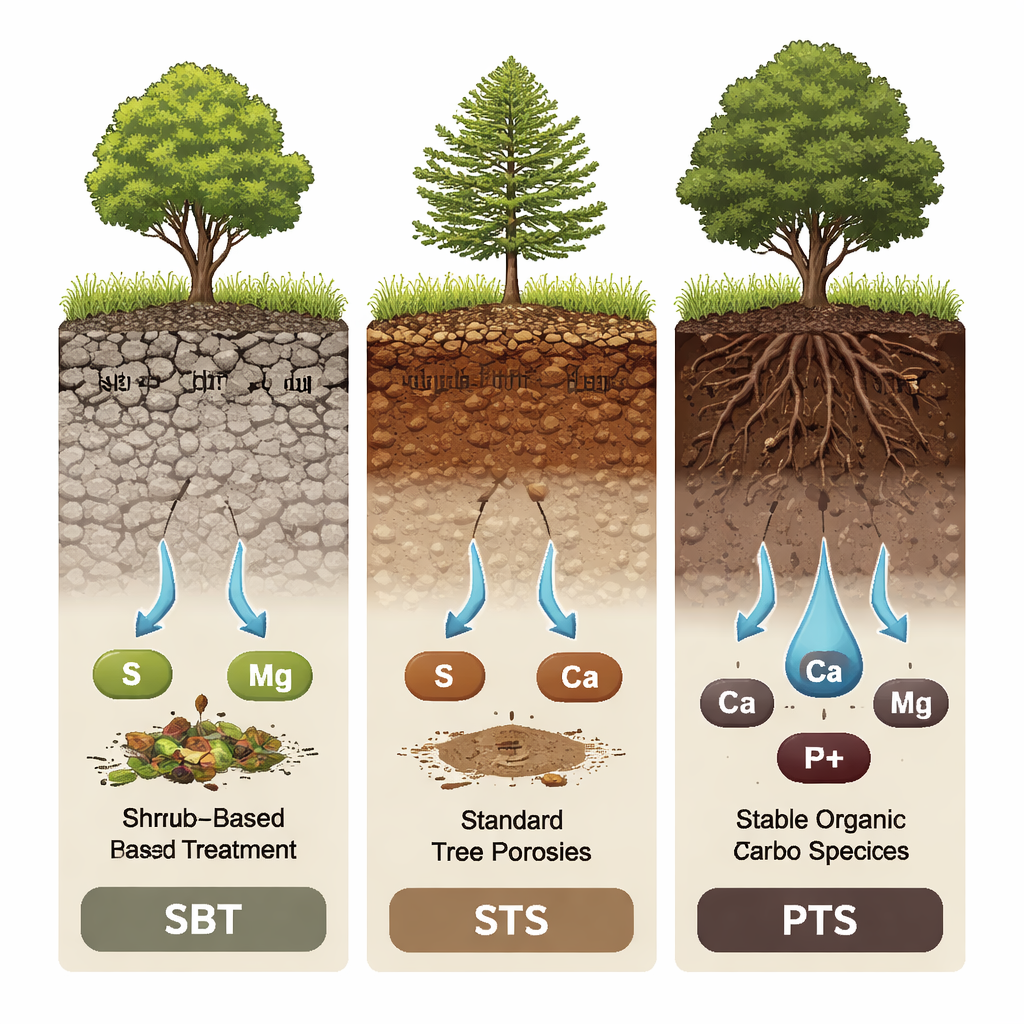
How carbon is stored in the rebuilt soil
Carbon in soil is not all the same. Some of it sits as loose fragments of fresh plant material that microbes can break down quickly; other portions are locked into tiny aggregates or stuck to mineral surfaces, where they can remain for many years. On the bare-spoil succession plots, the soil held more of the loose, "free" carbon fraction, likely coming from fine roots and surface litter that had not yet been fully decomposed. In the planted topsoil areas, more carbon occurred in the better-protected forms, suggesting that these sites were beginning to build longer-lasting carbon stores. Interestingly, when all fractions were added together, the total carbon in the soil was similar among the three methods—what differed was how securely that carbon was held.
What this means for restoring mined lands
For land managers, the message is that there is no single best recipe, but each strategy has clear trade-offs. Letting nature reclaim bare spoil on its own is cheaper and can create porous soils and fresh organic inputs, but nutrients remain limited and much of the carbon is in a fragile, easily lost form. Adding topsoil and actively planting trees requires more money, labor, and material, yet it builds soils that hold more water, retain more nutrients, and stabilize carbon for the long term. Areas with topsoil that are left to natural succession can still recover substantially and sometimes resemble planted sites. Choosing among these options will depend on local budgets, how much topsoil is available, and whether the main goal is quick greening, long-term carbon storage, better water management, or a balance of all three.
Citation: Pietrzykowski, M., Misebo, A.M., Woś, B. et al. Effects of afforestation on Technosol properties in reclaimed hard coal deep mining spoil heaps. Sci Rep 16, 6933 (2026). https://doi.org/10.1038/s41598-026-37992-z
Keywords: post-mining restoration, afforestation, soil health, carbon storage, coal spoil heaps