Clear Sky Science · en
Upstream migration of the invasive blue crab in the Po River, Italy, highlights the vulnerability of freshwater ecosystems
Why this roaming crab matters
The Atlantic blue crab, a familiar shellfish from the American coast, has become an unexpected troublemaker in the Mediterranean. This study shows that the crab is not only thriving in coastal lagoons of northern Italy, but is now marching far up the Po River into freshwater. Because rivers supply drinking water, food, and recreation for millions of people, understanding this inland invasion is crucial for protecting native wildlife and local fisheries.
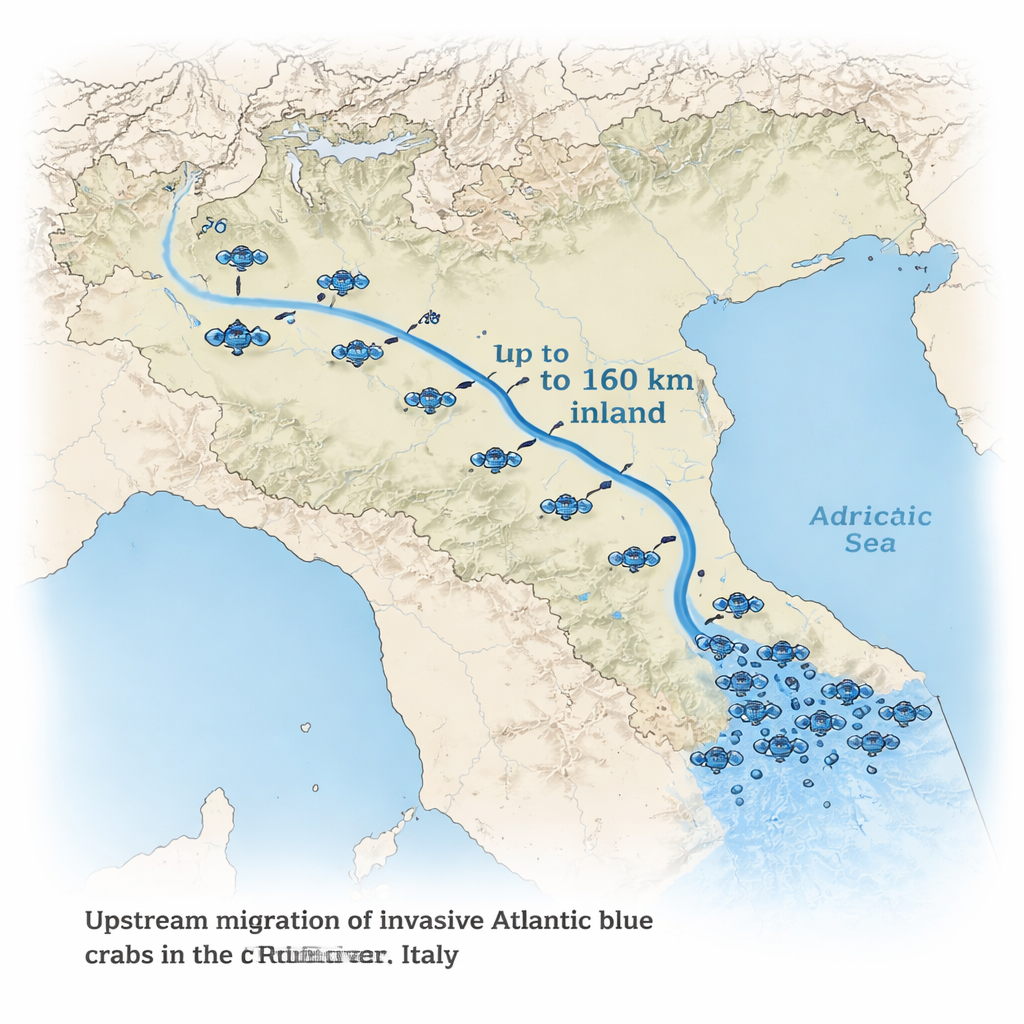
A coastal invader heads inland
Originally from the Atlantic shores of North America, the blue crab arrived in the Mediterranean, likely in ship ballast water, and has since spread rapidly along many coasts. It is hardy, highly adaptable, and eats a wide variety of prey, traits that make it a successful invader. Until recently, most reports from Europe focused on salty or brackish habitats such as lagoons and estuaries. The authors suspected that some crabs were also venturing well into freshwater sections of large rivers, where almost no formal studies had been done.
Listening to people who know the river
To track how far the crabs have moved, the researchers turned to those who spend the most time on the water: local fishermen. Between 2022 and 2025, they carried out structured face‑to‑face interviews at dozens of fixed fishing spots along about 250 kilometers of the Po River and its delta branches. Fishermen were asked where and when they caught blue crabs, how many, how big they were, and what gear was used. The scientists checked photos and specimens to confirm identifications and then mapped each reliable sighting with GPS. Although this approach does not provide exact crab numbers, it offers a detailed picture of how far inland the species has spread.
A powerful push up the river
The resulting map revealed that blue crabs are now found more than 160 kilometers from the sea, reaching as far as the area near Mantova—far beyond their typical coastal range. Most of these inland crabs were large adult males; females were seen mainly near saltier waters closer to the Adriatic, matching the species’ life cycle, where females must return to higher‑salinity areas to reproduce successfully. Catches generally grew smaller with distance from the river mouth, and no clear pattern in crab size appeared along the river. Still, in the delta branches closest to the sea, fishermen reported striking hauls, sometimes up to 150 kilograms in a single event, underscoring how abundant the species has become near the coast.
Environment not telling the whole story
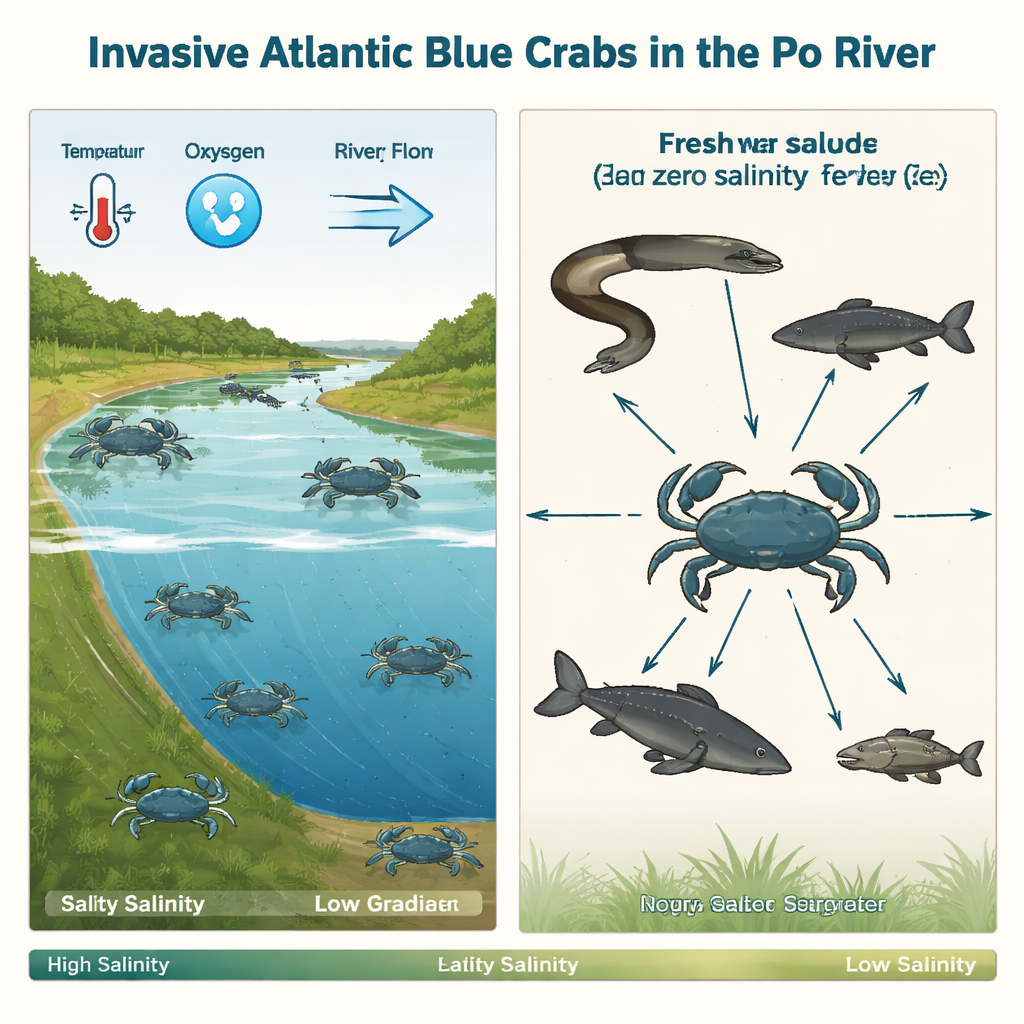
The team then asked whether basic water conditions might explain how far upstream the crabs could go. They combined long‑term measurements of water temperature, conductivity (a stand‑in for salinity), dissolved oxygen, and river discharge from official monitoring stations. These data showed that 2022 was an extreme year: high temperatures, strong saltwater intrusion, and unusually low river flow, followed by continued low flow in 2023 when the crabs reached their maximum recorded inland distance. Yet, when the scientists tested for statistical links, they found no clear relationship between these broad environmental measures and the furthest point reached by the crabs each year. That suggests that the species’ flexibility and biological pressures—such as crowding in coastal lagoons that may push individuals upstream—could be more important than simple physical thresholds.
New food‑web risks in freshwater
Because little is known about how blue crabs interact with river fish in Europe, the authors carried out a systematic review of scientific papers. Out of 27 fish species recorded in the lower Po, only three had any documented relationship with blue crab worldwide. The European eel is the only freshwater fish in the region reported as prey of the crab, mainly during its fragile juvenile stages, raising alarms for an already threatened species that uses the Po Delta as a migration corridor. At the same time, large predatory fish such as catfish, pikeperch, and seabass may eat blue crabs, possibly offering some natural control, although this has yet to be measured directly. Overall, the lack of studies means that many potential effects on native fish and bottom‑dwelling animals remain uncertain.
What this means for rivers and people
This work provides the first clear evidence that invasive blue crabs can colonize large European rivers far into freshwater, not just coastal lagoons. Their ability to tolerate changing salinity, temperature, and oxygen, combined with a flexible diet, suggests they could become long‑term residents of inland waters. For the Po River—already heavily populated by non‑native fish—the arrival of another powerful predator and competitor could reshape food webs and further stress local biodiversity. At the same time, abundant crabs in the delta branches may boost catches for some fisheries, even as they harm others. The authors argue that only systematic monitoring and targeted research on crab numbers, movements, and feeding will reveal the true scale of the threat and help managers protect freshwater ecosystems from this fast‑moving invader.
Citation: Gavioli, A., Gaglio, M., Cardi, D. et al. Upstream migration of the invasive blue crab in the Po River, Italy, highlights the vulnerability of freshwater ecosystems. Sci Rep 16, 6818 (2026). https://doi.org/10.1038/s41598-026-37990-1
Keywords: Atlantic blue crab, Po River, freshwater invasion, Mediterranean ecosystems, invasive species