Clear Sky Science · en
Experimental optimization of disc-type generators for low-velocity hydrokinetic energy harvesting
Turning Gentle Currents into Useful Power
Oceans and rivers are full of slow-moving water that flows day and night, but most turbines today need faster currents to generate electricity efficiently. This study explores a different way to tap that quiet but constant energy: instead of spinning big blades, it lets a small object in the flow "dance" back and forth and uses that motion to drive compact disc-shaped generators. The work shows how to tune these devices so that even modest currents can reliably produce electricity for marine sensors, navigation lights, or other low-power needs.
Making Water Push Instead of Spin
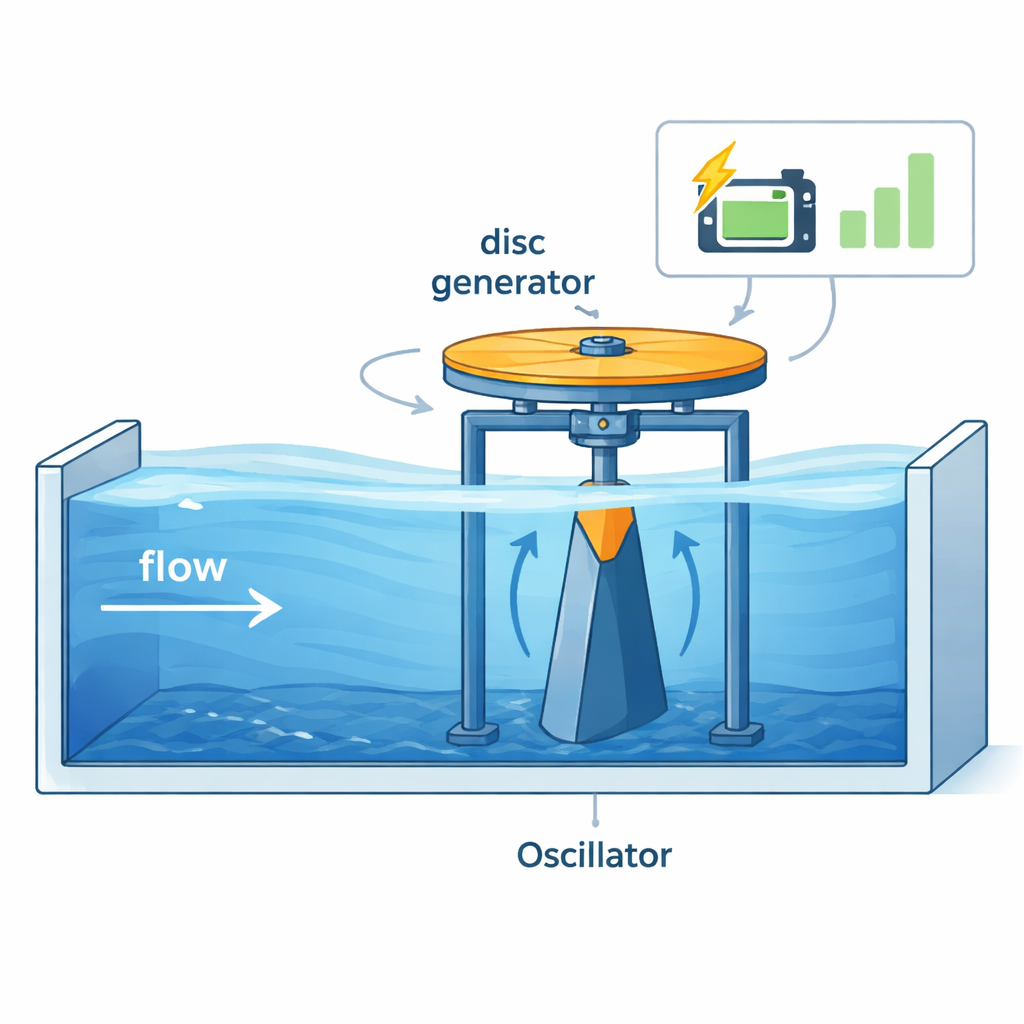
Traditional underwater turbines rely on steady rotation, which becomes inefficient and bulky when water moves slowly. The system tested here takes another route. A triangular metal prism is mounted on springs in a large laboratory flume and allowed to move sideways as water flows past it. The moving water sheds vortices and unstable forces on the prism, causing it to vibrate or even "gallop" with large swings. Those side-to-side motions are converted into rotation by a simple mechanical linkage that drives a flat, disc-type generator sitting safely above the water. Because disc generators are compact, produce high torque at low speed, and can be matched to oscillating motion, they are promising for harvesting energy from slow currents.
Why the Shape and "Dance" of the Prism Matters
The researchers chose an equilateral triangular prism because earlier studies had shown that this shape can avoid self-limiting behavior and keep oscillating strongly even at low flow speeds. As current speed increases, the prism’s motion passes through several regimes. First comes vortex-induced vibration, where small, fairly regular wiggles appear as swirling vortices shed from the prism. At higher speeds, the motion transitions into galloping, where a feedback between flow and motion makes the swings larger and more energetic. In this galloping state, the prism traces wide arcs with very stable rhythm, which is ideal for driving a generator. The team carefully measured displacement histories and frequency spectra to track how these motion patterns changed as they varied the water speed and the electrical load connected to the generator.
Tuning the Electrical Load to the Motion
A key insight of the work is that the electrical side of the system acts like an added brake on the motion. When the generator is connected to a resistor, electrical power is produced, but that process also exerts electromagnetic damping that can either help or hinder the oscillation. Too little damping and the system wastes potential power; too much and the motion is choked off. By systematically changing the load resistance, the authors showed that each generator has its own "sweet spot" where mechanical motion and electrical extraction are best matched. In this range, the prism still moves vigorously—especially in the galloping regime—while the generator pulls off a significant fraction of the flow’s energy as useful power.
Finding the Best Generator Size
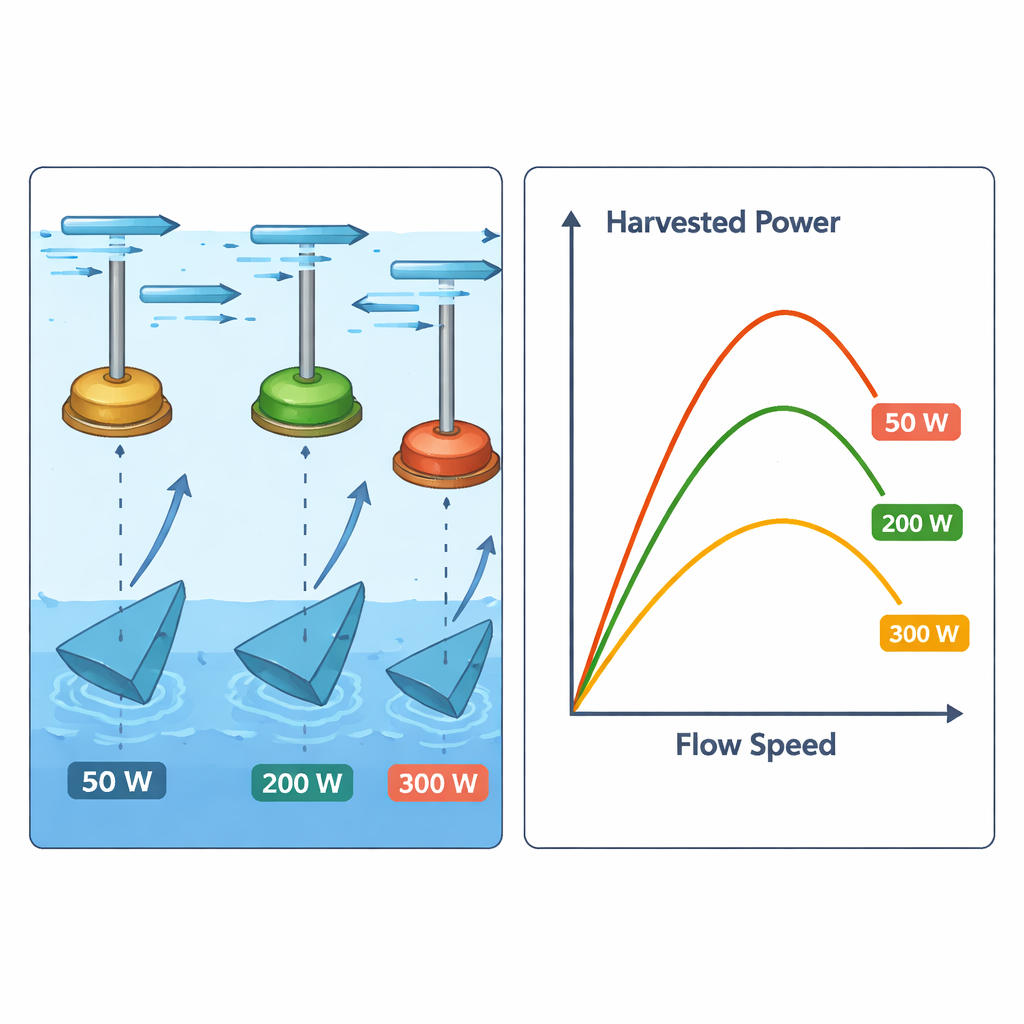
The team compared several axial-flux, coreless disc generators rated at 50, 100, 200, and 300 watts, all driven by the same triangular prism in currents between about 0.56 and 1.21 meters per second. They found that the smallest unit did not provide enough damping for efficient harvesting, while the largest one pushed the system strongly into galloping but did not convert that motion into power as effectively as hoped. The 200-watt generator emerged as the best compromise: at an optimized electrical load it produced a peak output of about 21 watts in the tested conditions and reached a maximum conversion efficiency of just over 12 percent of the theoretical fluid power available to the device.
What This Means for Future Ocean Power
For non-specialists, the main message is that there is more than one way to make electricity from water, and spinning propeller-like turbines are not always the best choice. By letting a simple object rock and swing in the current and coupling that motion to a carefully tuned disc-shaped generator, it is possible to pull useful power from relatively gentle flows that are common in coastal and river environments. The experiments show that with the right prism geometry, generator size, and electrical load, these systems can operate stably in large-amplitude galloping motion and achieve promising efficiencies. This makes them attractive candidates for powering distributed marine devices where reliability, compactness, and operation in low-speed currents matter more than very high power output.
Citation: Wang, H., He, M., Li, G. et al. Experimental optimization of disc-type generators for low-velocity hydrokinetic energy harvesting. Sci Rep 16, 7692 (2026). https://doi.org/10.1038/s41598-026-37988-9
Keywords: hydrokinetic energy, flow-induced vibration, galloping energy harvester, disc-type generator, ocean current power