Clear Sky Science · en
A new sauropod tracksite from the Lower Cretaceous of Ningxia, Northwestern China, with implications for overtrack preservation
Footprints on a Cliff
High on a steep rock face in northwestern China, dozens of giant fossil footprints record the passage of long‑necked dinosaurs that walked there more than 110 million years ago. Because bones are scarce in this region, these tracks offer a rare, almost cinematic glimpse of how these animals moved, how big they were, and how their steps were preserved in mud that later turned to stone.
A Hidden Dinosaur Highway
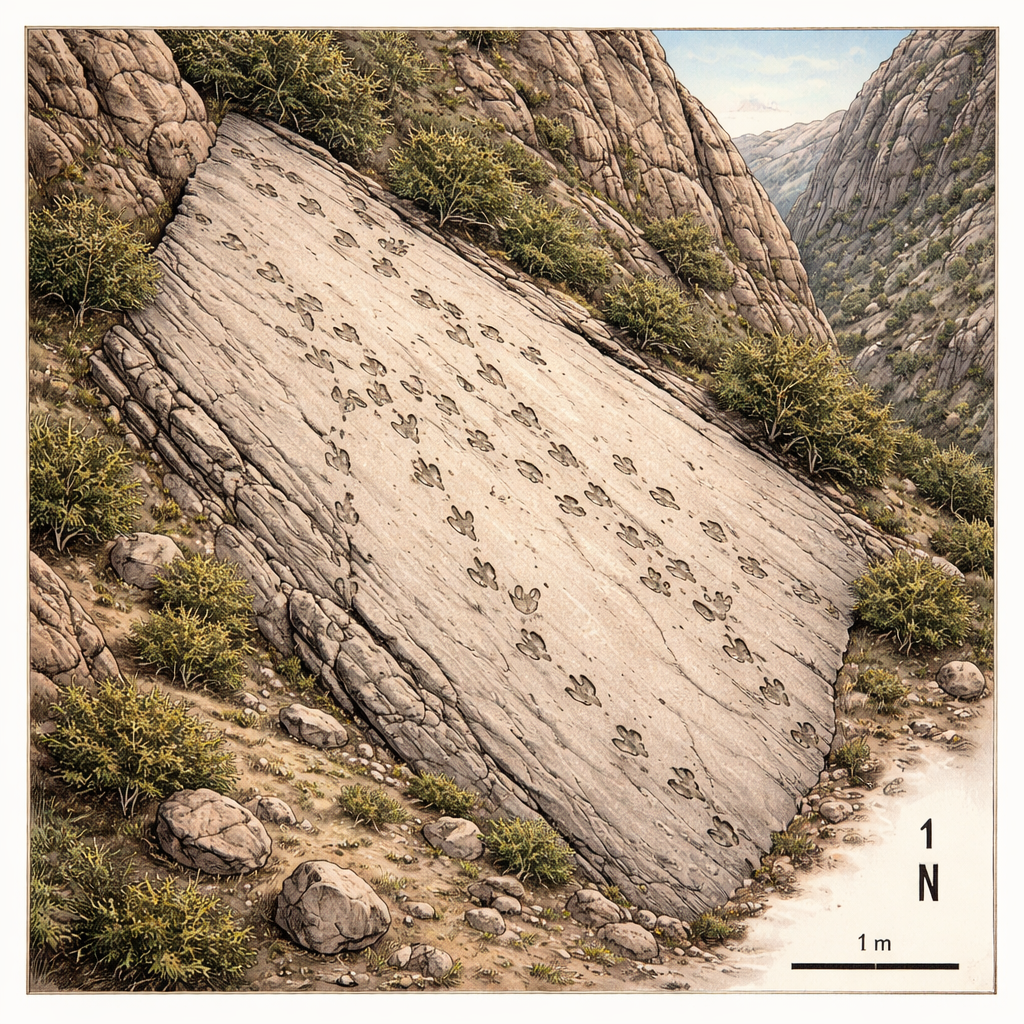
The study focuses on the Beilianchi tracksite in Ningxia, the largest dinosaur footprint site yet found in the local Madongshan Formation. The track‑bearing surface is about 650 square meters and so steep and inaccessible that researchers could not walk on it safely. Instead, they used a drone to collect hundreds of overlapping photographs and built a detailed three‑dimensional model of the surface. On this virtual outcrop they mapped nine clear trackways—series of footprints made by walking animals—plus more than a hundred isolated tracks. All belong to sauropods, the huge, four‑legged plant‑eaters with long necks and tails.
Reading the Landscape of Deep Time
Geologically, the tracks lie in lake‑margin mudstones of the Early Cretaceous, roughly 113 to 108 million years old, when this part of China was a broad basin filled with rivers and lakes under a subtropical climate. Layers of mudstone, marl, and limestone show that conditions shifted between shallow and deeper water over time. Pollen grains preserved in the same rocks reveal a changing plant community, from conifer‑dominated forests to fern‑rich wetlands, hinting at climate swings from semi‑humid to more arid and back to humid conditions while dinosaurs roamed the area.
How Giant Feet Leave Lasting Marks
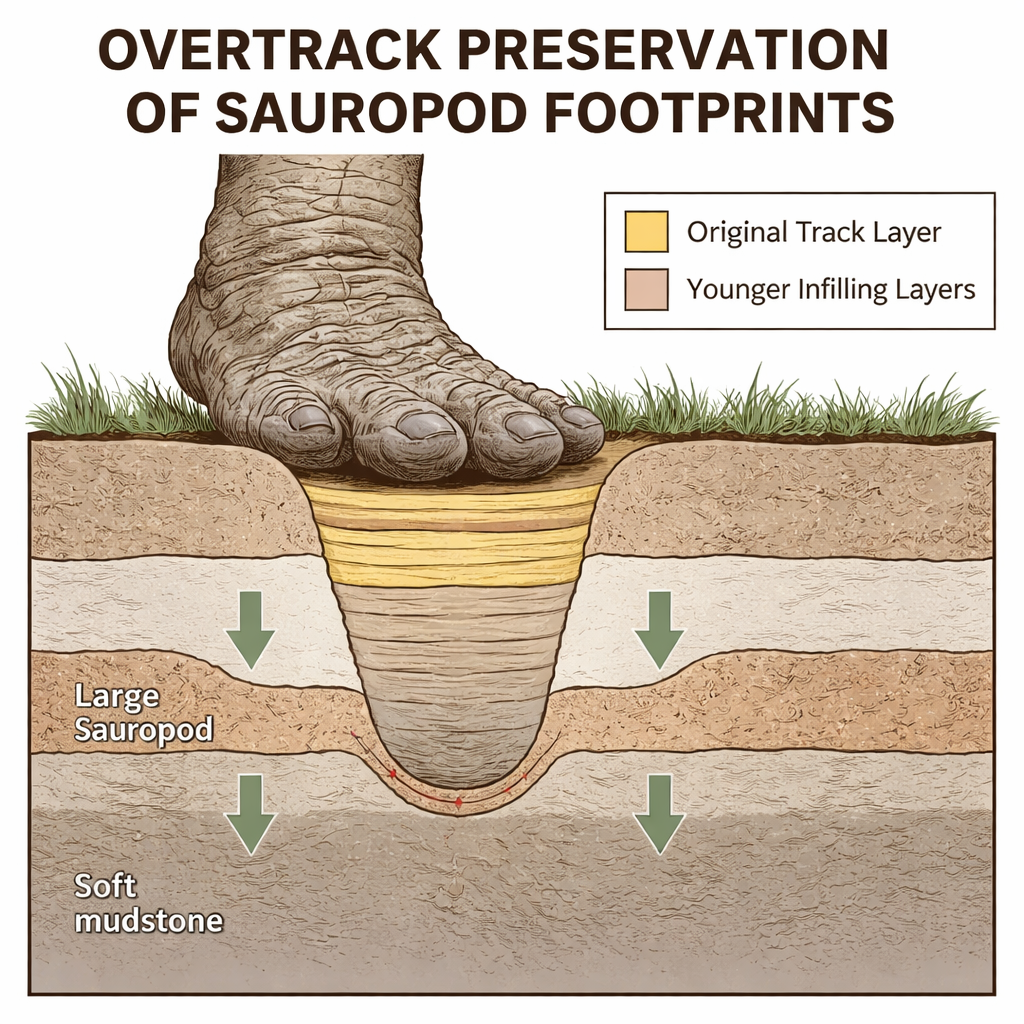
The Beilianchi surface preserves not just the footprints themselves, but also how they were modified after they formed. Many tracks contain “plugs” of rock—stacks of thin layers that filled the original depressions. These infills, called overtracks, formed when new mud settled into the holes left by the dinosaurs’ feet, building a thicker package of sediment inside each footprint than on the surrounding surface. Later erosion stripped away most of those younger layers, but the thicker parts survived as neat plugs still sitting in their original tracks. Alongside sharp, well‑defined footprints, the researchers also found very shallow, blurry impressions arranged in zig‑zag patterns. After testing different explanations, they concluded that these faint marks were older tracks that had been weathered by drying, wetting, and water flow before fresher dinosaur traffic added the clearer prints. Together, this shows that the track surface records at least two distinct episodes of dinosaur activity separated in time.
Tracking the Giants Themselves
From the size and spacing of the footprints, the team estimated that the trackmakers were medium‑ to large‑bodied sauropods with hip heights around three to almost five meters. The hind‑foot prints are oval to triangular and much larger than the smaller, semicircular front‑foot impressions. Some trackways are narrow, others wide, and the feet are turned slightly outward, all features that help paleontologists compare them to well‑known sauropod track types from around the world. The Beilianchi tracks turn out to be intermediate between two common categories, called Brontopodus (typically wide‑gauge) and Parabrontopodus (more narrow‑gauge). Because the exact shape and spacing of tracks can be distorted by soft, water‑rich mud and later erosion, the authors avoid naming a precise track “species,” but they suggest the animals were likely relatives of broad‑bodied macronarian sauropods, possibly with ties to titanosaurs known from nearby regions.
What These Ancient Steps Tell Us
By combining careful mapping, 3D modeling, and geological detective work, the researchers show that the Beilianchi cliff is not just a snapshot of one dinosaur herd, but a time‑averaged record of repeated visits by large sauropods to a lakeshore setting. Their findings confirm that big, long‑necked dinosaurs were common in this part of China during the Early Cretaceous, even though their bones are rarely found. The unusual overtrack plugs and mixture of sharp and faint footprints reveal how changing mud conditions and later erosion shape what we see today. For non‑specialists, the study highlights how much information can be drawn from something as simple as a footprint—offering a way to watch giant dinosaurs walk across a vanished landscape, using nothing more than the marks they left behind.
Citation: Yang, Q., Xing, L., Lallensack, J.N. et al. A new sauropod tracksite from the Lower Cretaceous of Ningxia, Northwestern China, with implications for overtrack preservation. Sci Rep 16, 7531 (2026). https://doi.org/10.1038/s41598-026-37987-w
Keywords: dinosaur footprints, sauropods, fossil trackways, Early Cretaceous China, trace fossil preservation