Clear Sky Science · en
Anti interference and fault tolerant control of UAVs integrating residual based diagnosis disturbance estimation with counter drone strategies
Why smarter drones matter
Small unmanned aerial vehicles—drones—are rapidly becoming workhorses for deliveries, inspections, disaster response, and security. But real skies are messy: motors wear out, sensors drift, winds buffet the airframe, and hostile actors can try to jam or mislead a drone’s navigation. This paper explores how to make drones far more self‑reliant and hard to knock off course by giving them the ability to sense when something is wrong, understand what is causing it, and automatically adjust their flight in real time—even when another drone or a jammer is actively trying to interfere.
Many ways a drone can get into trouble
The authors begin by outlining the growing list of threats modern drones face. Inside the vehicle, motors can lose power, control surfaces can stick, and sensors like gyroscopes and GPS receivers can become biased or noisy. Outside, gusty winds, turbulence, and changing payloads can push a drone off course. On top of that, an adversary can blast radio signals to drown out commands, fake satellite signals to mislead navigation, or even send another drone on a collision path. Traditional control systems generally tackle one problem at a time—either coping with faults, or with wind, or with hostile drones—but not all of them together. This piecemeal approach leaves dangerous gaps when several issues occur simultaneously, which is likely in real missions.
A single brain for faults, noise, and threats
To close these gaps, the paper proposes a unified control architecture that weaves three ideas into one loop. First, a self‑fault diagnosis module constantly compares what the drone actually does with what a mathematical model says it should do. Mismatches—called residuals—reveal when a motor or sensor is starting to misbehave and even estimate how badly it is degraded. Second, an adaptive disturbance estimator treats all unknown pushes and pulls from the environment as an extra hidden variable in the model and learns its value on the fly, allowing the controller to cancel out wind and other unmodeled effects. Third, a counter‑drone strategy sits on top of this, watching for signatures of radio jamming, fake GPS signals, or nearby flying objects on a collision path and then commanding evasive maneuvers while the lower‑level control keeps the drone stable.
How the new control loop behaves in flight
The authors build a detailed mathematical model of a quadrotor, including its position, orientation, and the way each rotor’s speed turns into thrust and turning forces. They then embed the three modules into a two‑layer controller: an outer loop that steers the drone along a desired path, and an inner loop that keeps it level and pointed in the right direction. When the residuals indicate a fault, the system estimates how much effectiveness a motor has lost and adjusts the commands to the remaining healthy rotors so that the drone still produces the required forces. At the same time, the disturbance estimator, whose speed of response adapts based on how large the residuals are, learns the current wind and other unknown effects and feeds compensating signals into the controller. If sensors and onboard perception report a fast‑approaching object or inconsistent radio and satellite data, the counter‑drone logic declares a threat and reshapes the drone’s target path to dodge while leaving the stability layer in charge of smooth motion.
What the simulations reveal
To test the approach, the researchers simulate a quadrotor in a virtual environment with strong wind gusts and a series of deliberately injected problems: partial power loss in several rotors, sensor biases, saturation of one motor, and the complete failure of another, all at different moments. They also simulate hostile encounters that require evasive turns and altitude changes. With a conventional controller, position errors grow to around a quarter of a meter and attitude errors accumulate, which could be risky near obstacles or power lines. With the integrated framework active, position deviations shrink below five centimeters and orientation errors below a few hundredths of a degree, even when faults and wind occur together. The system estimates faults and disturbances accurately enough that the drone quickly re‑centers on its planned path. In threat scenarios, every simulated evasive maneuver succeeds while keeping the flight path smooth and stable.
Why this matters for future airspace
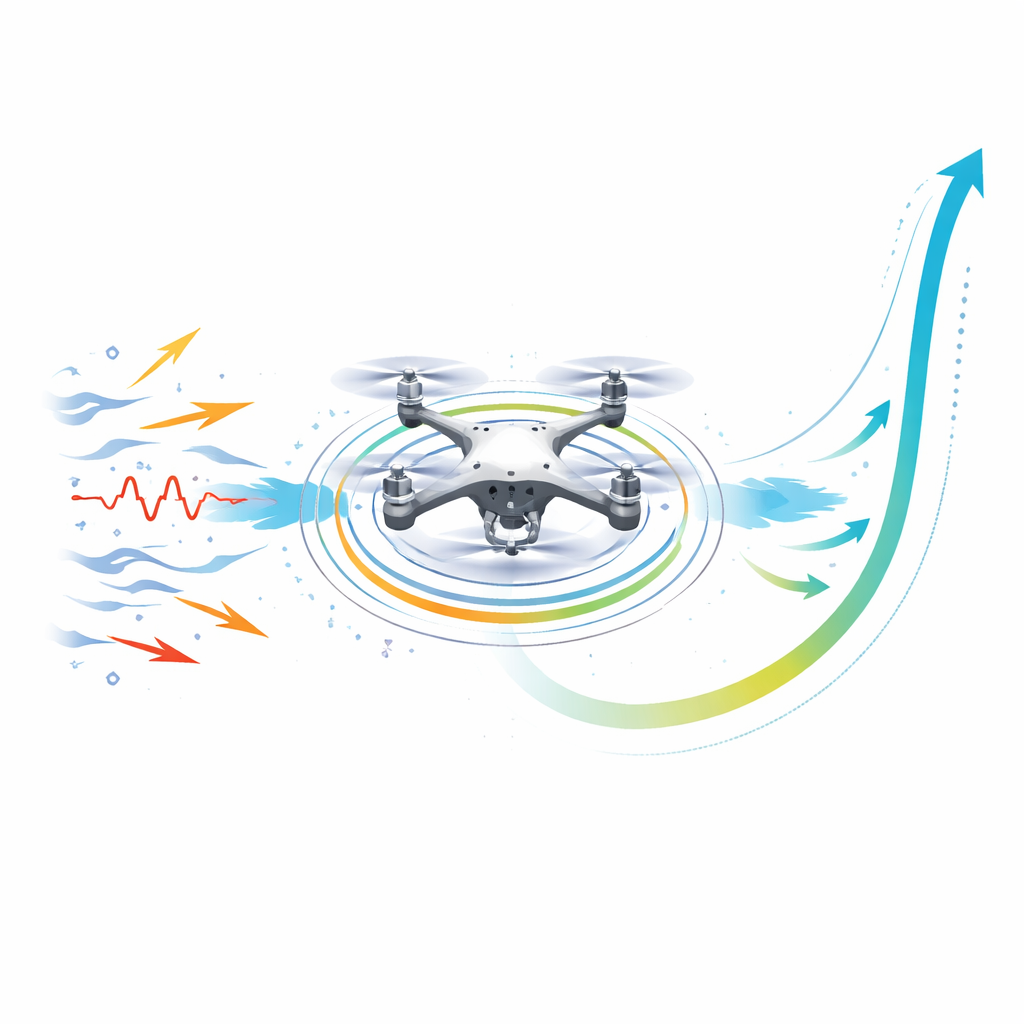
In plain terms, the study shows that drones can be engineered to “feel” when something is wrong—whether it is a failing motor, a sudden gust, or a hostile drone—and automatically take the right combination of corrective and evasive actions without human intervention. By fusing fault detection, disturbance rejection, and counter‑drone tactics into one coherent control system, the authors demonstrate a drone that is not only precise under ideal conditions but also resilient when the sky turns unfriendly. Such designs could help make future delivery networks, inspection fleets, and emergency‑response drones safer and more reliable in crowded, contested, and unpredictable airspace.
Citation: Xie, Z., Long, Y. Anti interference and fault tolerant control of UAVs integrating residual based diagnosis disturbance estimation with counter drone strategies. Sci Rep 16, 9429 (2026). https://doi.org/10.1038/s41598-026-37984-z
Keywords: drone resilience, fault tolerant control, anti jamming, autonomous UAVs, counter drone tactics