Clear Sky Science · en
Sex differences in the development of object imagery abilities across age groups
Why how we picture things in our mind matters
When you imagine a friend’s face, a favorite chair, or the pattern on your shirt, you are using “object imagery” – your mind’s eye for color, shape, and texture. Scientists have long known that boys and men often respond faster on tasks that involve spinning shapes in their head, a skill called spatial ability. Much less is known about whether females and males differ in object imagery, and how these abilities grow from early teens into adulthood. This study followed more than 800 teenagers and young adults in Singapore to find out whether our ability to picture what things look like develops differently in girls and boys.
Two different ways of seeing in the mind
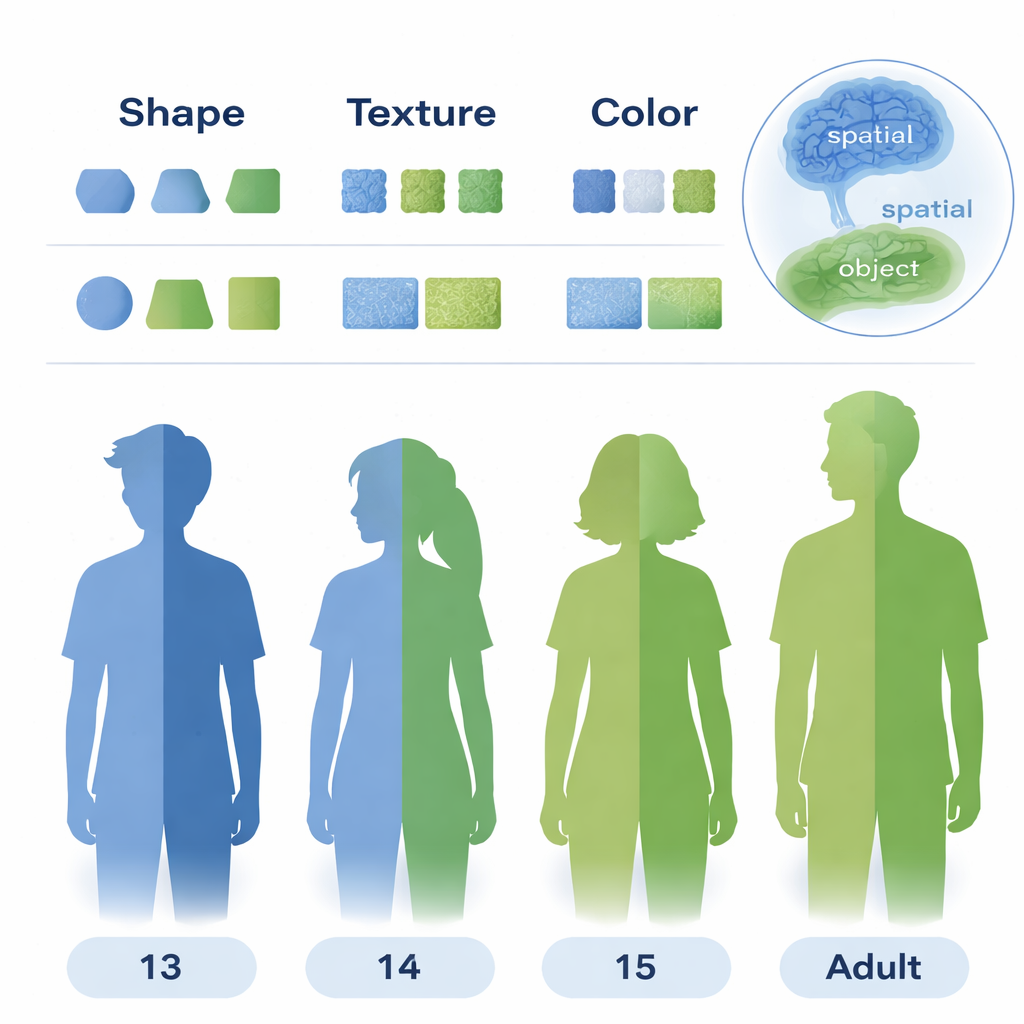
The researchers started from the idea that our brains use at least two major visual routes. One route helps us judge where things are and how they move in space, which is key for tasks like mentally rotating a 3D object. The other route helps us recognize what things look like – their outlines, colors, and textures – which is crucial for recognizing faces, reading maps with symbols, or doing art and design. Earlier work suggested that these two routes are partly independent and may mature on different timelines. That raised an intriguing question: might sex differences that are well known for spatial skills look quite different for the more appearance-focused side of visual thinking?
Testing teens and adults on mental pictures
To explore this, the authors tested 13-, 14-, and 15-year-old secondary school students, along with university students aged 18 to 35. Everyone completed a classic mental rotation test, where they judged whether two rotated 3D shapes were the same or different. They also took three object imagery tests. One asked them to recognize everyday objects hidden in noisy, degraded line drawings, tapping how well they can mentally complete a shape from fragments. Another required them to memorize a patch of visual texture and then pick it out from similar patterns, probing sensitivity to fine surface detail. A third test did the same with simple colors, asking participants to match a briefly seen color among several options.
Girls lead on shape and texture, boys stay faster at rotation
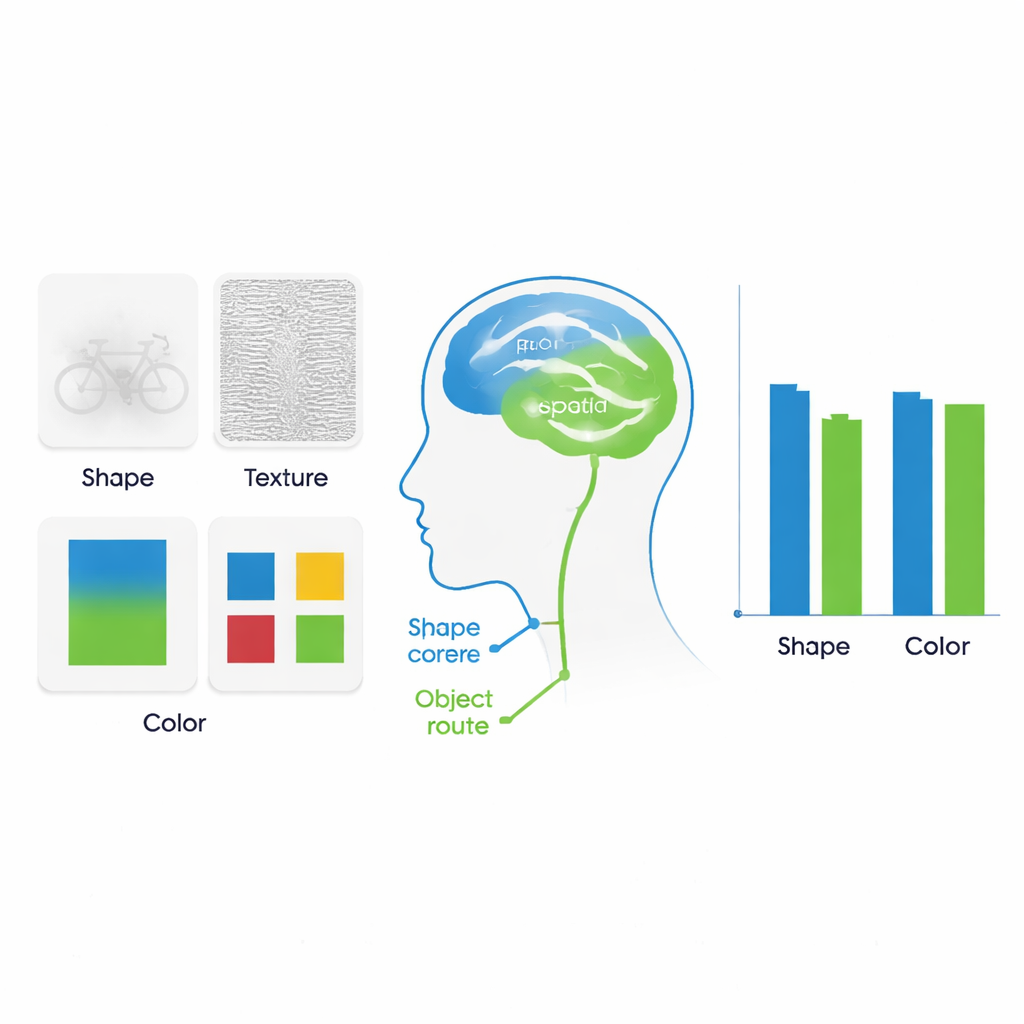
The results drew a sharp contrast between spatial and object imagery. On the mental rotation task, males were reliably faster than females starting already at age 13, but both sexes were similarly accurate. This echoes decades of findings that males tend to favor speed in spatial transformations. In the object imagery tasks, however, the pattern flipped. Females tended to score higher than males when recognizing degraded shapes and memorizing textures, and this benefit appeared from early adolescence onward. The texture advantage for girls was strongest at 13 and 14 and then leveled off by 15, while their edge in recognizing incomplete shapes remained visible even in adults. In color matching, by contrast, females and males performed similarly at all ages, suggesting that not all aspects of appearance-based imagery follow the same developmental path.
School focus, study choices, and culture
Because the work was carried out in Singapore, where schools place heavy emphasis on mathematics and science, the researchers also took a first look at how study choices might relate to these abilities. They compared university students in science, computing, and engineering with those in arts and social sciences. As in earlier work, students in technical fields showed strong spatial performance, with a continued male speed advantage in mental rotation. Yet specialization did not erase the female strengths in shape and texture imagery. The authors suggest that intense focus on testable, symbolic skills in high-pressure school systems may encourage strategy-based problem solving over rich visual exploration, potentially limiting chances to train fine-grained object imagery for all students.
What this means for everyday thinking and careers
For non-specialists, the main takeaway is that there is no single “visual ability.” Skills for rotating objects in the mind and for vividly picturing how things look are partly separate, grow on different timelines, and show different sex patterns. In this study, males kept their edge in how quickly they could carry out mental rotations, while females tended to excel in imagining and recognizing shapes and textures. These strengths may matter for different real-world paths: spatial skills can support success in many STEM fields, while rich object imagery is especially valuable in design, architecture, and the visual arts. Understanding these differences can help educators design training that nurtures both kinds of visual thinking in all students, rather than assuming that one style fits everyone.
Citation: Kozhevnikov, M., Bonavita, A. & Piccardi, L. Sex differences in the development of object imagery abilities across age groups. Sci Rep 16, 7409 (2026). https://doi.org/10.1038/s41598-026-37983-0
Keywords: object imagery, spatial ability, sex differences, adolescent development, visual cognition