Clear Sky Science · en
The mechanical and microstructural characteristics of low-energy calcined clay from a high-Egyptian gray clay with hydrated lime for rendering mortar applications
Greener Walls for Everyday Buildings
From homes to historic monuments, most of the walls we see are covered with thin layers of mortar based on Portland cement, a material that carries a heavy carbon footprint. This study explores a different path: using Egyptian gray clay that has been gently fired, then blended with traditional lime, to create colored wall coatings that are easier on the climate, kinder to old buildings, and still strong enough for everyday use. The work shows how these low‑energy mixtures behave and why they could help shift construction toward more sustainable finishes.
Why Rethink the Stuff on Our Walls?
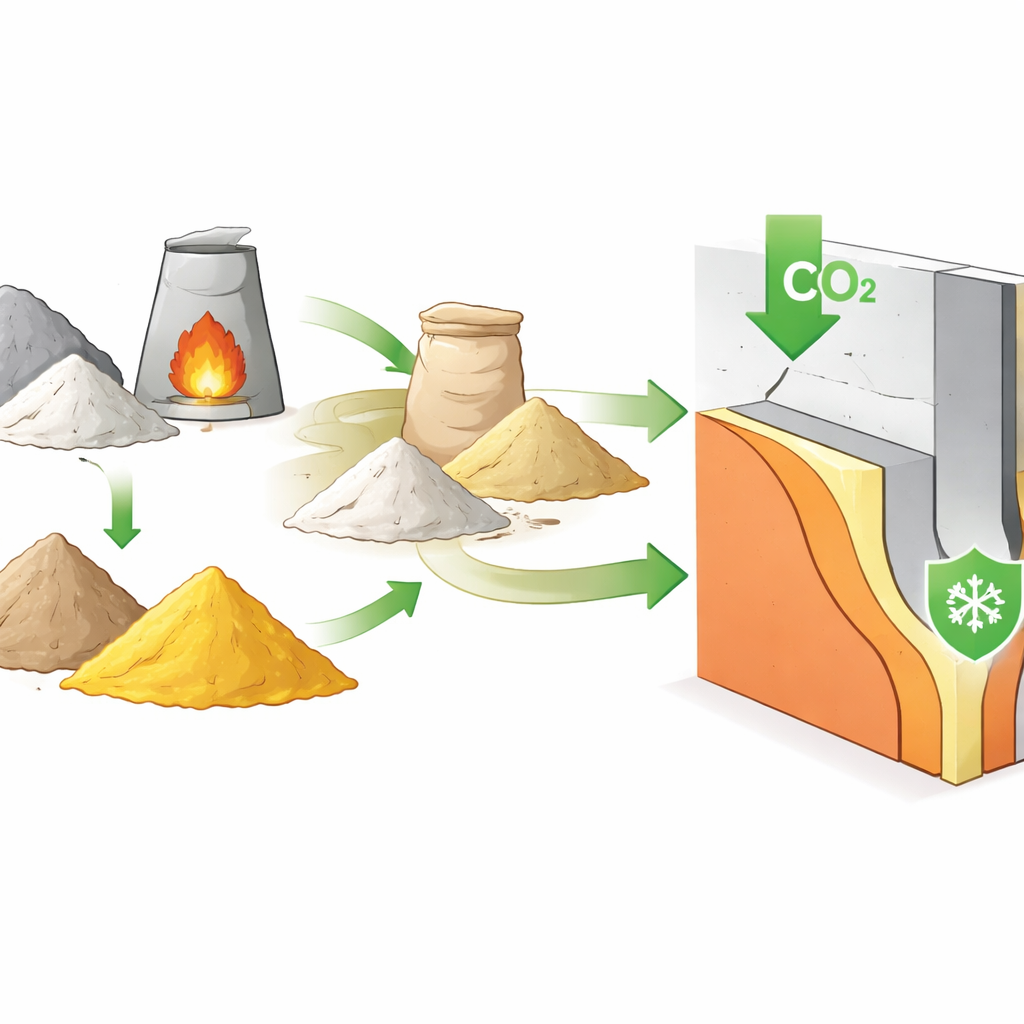
Ordinary Portland cement is made in giant kilns at temperatures up to about 1450 °C, releasing nearly a ton of carbon dioxide for every ton produced. By contrast, lime and calcined clay can be made at significantly lower temperatures and even reabsorb some CO₂ over time. Lime-based renders are already valued in the restoration of old buildings because they let walls “breathe,” allowing moisture to escape instead of trapping it inside. However, pure lime sets slowly and is not very strong. The authors asked whether a binder made mostly from low‑temperature calcined clay and hydrated lime could replace cement in decorative renders, especially in countries like Egypt where suitable clays are abundant.
Turning Local Clay into a New Binder
The research team collected gray clay from southern Sinai and heated it in an electric furnace at 750 °C, a temperature chosen to activate the clay’s internal structure without turning it into a dense ceramic. This treatment transformed the clay into a fine, highly reactive powder known as calcined clay. They then blended this powder with hydrated lime in several ratios to make a series of basic mortars, all mixed with standard sand and enough water to reach a workable consistency. Using techniques such as X‑ray diffraction and infrared spectroscopy, they tracked how the mixture’s internal structure changed as it hardened, looking for the formation of new mineral phases that would bind the sand grains together.
Finding the Sweet Spot for Strength and Workability
By testing compressive and bending strength at 7, 28, and 90 days, the team found that a mix containing about 60% calcined clay and 40% hydrated lime (called L40) offered the best balance. This blend needed relatively little water, set in a practical time, and developed strengths suitable for render applications as the calcined clay and lime reacted to form cement-like binding phases. Too little lime left some of the clay underused, while too much lime created unstable compounds that could weaken the mortar over longer periods. The researchers showed that in the L40 mix, both the early chemical reactions and slower carbonation of lime contributed to a denser, stronger microstructure.
Adding Color Without Sacrificing Performance
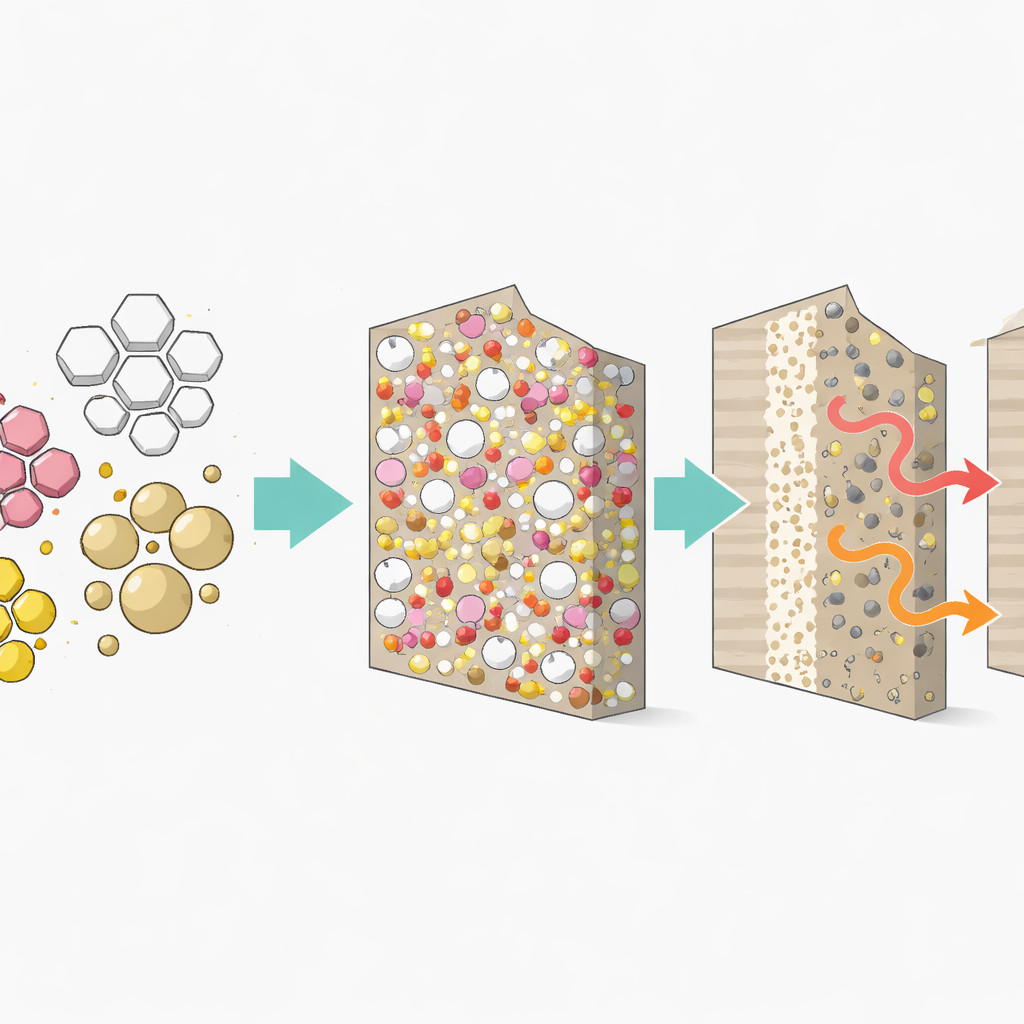
With the optimum binder identified, the team moved to a second phase: creating colored renders by mixing L40 with sand, limestone filler, a small amount of a water-retaining additive, and either green or yellow inorganic pigments. They varied the amount of binder and pigment and then measured how easily the fresh mortars spread, how fast they set, and how strong and porous they became after hardening. All of the colored mortars met the European standard EN 998‑1 for rendering mortars. A yellow-pigmented mix containing 35% L40 binder and 2% pigment (R35Y) emerged as particularly attractive: it combined adequate strength, good workability, and stable color, while using materials that are relatively inexpensive and readily available in Egypt.
Comfort, Adhesion, and Protection for Buildings
Beyond raw strength, the study examined properties that matter directly to building performance. The R35Y render showed lower thermal conductivity than a conventional white cement-based reference, thanks to its more porous structure, meaning it can help walls insulate better against heat flow. Its adhesion to typical substrates was comparable to that of the cement render, and its porosity allowed moisture to move through the coating rather than becoming trapped. These features are especially important for historic masonry, where rigid, dense cement renders can cause cracking, salt damage, and peeling over time.
What This Means for Future Construction
In simple terms, the authors demonstrate that a carefully tuned blend of low‑temperature calcined Egyptian clay and hydrated lime can stand in for traditional cement in decorative and protective wall coatings. The best formulations deliver enough strength, stick well to the underlying wall, help regulate moisture, and even improve insulation, all while using less energy and generating less CO₂ in production. While long‑term durability under harsh weather still needs to be fully tested, these clay–lime renders point toward a future where the colorful skins of our buildings contribute not just to appearance, but also to climate‑friendly, heritage‑sensitive construction.
Citation: Salama, K.S., Kishar, E.A., Ahmed, D.A. et al. The mechanical and microstructural characteristics of low-energy calcined clay from a high-Egyptian gray clay with hydrated lime for rendering mortar applications. Sci Rep 16, 7932 (2026). https://doi.org/10.1038/s41598-026-37982-1
Keywords: calcined clay, lime render, low carbon construction, colored mortars, historic building conservation