Clear Sky Science · en
Salivary AQP9 mRNA expression is associated with caries and periodontitis prevalence
Why spit can tell a story about your teeth
Most of us think of saliva as something we barely notice—until a trip to the dentist reveals new cavities or bleeding gums. This study suggests that our spit may quietly record early warning signs of two of the world’s most common dental problems: tooth decay (caries) and gum disease (periodontitis). By reading tiny genetic signals in saliva, the researchers explored whether a molecule called AQP9 could flag people at higher risk long before serious damage occurs. 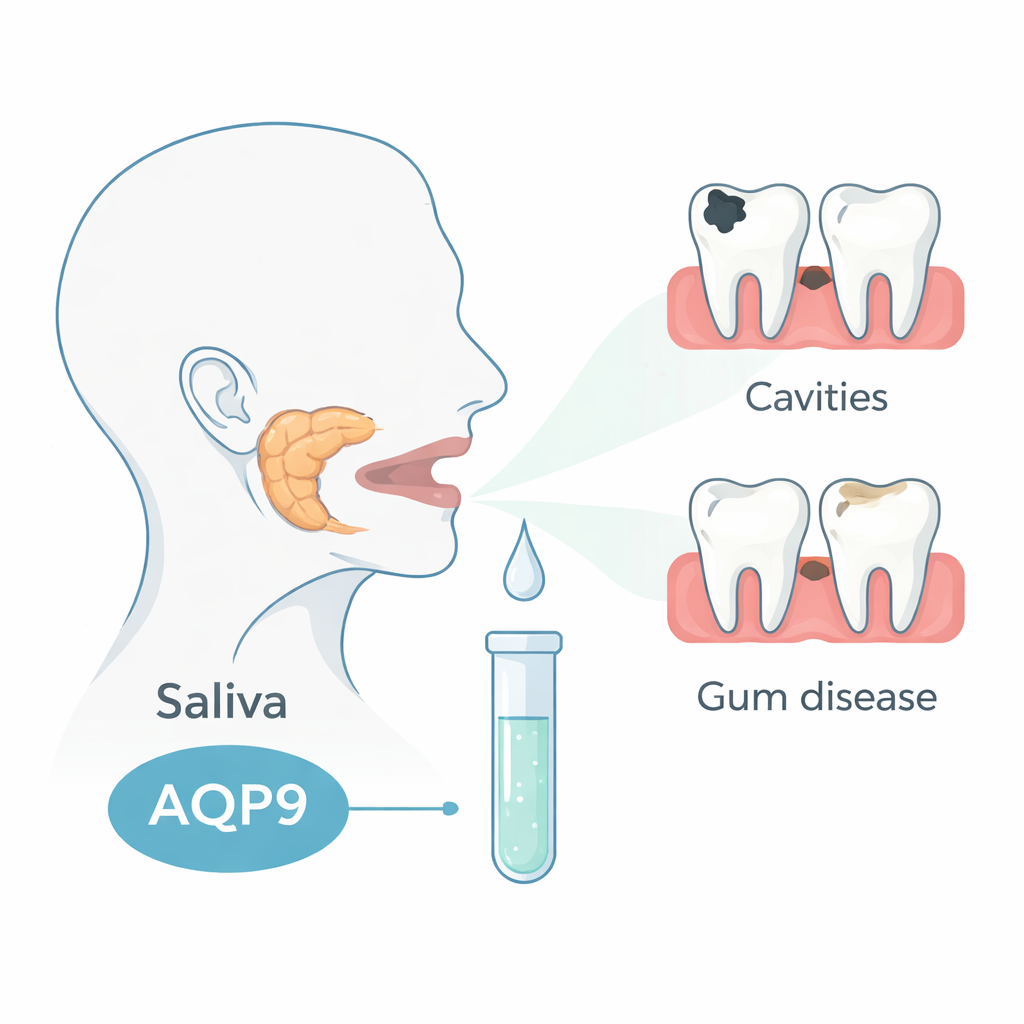
The hidden toll of common dental problems
Tooth decay and gum disease affect billions of people and often worsen with age. Cavities form when bacteria in dental plaque turn sugars into acids that slowly dissolve tooth enamel. Periodontitis starts with inflamed gums and can progress to bone loss and loose teeth. Brushing, flossing, and careful food choices help, but they do not fully protect everyone—especially older adults or people with other health issues. Dentists therefore need better ways to spot high-risk patients early, ideally using simple, noninvasive tests.
A tiny channel molecule with a big role
AQP9 belongs to a family of proteins called aquaporins, which sit in cell membranes and act like microscopic channels. They allow water and small molecules such as glycerol to pass in and out of cells. AQP9 is well studied in the liver and immune cells, but only recently has it been detected in human saliva. Because saliva constantly bathes the teeth and gums, the team suspected that levels of AQP9’s genetic blueprint—its mRNA—might change when the mouth is battling cavities or gum inflammation. If so, measuring AQP9 mRNA could give a quick snapshot of oral health.
Collecting samples and measuring signals
In the OKAPI study, 135 adult dental patients in Germany provided saliva samples before their treatment, after avoiding food and drink for at least half an hour. Dentists examined each person’s teeth and gums, assigning standard scores for total lifetime tooth damage (the DMFT index) and for gum health (the Periodontal Screening Index). The saliva samples were processed in the lab to extract RNA, which was converted into complementary DNA and analyzed using a sensitive technique called qRT-PCR. This allowed the researchers to quantify how much AQP9 mRNA was present relative to a reference gene in each sample.
Higher AQP9 goes with worse dental health
The results showed a clear pattern. People with severe caries—those with fifteen or more teeth affected by decay, fillings, or tooth loss—had higher AQP9 mRNA levels than those with milder caries. AQP9 levels also rose stepwise from mild to medium to severe caries categories. Likewise, individuals with periodontitis had higher salivary AQP9 expression than those without gum disease. Using statistical tools known as ROC curves, the team calculated threshold (“cut-off”) values of AQP9 that best separated severe from non-severe cases. Patients above the cut-off were several times more likely to have severe decay or periodontitis, even after taking other risk factors such as smoking, high blood pressure, and heart disease into account. Age still mattered, but AQP9 remained an important independent signal, especially for gum disease. 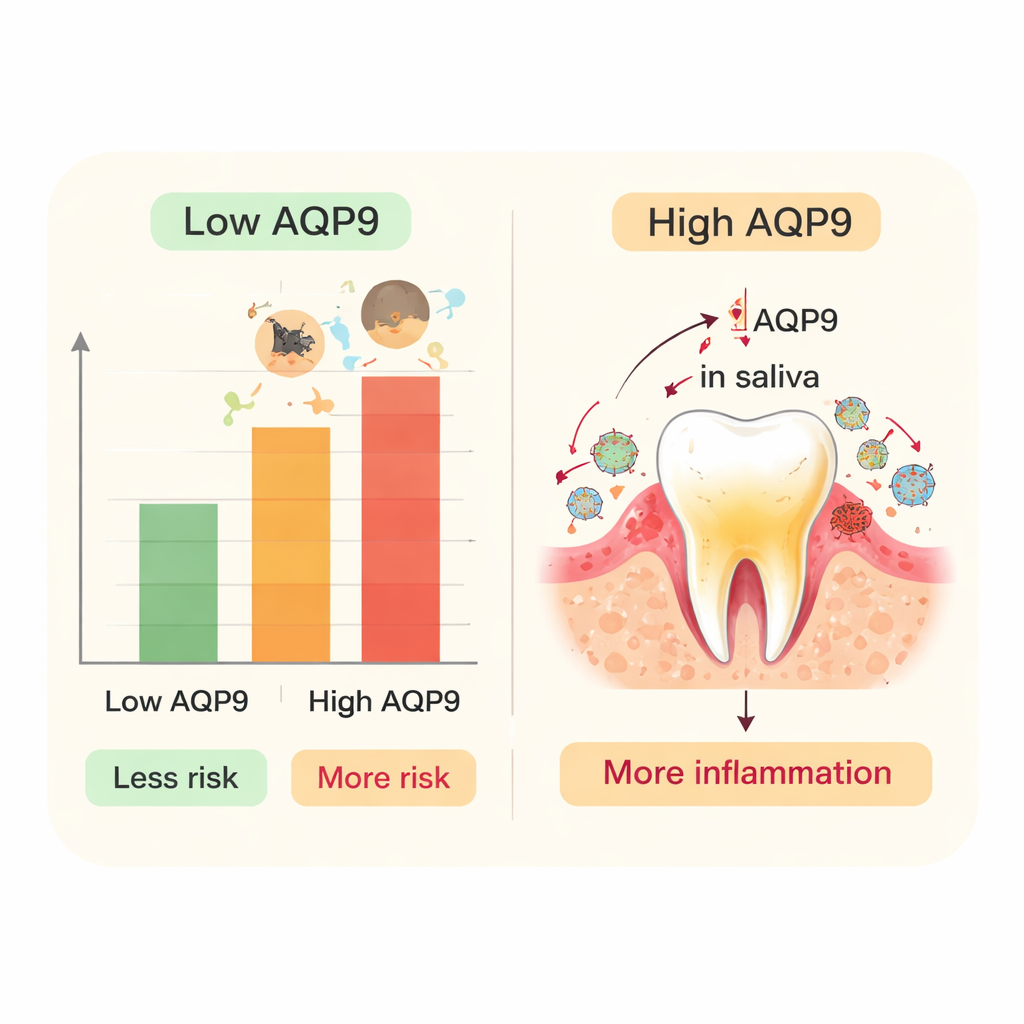
What this means for future check-ups
The authors caution that AQP9 alone cannot yet serve as a stand‑alone diagnostic test. Its accuracy is moderate, and the study only captured a single time point, so it cannot prove that AQP9 causes disease rather than simply reflecting it. Still, because saliva is easy and painless to collect, and because AQP9 mRNA can be measured reliably, this marker could be part of a future multi‑marker “saliva panel” to flag people at higher risk of cavities or periodontitis. For patients, the key message is that their spit may one day help dentists see trouble coming earlier, tailor prevention more precisely, and protect teeth and gums before lasting damage occurs.
Citation: Baumann, M., Rump, K., Ziehe, D. et al. Salivary AQP9 mRNA expression is associated with caries and periodontitis prevalence. Sci Rep 16, 6507 (2026). https://doi.org/10.1038/s41598-026-37980-3
Keywords: salivary biomarkers, dental caries, periodontitis, AQP9, oral health