Clear Sky Science · en
Assessment of saline-alkaline water quality and rice-crab co-culture improvement effects in the Songnen Plain
Turning bad water into better harvests
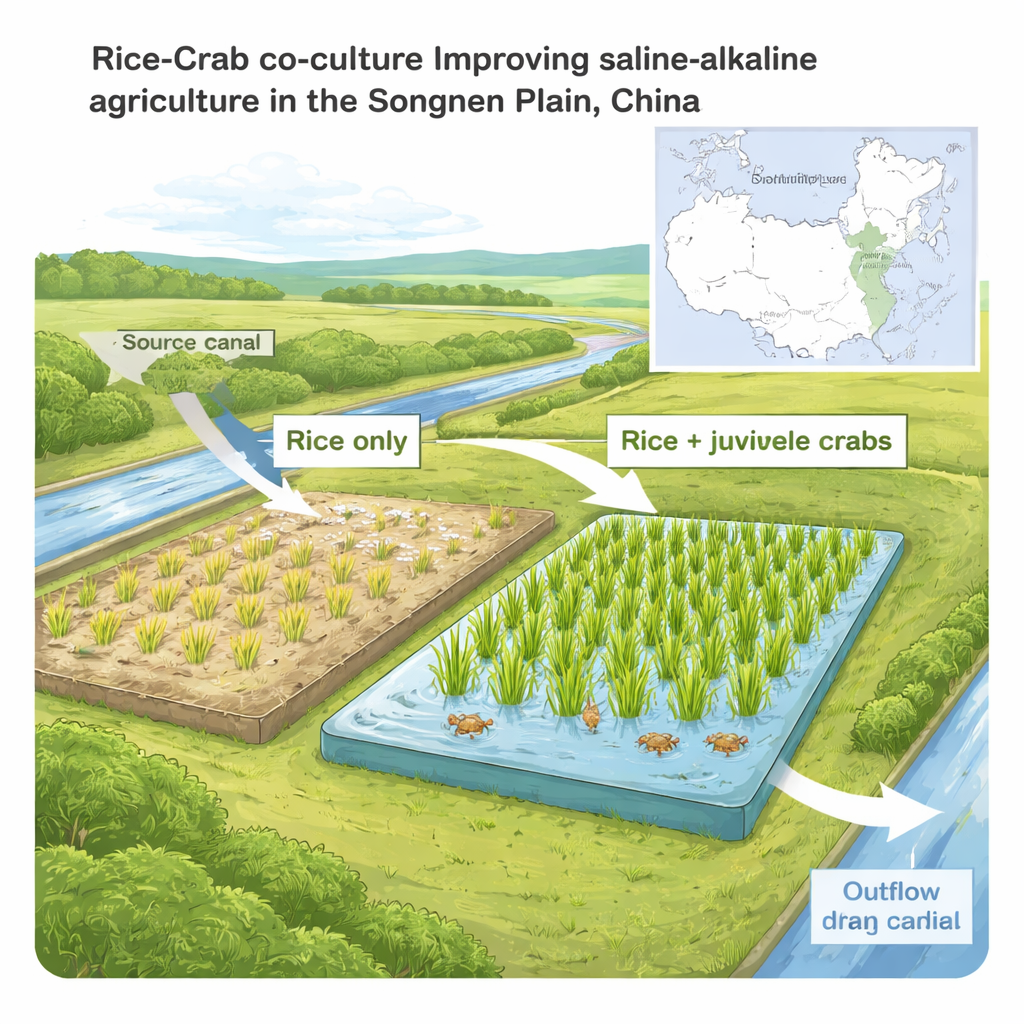
Across the world, farmers are being pushed onto tougher land as fresh water becomes scarce and soils degrade. In Northeast China’s Songnen Plain, fields are flooded with harsh, salty, and alkaline water that normally stunts crops. This study asks a surprising question with global relevance: can adding crabs to rice paddies help farmers turn this problematic water from a liability into a resource, boosting both harvests and income?
Farming on harsh, salty ground
The Songnen Plain is one of China’s key grain baskets, yet much of its land and water has become salty and alkaline over time. High evaporation, particular rock types, and decades of intensive use—such as irrigation without proper drainage and heavy fertilizer inputs—have turned many waters into a natural “soda solution,” rich in sodium and bicarbonate. When such water is used for irrigation, it can destroy soil structure, making it hard for water and air to move through the ground and for plant roots to grow. The authors show that nearly two-thirds of the water samples they collected fell into the most dangerous category for irrigation, with sodium levels two to almost five times above accepted safety thresholds.
Measuring what makes water risky
To understand just how hazardous this water is, the researchers went beyond simple measures like salt content and pH. They calculated a series of standard irrigation indices that describe how sodium, carbonate, magnesium, and other ions affect soil. These indicators, such as the sodium adsorption ratio and residual sodium carbonate, capture whether irrigation water will cause soil particles to break apart, clog pores, and create hard, crusted layers. They found that aquaculture ponds and drainage canals, in particular, contained extremely risky water across nearly all indices. Even many source waters, before entering fields, were only marginally suitable. In short, directly using most local water for farming is ecologically unsustainable unless something actively changes its chemistry or the way it interacts with soil.
Crabs as tiny soil engineers
That “something” may be crabs. The team compared conventional rice paddies with fields where rice was grown together with either juvenile or adult Chinese mitten crabs. They tracked water chemistry and soil-related indices throughout the growing season, from transplanting to harvest, and also measured rice and crab yields. The co-culture fields, especially those with juvenile crabs, consistently showed lower alkalinity, lower pH, and smaller total ion loads in the floodwater than rice-only fields. Key indicators of sodium stress improved as well: sodium-related hazard scores fell, soil permeability improved, and the share of sodium among all major ions dropped markedly. At the same time, rice yields rose by roughly 9–11 percent, and crab harvests added substantial extra income, boosting overall economic output by up to about 85 percent compared with rice alone.
How crabs may rewrite the chemistry
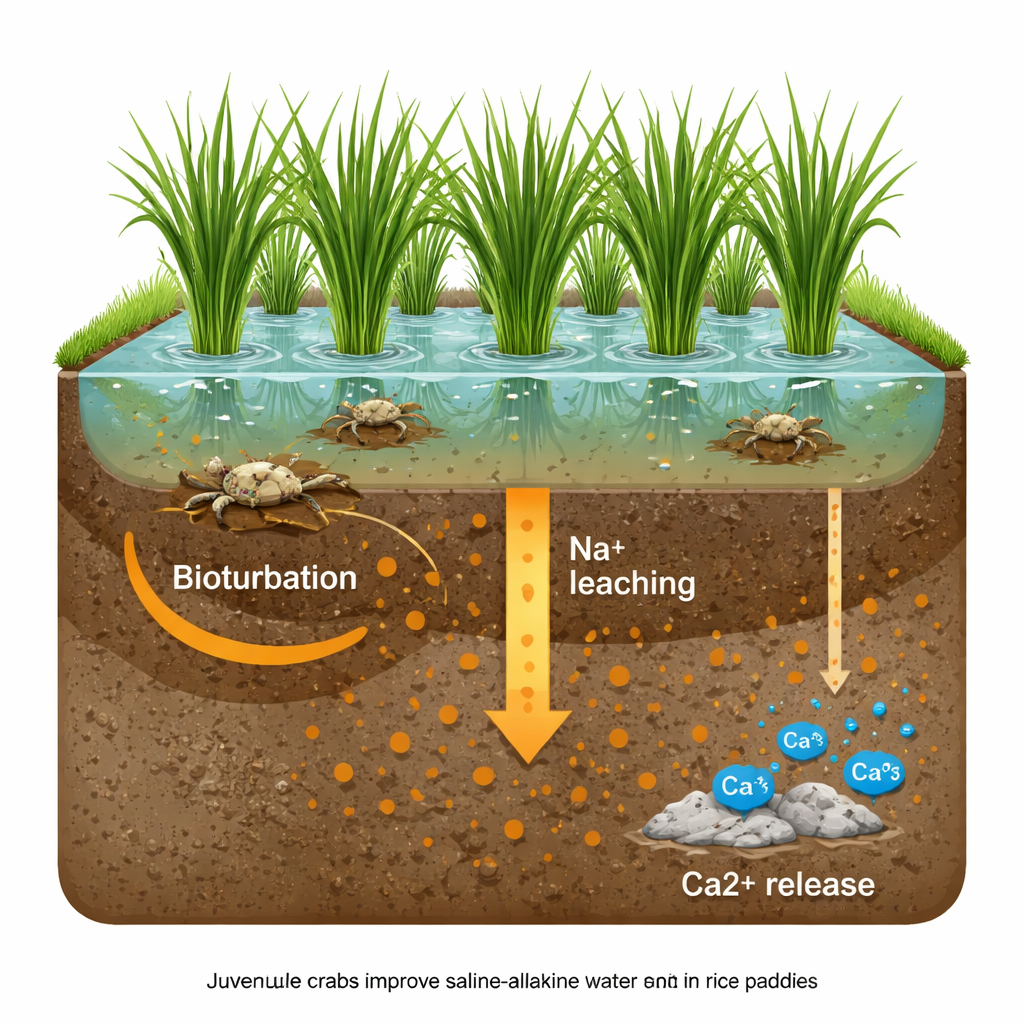
The study also offers an intriguing explanation for how crabs might be doing this. By burrowing and stirring the muddy bottom, crabs mix water and soil, speeding up the dissolution of carbonate minerals. This process releases calcium into the floodwater while forming more bicarbonate and carbonate ions. In many settings, a rise in a common water quality measure called residual sodium carbonate would be judged as a simple warning sign of worsening alkalinity. Here, however, the authors argue that a modest increase may signal something different: newly released calcium is trading places with sodium on soil particles, freeing the sodium to be washed away. This fits with their observation that, even as this index rose from negative to slightly positive values, sodium-related hazards and soil structure actually improved. Juvenile crabs, with higher activity and more intense burrowing per unit weight, appeared to enhance these effects more strongly than adults.
A nature-based tool for tough lands
For lay readers, the main message is that the right mix of plants and animals can help “heal” damaged land in ways that fertilizers and engineering alone may not achieve. In this case, young crabs in rice paddies helped transform extremely salty, alkaline water into a less harmful resource, while simultaneously raising food production and farm income. Although more controlled experiments are needed to confirm the exact mechanisms, rice–juvenile crab co-culture emerges as a promising, nature-based strategy for regions worldwide that struggle with saline and alkaline soils: a way to turn bad water into better harvests, and degraded fields into more productive, resilient landscapes.
Citation: Sun, Z., Ding, T., Sun, C. et al. Assessment of saline-alkaline water quality and rice-crab co-culture improvement effects in the Songnen Plain. Sci Rep 16, 7053 (2026). https://doi.org/10.1038/s41598-026-37967-0
Keywords: saline-alkaline soil, rice-crab co-culture, water quality, sustainable irrigation, Songnen Plain