Clear Sky Science · en
Sampled-data fuzzy $$H_\infty$$ estimators for control of nonlinear parabolic partial differential equations
Keeping Complex Systems Steady
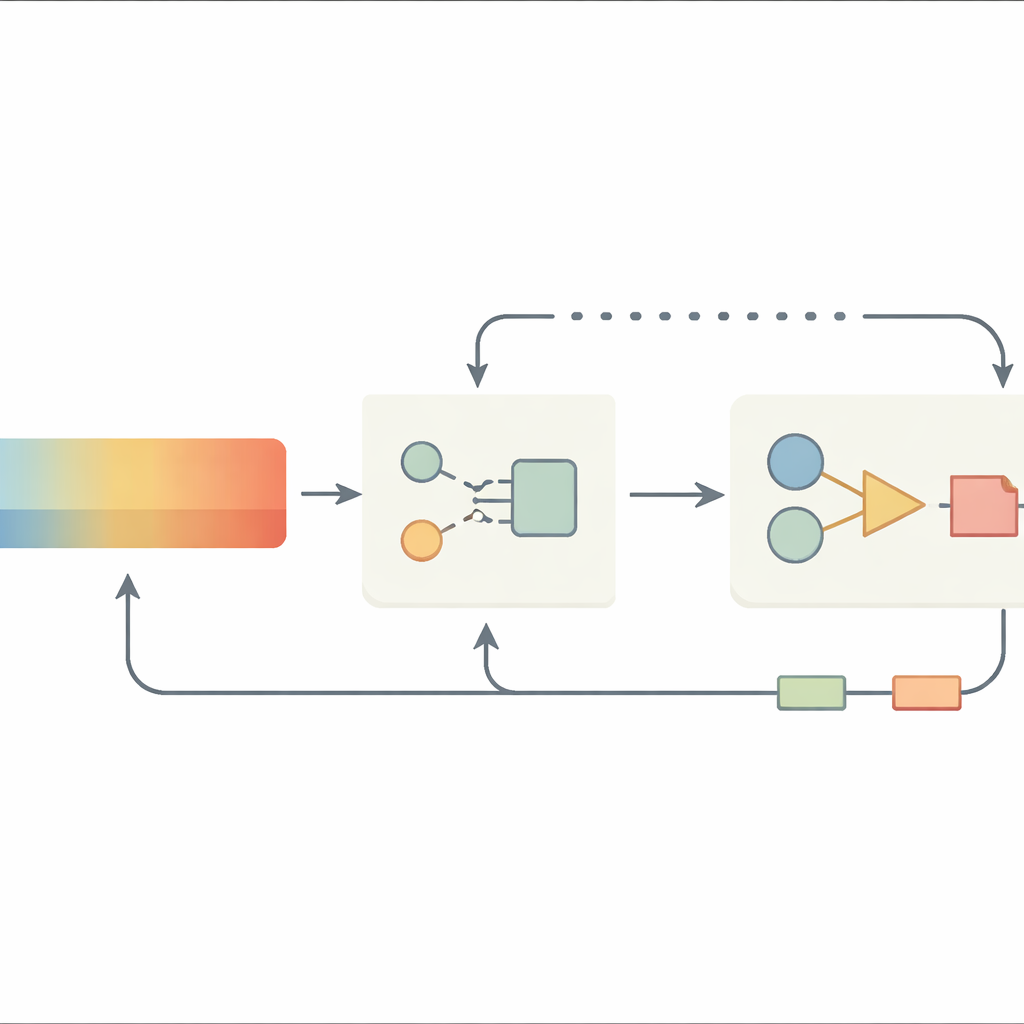
Many physical and biological systems—such as heat flow in a metal rod, the spread of chemicals in a reaction, or signals traveling through tissue—change both over time and across space. These systems can be hard to keep stable, especially when real-world noise and disturbances are present. This paper presents a new way to design digital controllers that keep such systems steady and resistant to disturbances, while still being practical enough to implement on modern computers and microcontrollers.
Why Space and Time Both Matter
In everyday control problems, engineers often model a system with ordinary differential equations, where variables depend only on time. But many important phenomena—from temperature in a furnace to chemical concentrations in a reactor—also depend on position. These are better described by partial differential equations, which track how quantities evolve in both space and time. Such models are powerful but mathematically demanding, especially when the underlying behavior is nonlinear and influenced by random disturbances and measurement noise.
From Fuzzy Rules to a Manageable Model
To tame this complexity, the authors use a fuzzy modeling framework known as the Takagi–Sugeno (T–S) approach. Instead of working directly with a single complicated nonlinear equation, they approximate the system by smoothly blending several simpler linear models, each valid in a local region of operation. These pieces are linked through fuzzy “if–then” rules, turning an unwieldy nonlinear partial differential system into a structured family of linear ones. The researchers carefully account for the small errors introduced by this approximation, ensuring that these do not undermine stability or performance.
Digital Control That Samples in Time
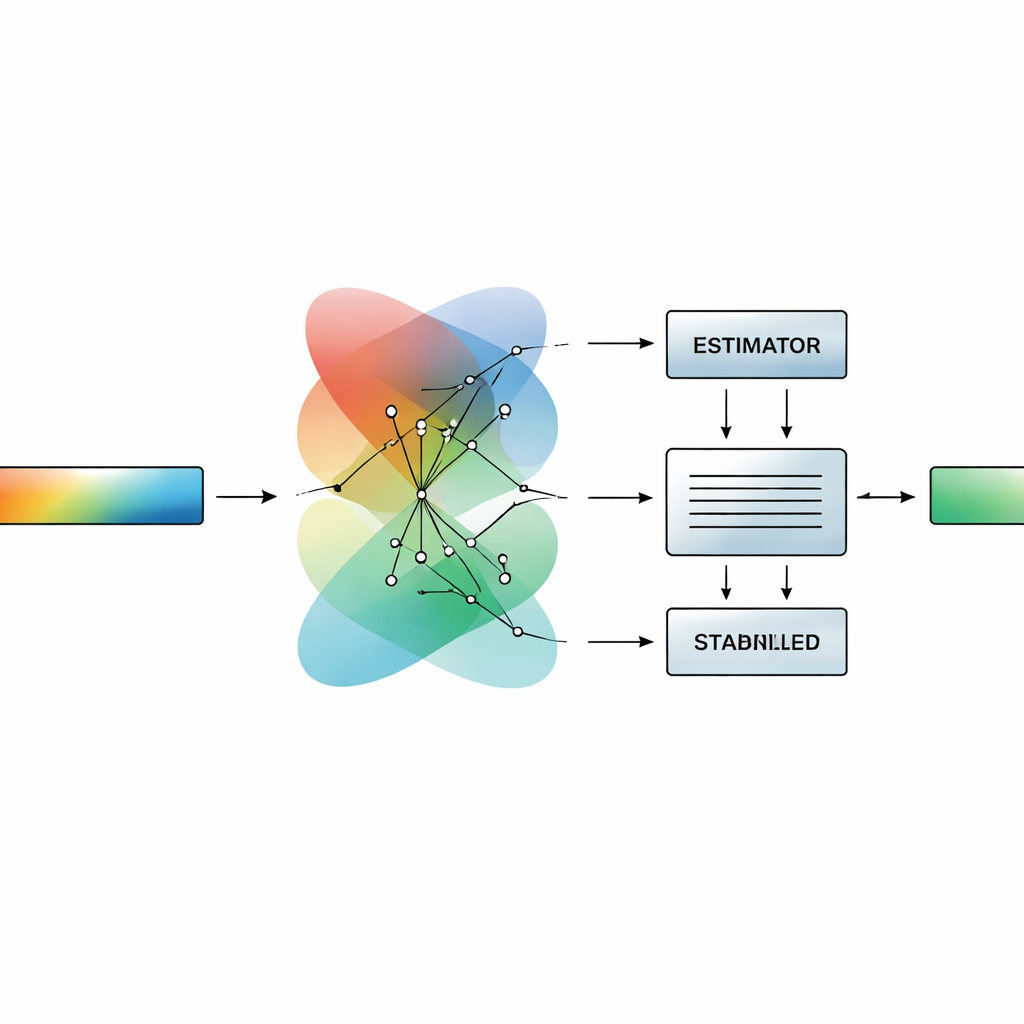
Modern controllers are usually implemented on digital hardware, which updates control actions at discrete time instants rather than continuously. This “sampled-data” behavior can itself introduce challenges, such as delays and abrupt changes between updates. The paper designs a controller that explicitly respects this sampled nature. It relies on an estimator, which reconstructs the internal state of the distributed system from noisy measurements, and a fuzzy feedback law that computes the control input at each sampling instant. By treating the effect of sampling as a time delay in the control channel, the authors build a mathematical framework that captures how these digital updates interact with the spatially distributed dynamics.
Guaranteeing Robust Performance
Real systems are never perfectly quiet: external disturbances, sensor noise and modeling uncertainties can all degrade performance. To address this, the authors adopt an H-infinity style performance measure, which asks the controller to keep the impact of disturbances below a prescribed level for all allowable noise signals. Using modern tools from stability theory—such as Lyapunov functionals, integral inequalities and a formula that handles diffusion terms—they derive conditions under which the closed-loop system is not only stable over time but also robust to disturbances. Crucially, they express these conditions as linear matrix inequalities, a standard optimization format that can be efficiently checked and solved with off-the-shelf software like MATLAB’s LMI toolbox.
Testing the Method on an Oscillating Chemical Reaction
To show that the theory works beyond pencil-and-paper math, the authors apply their method to the Belousov–Zhabotinsky reaction, a classic oscillating chemical system whose waves resemble those found in biological tissues such as the heart. They model the reaction as a spatially distributed process, then design a sampled-data fuzzy estimator and controller using their proposed criteria. Numerical simulations demonstrate that the controller drives the system toward a stable behavior, both without disturbances and in the presence of sizeable external noise. The method also outperforms several earlier approaches in terms of the disturbance level it can tolerate while maintaining stability.
What This Means in Practice
In plain terms, this work shows how to design a digital controller that can reliably stabilize complex processes spread out in space, even when the system is nonlinear and affected by noise. By combining fuzzy modeling, an estimator to reconstruct hidden states, and a robust performance measure, the authors provide a recipe that engineers can implement using standard numerical tools. This opens the door to more reliable control of processes ranging from chemical reactors to advanced thermal and biological systems, all with controllers that run efficiently on modern digital hardware.
Citation: Sivakumar, M., Dharani, S. & Cao, J. Sampled-data fuzzy \(H_\infty\) estimators for control of nonlinear parabolic partial differential equations. Sci Rep 16, 9010 (2026). https://doi.org/10.1038/s41598-026-37959-0
Keywords: fuzzy control, sampled-data systems, distributed parameter systems, robust stabilization, Belousov–Zhabotinsky reaction