Clear Sky Science · en
Position prediction from performance and anthropometric indicators in young footballers: a machine learning approach
Why picking the right spot on the pitch matters
For any teenager dreaming of a pro football career, finding the position that best fits their body and skills can make a big difference. Coaches usually rely on experience and instinct to decide who plays in defence, midfield, or up front. This study asks whether data and computer algorithms can add an objective layer to those choices by using measurable traits—such as height, weight, and ball skills—to predict where a young player is most likely to succeed. 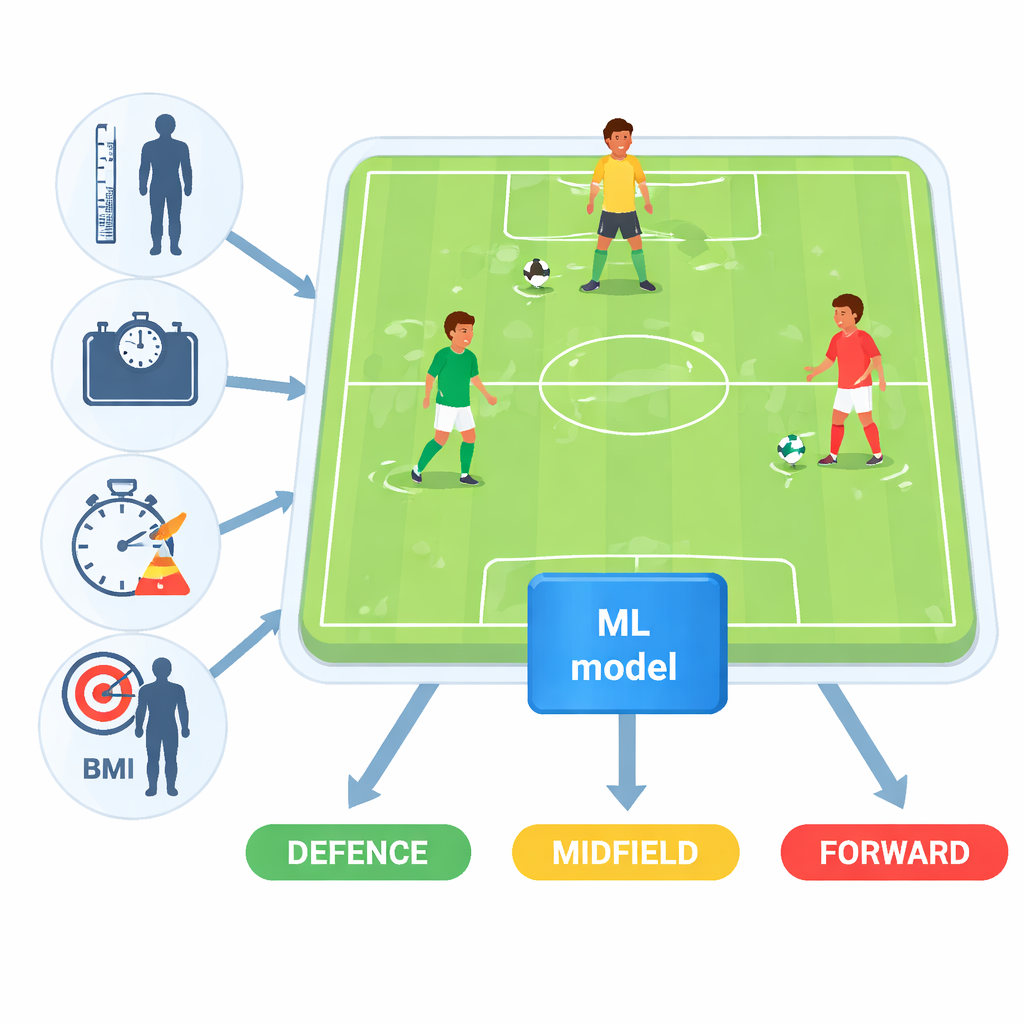
From basic body data to ball skills
The researchers worked with 200 male youth footballers aged 15 to 17 from clubs in Kazakhstan. Each player was already assigned a main position—defender, midfielder, or forward—by their coach. The scientists measured simple body characteristics such as age, height, weight, and body mass index (BMI), alongside football-specific skills: juggling the ball with the head and feet, weaving through cones while dribbling, sprint-dribbling over 20 meters, and shooting at marked targets in the goal. These tests were chosen because they reflect everyday actions on the pitch—controlling the ball, moving quickly with it, and finishing attacks.
Spotting patterns between positions
First, the team used standard statistical tests to see how defenders, midfielders, and forwards differed on average. They found meaningful differences in several areas. Midfielders tended to be slightly older than defenders. Forwards were generally taller and had lower BMI than both defenders and midfielders, suggesting a leaner build. Forwards also juggled the ball with their head more effectively and completed the cone dribbling test faster than defenders. Surprisingly, there were no clear differences in basic weight, foot juggling, shooting scores, or the simple 20-meter dribbling time across positions, hinting that some skills may develop similarly regardless of where a young player lines up.
Letting machines guess each player’s role
Next, the researchers turned to machine learning—computer programs that learn patterns from data. They fed all the body and skill measurements into several algorithms and asked them to predict each player’s position. After training on most of the data and testing on the rest, one method, called Support Vector Machines, stood out. It predicted the correct position for 86% of players overall. The model was especially accurate for forwards, getting every forward right in the test data. It did slightly less well for defenders and midfielders, which were sometimes confused with each other, reflecting their overlapping physical and technical profiles in this age group. 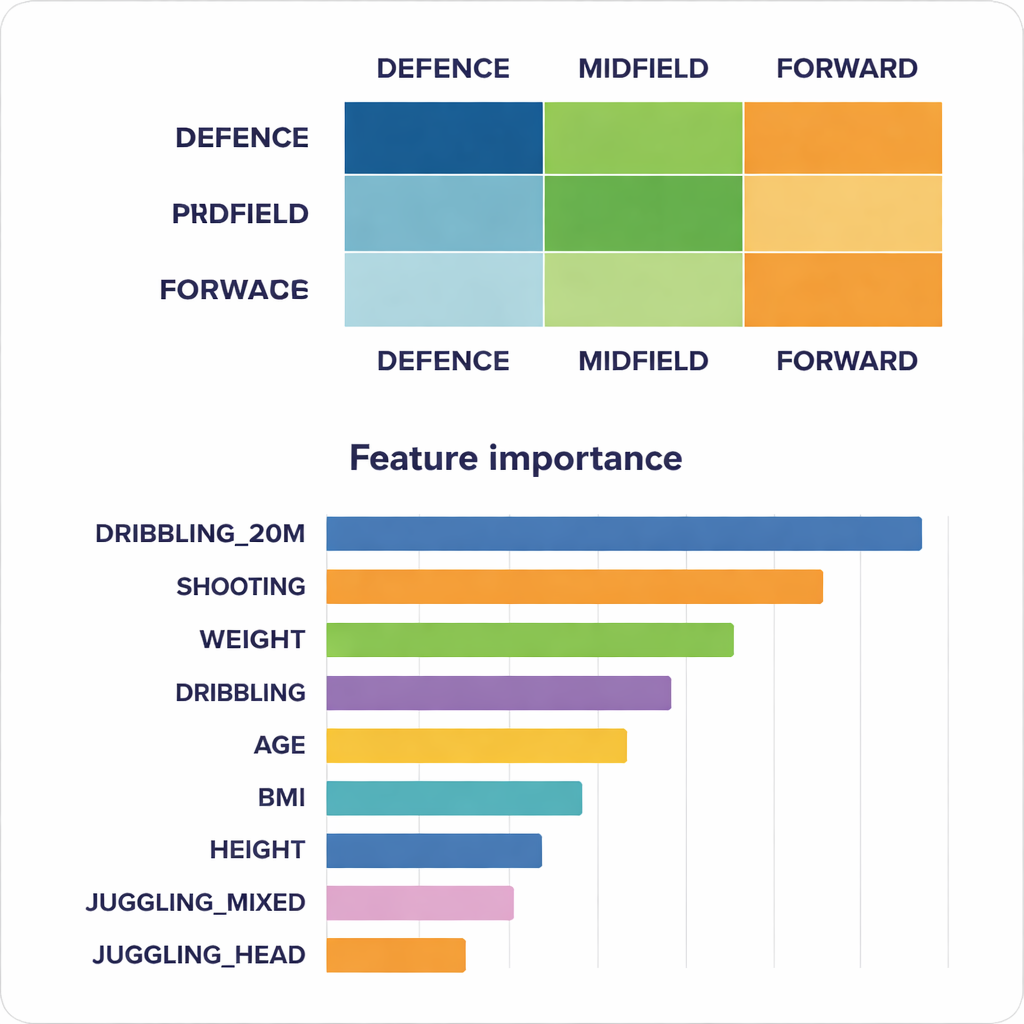
Which abilities mattered most
To understand what drove the model’s decisions, the team tested how much accuracy dropped when each measurement was scrambled. The biggest hits came from performance related to speed with the ball and finishing: the 20-meter dribbling time, shooting score, body weight, and general dribbling test were the most influential. In contrast, juggling the ball—for example, repeatedly bouncing it off the head or mixing head and foot touches—mattered far less to predicting position. This suggests that, at least for these teenagers, practical match-like skills such as sprinting with the ball and taking accurate shots carry more positional information than showy control drills.
What this means for young players and coaches
For parents, players, and coaches, the study shows that relatively simple tests can provide useful signals about where a teenager might fit best on the pitch, and that machine learning can turn those signals into reasonably accurate position predictions. However, the overlap between defenders and midfielders, and the fact that many abilities are still developing at ages 15 to 17, means numbers should complement, not replace, a coach’s eye and a player’s preferences. The main takeaway is that data-driven tools can help guide early positional choices—especially for clearly distinct roles like forward—but they work best when combined with broader assessments of game sense, decision-making, and tactical understanding.
Citation: Izhanov, Z., Seisenbekov, Y., Marchibayeva, U. et al. Position prediction from performance and anthropometric indicators in young footballers: a machine learning approach. Sci Rep 16, 6766 (2026). https://doi.org/10.1038/s41598-026-37957-2
Keywords: youth football, playing position, machine learning, performance testing, talent identification