Clear Sky Science · en
Changes in retinal oxygen saturation before and after femtosecond LASIK in adult myopic individuals with anisometropia
Why the oxygen in your eyes matters
Laser eye surgery such as LASIK is now a routine way to correct blurry distance vision caused by myopia, or nearsightedness. But myopia is more than an inconvenience; as the eye grows longer, the delicate retina at the back of the eye stretches and can become fragile. This study asked a deceptively simple question with big implications: after we correct vision with modern laser surgery, how well does the retina still receive oxygen, the fuel it needs to stay healthy?
Looking at unequal eyes for clear answers
To untangle this puzzle, researchers focused on adults with anisometropia, a condition where one eye is more nearsighted than the other. This natural difference let the team compare a “less myopic” eye with a “more myopic” partner in the same person, removing many individual differences in health and lifestyle. All 196 participants underwent femtosecond LASIK, a precise form of laser eye surgery that reshapes the cornea at the front of the eye. Before surgery and again one month later, the scientists measured vision, eye pressure, eye length, corneal thickness, and most importantly, the oxygen saturation in retinal arteries and veins using a specialized retinal camera.
What changed after laser vision correction
As expected, LASIK greatly improved vision in both eyes, bringing their prescriptions close to zero so that glasses were no longer needed. However, the oxygen story was more subtle. Even before surgery, the less myopic eyes had slightly higher levels of oxygen in their retinal arteries than the more myopic eyes. After LASIK, when the focusing power of both eyes had been equalized, this difference persisted: the more myopic eyes still showed lower arterial oxygen saturation. Overall, across all eyes, average retinal arterial oxygen levels dropped a little after surgery, while venous oxygen and the difference between arteries and veins stayed about the same.
Longer eyes, less oxygen
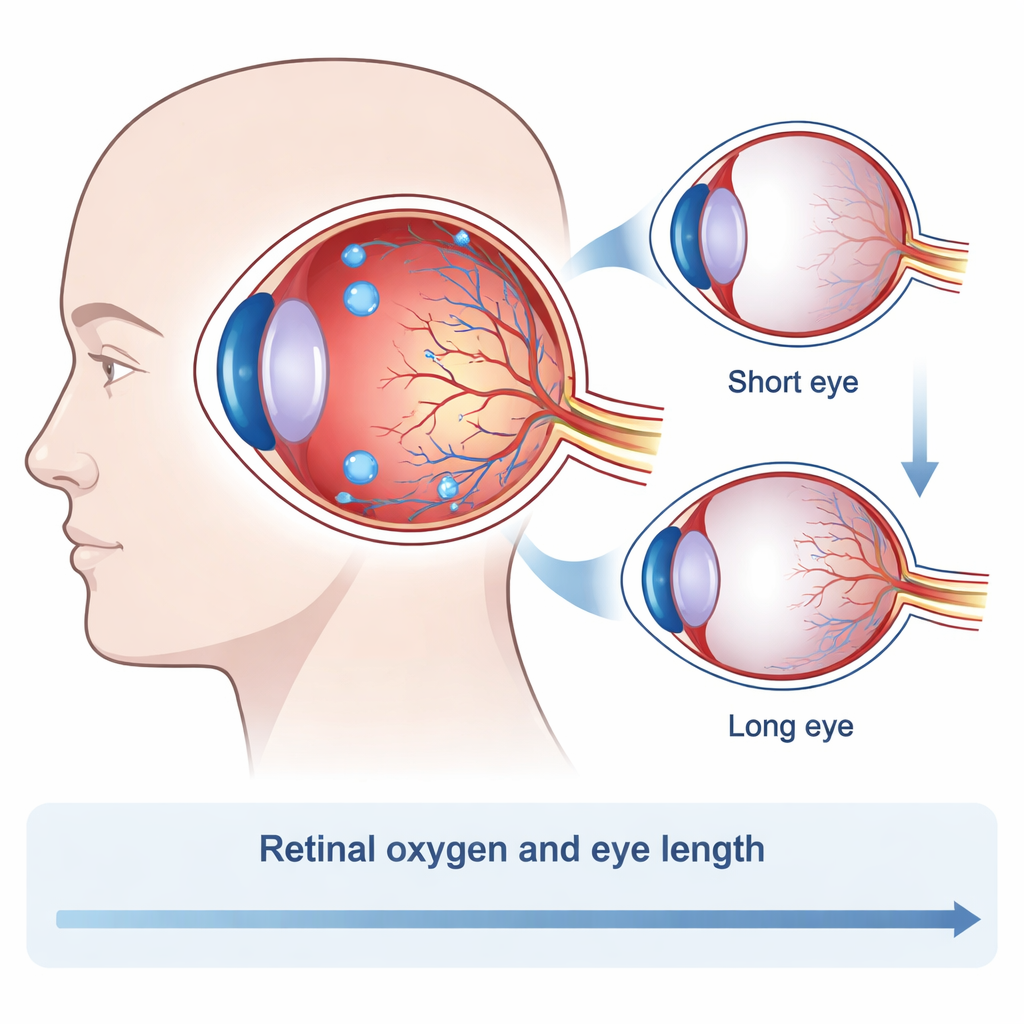
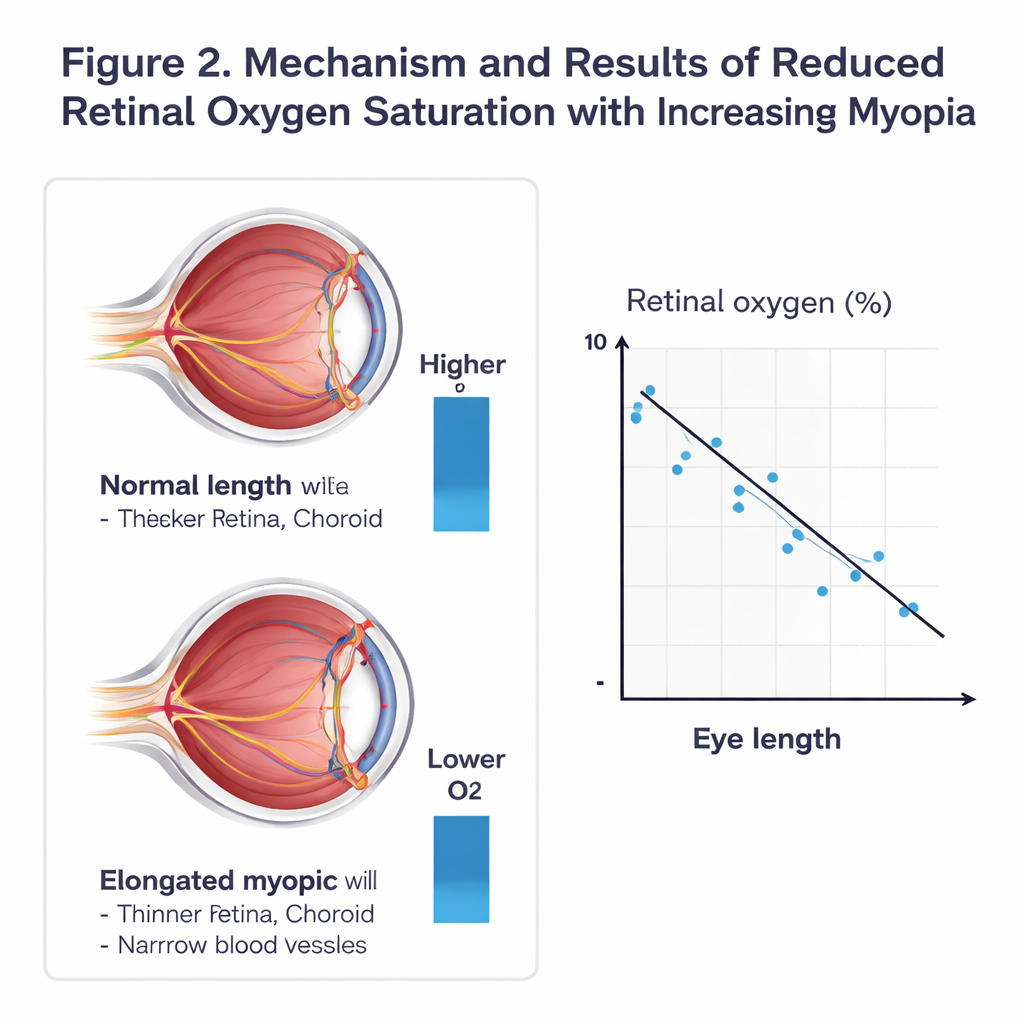
To see what lay behind these patterns, the team examined how retinal oxygen related to the physical length of the eye, known as axial length. They found a clear trend: longer eyes tended to have lower retinal arterial oxygen saturation, even after accounting for age, eye pressure, corneal thickness, and corneal curvature. In other words, once the optical effects of refractive error and magnification were stripped away by LASIK, the association between greater eye length and lower retinal oxygen remained. This suggests that the structure of the myopic eye itself, rather than just the way doctors measure it, plays a key role in how much oxygen reaches the retina.
What might be happening inside the myopic eye
The authors propose that as myopia worsens and the eye stretches, the retina and underlying blood layers thin and undergo slow degenerative changes. With fewer active cells and altered blood vessels, the tissue may simply consume less oxygen, leading to lower measured saturation in the arteries. Narrower vessels and longer light paths in elongated eyes may also influence how oxygen meters read these values. Previous work in children has shown a different pattern, with higher retinal oxygen levels acting as a possible compensation for reduced blood flow. In adults, by contrast, long-standing myopia appears to shift the retina toward lower demand and lower oxygen use.
What this means for people with myopia
For patients and clinicians, the message is reassuring but cautionary. Laser surgery effectively clears the visual blur of myopia, yet it does not erase the deeper changes that come with a long, stretched eye. This study shows that even after vision is corrected, more myopic eyes tend to run on lower retinal oxygen. That finding helps explain why high myopia carries a higher risk of retinal problems later in life and underscores the importance of monitoring the back of the eye, not just the prescription. Understanding how eye length and oxygen supply interact may guide future strategies to prevent or slow myopia and protect retinal health in the growing number of people who choose surgical vision correction.
Citation: Ge, S., Ma, X., Zhou, X. et al. Changes in retinal oxygen saturation before and after femtosecond LASIK in adult myopic individuals with anisometropia. Sci Rep 16, 7426 (2026). https://doi.org/10.1038/s41598-026-37955-4
Keywords: myopia, LASIK, retinal oxygen, anisometropia, axial length