Clear Sky Science · en
Genome wide identification and expression analysis of gibberellin oxidase family genes in sweet potato and its two diploid relatives
Why Sweet Potatoes Grow the Way They Do
Sweet potatoes feed hundreds of millions of people, yet we still know surprisingly little about the genes that decide how long their vines grow, how big their storage roots become, and how well they cope with drought or salty soil. This study digs into a key set of genes that manage a powerful group of plant hormones and shows how they may be tuned to breed sweeter harvests with shorter vines and stronger stress resilience.
The Plant Hormones Behind Growth
Plants rely on chemical messengers called hormones to decide when to sprout, stretch, flower, and store energy. One major hormone group, gibberellins, acts a bit like a growth accelerator, promoting stem elongation and helping plants shift from juvenile to adult stages. Only a few forms of gibberellin are truly active; the rest are precursors or switched-off versions. Enzymes known as gibberellin oxidases are the plant’s internal mechanics for turning these hormones on and off, carefully controlling how fast tissues grow, which organs expand, and how the plant reacts when conditions turn harsh.
Tracking Key Genes Across Sweet Potato Relatives
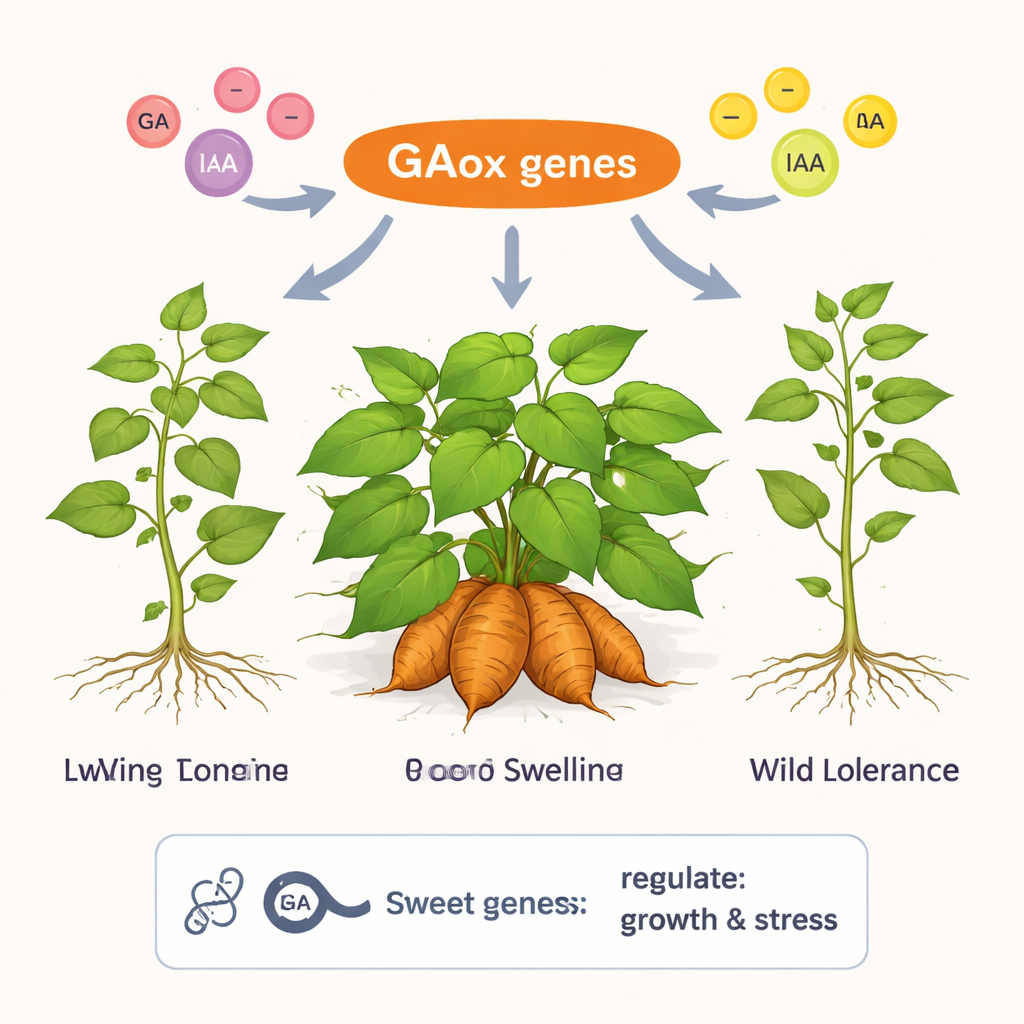
The researchers scanned the genomes of cultivated sweet potato and its two closest wild relatives to catalog all genes belonging to the gibberellin oxidase family. They identified 71 such genes in total, split among three main enzyme types that either activate gibberellins or break them down. Surprisingly, despite sweet potato having a much larger, more complex genome than its diploid relatives, it does not carry more of these genes. This suggests that over evolutionary time the crop shed extra copies and kept a streamlined, “core” toolkit, rather than endlessly multiplying gene copies as many other polyploid crops have done.
Built-In Switches for Hormones and Stress
Looking more closely, the team found that these genes fall into four clear groups, each with its own combination of short protein motifs—recurring sequence patterns that often mark specific functions. Promoter regions, the DNA “switchboards” just ahead of each gene, were packed with control elements tied to many hormones, including gibberellin itself, auxin, abscisic acid, and jasmonate, as well as tags that sense cold, salt, and water shortage. This wiring means the same gene family can help coordinate growth with changing weather and shifting hormone levels, rather than acting in isolation.
From Thin Roots to Plump Storage Organs
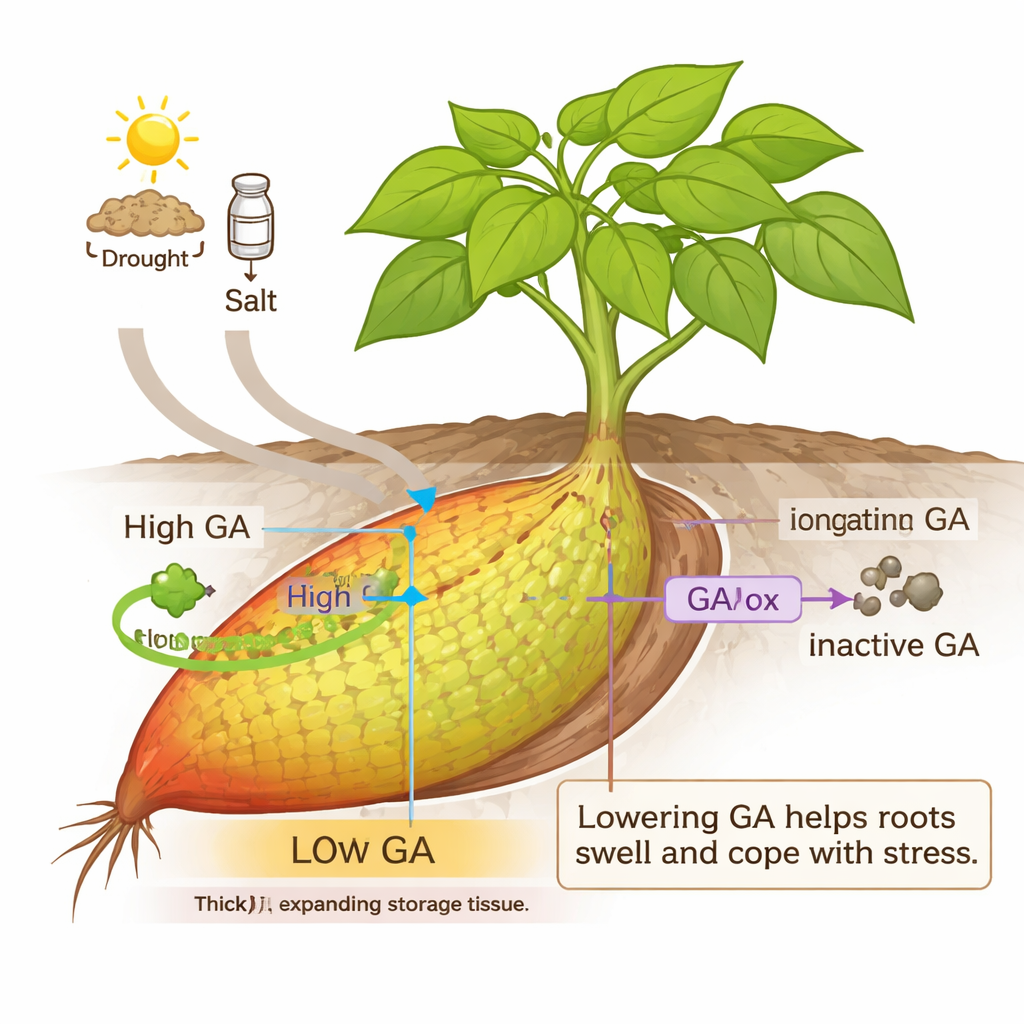
To see what the genes actually do in the plant, the authors measured their activity in stems, leaves, buds, and different root types, and under sprays of several plant hormones or simulated drought and salt stress. Most genes showed strong preferences for particular organs or conditions. One standout, called ibGA2ox10, was expressed far more strongly in swelling storage roots than in thin fibrous roots or above-ground tissues. Because this gene helps deactivate growth-promoting gibberellins, its high activity suggests it helps create a low-growth, high-storage environment that favors radial thickening and starch buildup—the very process that turns a root into the familiar plump sweet potato.
Balancing Growth, Chemicals, and Hard Times
The study also charted how these genes rise and fall together, revealing tight co-expression networks. Under treatments with gibberellin and auxin, genes that make active hormone and genes that break it down often increased in concert, hinting that the plant aims for rapid turnover rather than a simple on/off switch. Under drought- and salt-like conditions, genes that promote gibberellin production surged briefly before dropping, while others showed the opposite trend. This pattern points to an early attempt to keep growing or prepare defenses, followed by a strategic slowdown that conserves resources once stress persists.
What This Means for Future Harvests
In everyday terms, this research maps the hormone knobs and dials that let sweet potato plants shift between stretching their vines, fattening their roots, and hunkering down under bad weather. By pinpointing key players, such as ibGA2ox10 for root swelling or specific genes linked to drought and salt responses, breeders and biotechnologists gain potential targets for creating varieties with shorter vines, larger and more uniform storage roots, and less reliance on chemical growth regulators. The work does not yet deliver new cultivars, but it provides a detailed blueprint of the growth-control machinery that future efforts can tweak for more resilient and productive sweet potato crops.
Citation: Zhang, S., Cao, Y., Yan, H. et al. Genome wide identification and expression analysis of gibberellin oxidase family genes in sweet potato and its two diploid relatives. Sci Rep 16, 6882 (2026). https://doi.org/10.1038/s41598-026-37951-8
Keywords: sweet potato, plant hormones, gibberellin genes, root development, drought tolerance