Clear Sky Science · en
Submarine groundwater discharge and associated fluxes along the Kanyakumari coast of India using radon and nutrient mass balance approach
Hidden Freshwater Beneath the Waves
Along many coasts, including the southern tip of India, huge amounts of freshwater quietly leak into the sea through the seabed. This invisible flow, called submarine groundwater discharge, can carry life‑supporting nutrients—but also pollution—from land to ocean. The study behind this article focuses on the Kanyakumari coast, where the Arabian Sea meets the Indian Ocean, and shows how tracking a naturally occurring gas in water helps reveal where this hidden flow happens, how strong it is, and what it means for coastal ecosystems and local water security.
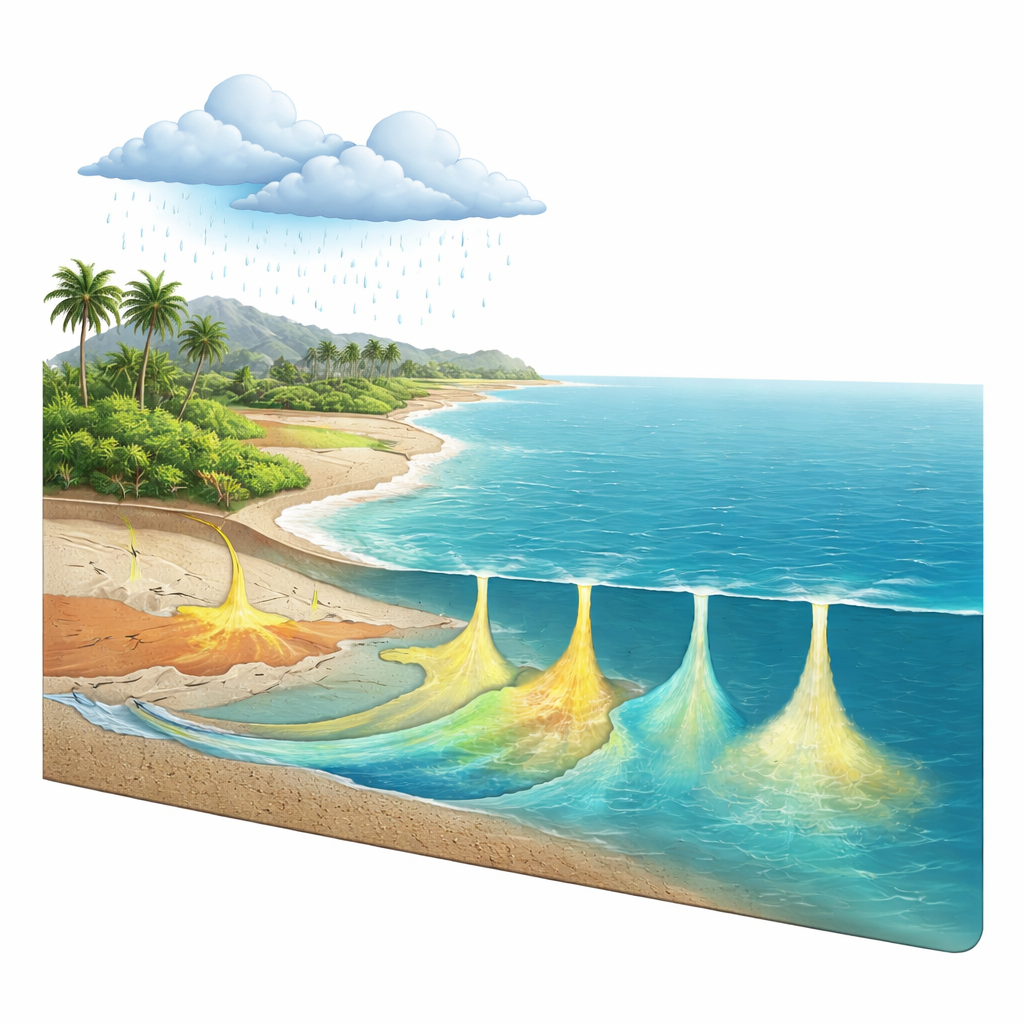
A Coast Where Three Seas Meet
The Kanyakumari district, at the southernmost tip of India, combines rocky headlands, sandy beaches, and rich estuaries backed by rivers and wetlands. It receives heavy seasonal rains from both the southwest and northeast monsoons, which recharge underground aquifers. Beneath the surface, layers of weathered rock, sand, and clay store groundwater that is tapped for drinking and irrigation. But some of this water never reaches wells or rivers; instead, it seeps directly into the sea through porous coastal sediments. Because this exchange happens out of sight, understanding it is crucial for a region that already faces groundwater scarcity, saltwater intrusion, and growing pollution from farming, sewage, and industry.
Using a Natural Gas as a Tracker
To measure the hidden flow of groundwater into the sea, the researchers used radon‑222, a radioactive gas that forms naturally in rocks and soil. Groundwater picks up radon as it moves through underground minerals, so it typically contains far more radon than surface seawater. By collecting water from inland wells and from porewater in beach sands during both high and low tides, and before and after the monsoon season, the team measured radon levels along with basic water chemistry and key nutrients. They then applied a radon "mass balance"—a bookkeeping exercise that weighs all radon sources and losses—to estimate how much groundwater must be seeping into coastal waters to explain the observed concentrations.
Seasonal Pulses of Groundwater and Nutrients
The measurements revealed that radon in groundwater was one to two orders of magnitude higher than in nearby seawater, confirming that seepage from below is the main source of radon along this coast. Using the mass‑balance approach, the team found that submarine groundwater discharge varied from about 0.01 to nearly 1 cubic meter per square meter of seabed each day, with higher values after the monsoon rains. Post‑monsoon recharge raises groundwater levels and pressure, which pushes more water out to sea. At the same time, the chemistry showed that areas with high radon but low salt content mark fresher groundwater inputs, while high salt and lower radon indicate zones where seawater is simply circulating in and out of the seabed.
Food for Life—and Fuel for Blooms
Along with radon, the researchers tracked dissolved forms of nitrogen, phosphorus, and silica—nutrients that feed marine life. They found that these nutrients are generally more concentrated in groundwater than in surface seawater, and that their delivery to the ocean through groundwater changes with the seasons. Before the monsoon, when dilution is lower, groundwater carried relatively more dissolved nitrogen and silica, raising the risk that these inputs could help trigger algal blooms or low‑oxygen conditions in nearshore waters. After the monsoon, stronger groundwater flow coincided with more dilution, so nutrient concentrations in the discharging water were lower even though the total water flux was higher.
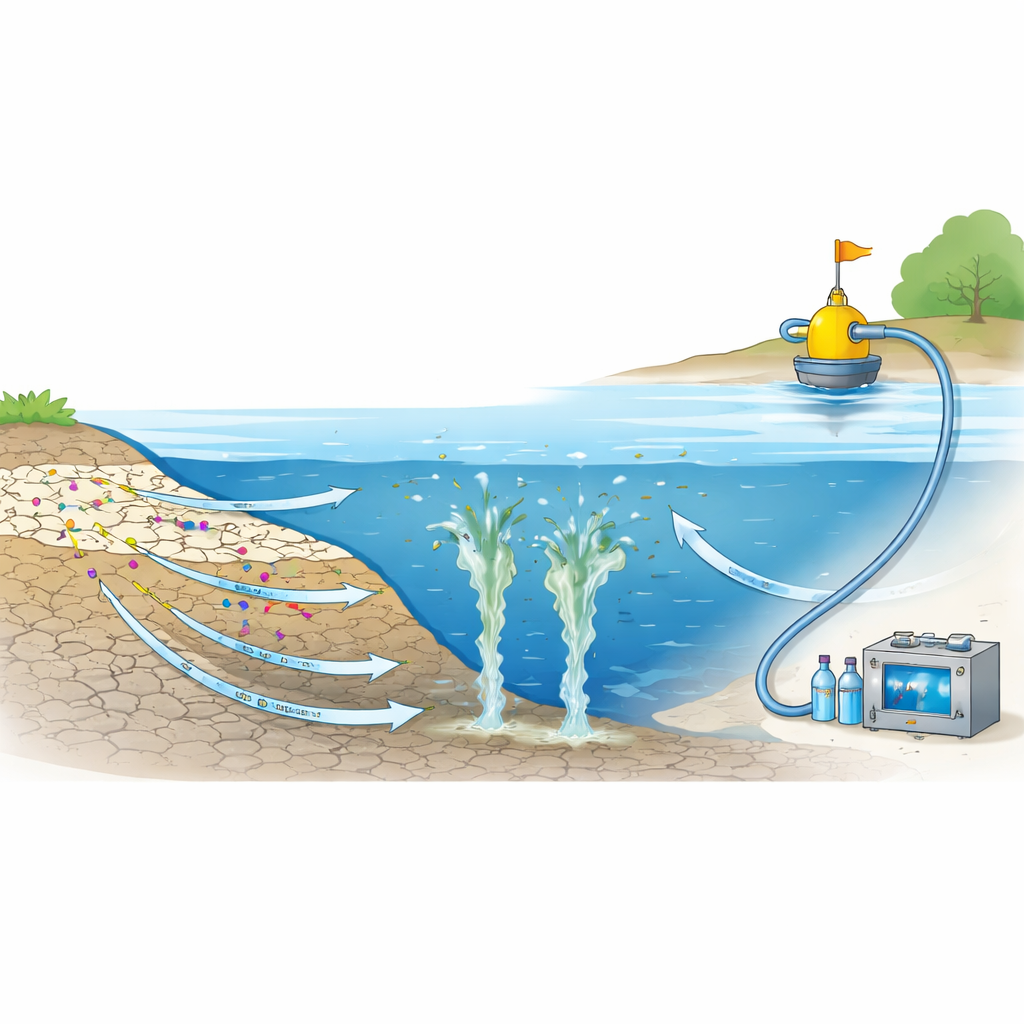
What This Means for Coasts and Communities
In simple terms, this study shows that the seafloor along the Kanyakumari coast acts like a leaky boundary, where underground freshwater—sometimes clean, sometimes polluted—steadily enters the sea. By using radon as an invisible dye, the authors mapped where this leak is strongest, how it changes between dry and rainy seasons, and how it delivers nutrients that can both support marine food webs and, in excess, harm them. Their results suggest that managing coastal water quality in monsoon‑influenced regions cannot rely on rivers and surface runoff alone; it must also account for what happens beneath the sand. Better control of fertilizers, wastewater, and groundwater pumping inland will directly shape the health of the coastal ocean offshore.
Citation: George, A.K., Gandhi, M.S., Muthukumar, P. et al. Submarine groundwater discharge and associated fluxes along the Kanyakumari coast of India using radon and nutrient mass balance approach. Sci Rep 16, 8655 (2026). https://doi.org/10.1038/s41598-026-37950-9
Keywords: submarine groundwater discharge, coastal aquifers, radon tracer, nutrient flux, Arabian Sea