Clear Sky Science · en
Effective elastic properties and conductivity of minimal surface based stochastic and periodic metamaterials
Why sponge-like solids are exciting
Many of tomorrow’s airplanes, cars, medical implants and protective gear will rely on materials that are mostly empty space, yet remarkably strong and efficient at carrying heat. This study looks at a special family of such “architected” materials built from smooth, labyrinth‑like surfaces, and compares them with more random, foam‑like structures. By carefully tweaking their internal geometry, the authors show how to boost stiffness, control heat flow and make the material behave almost the same in every direction—features that engineers badly need but traditional materials rarely offer.
From ordered lattices to controlled randomness
Cellular materials are solids made of a network of thin walls or struts, a bit like a 3D mesh of bubbles. They can be built in two broad ways: periodically, where a single building block repeats like floor tiles, or stochastically, where the pattern is deliberately disordered. Periodic lattices are very light and stiff, but they can be sensitive to tiny manufacturing flaws and often behave differently depending on the loading direction (they are anisotropic). Random or stochastic structures spread stresses more evenly and tend to be less sensitive to defects, but their properties are harder to predict and design.
Minimal surfaces and spinodal foams
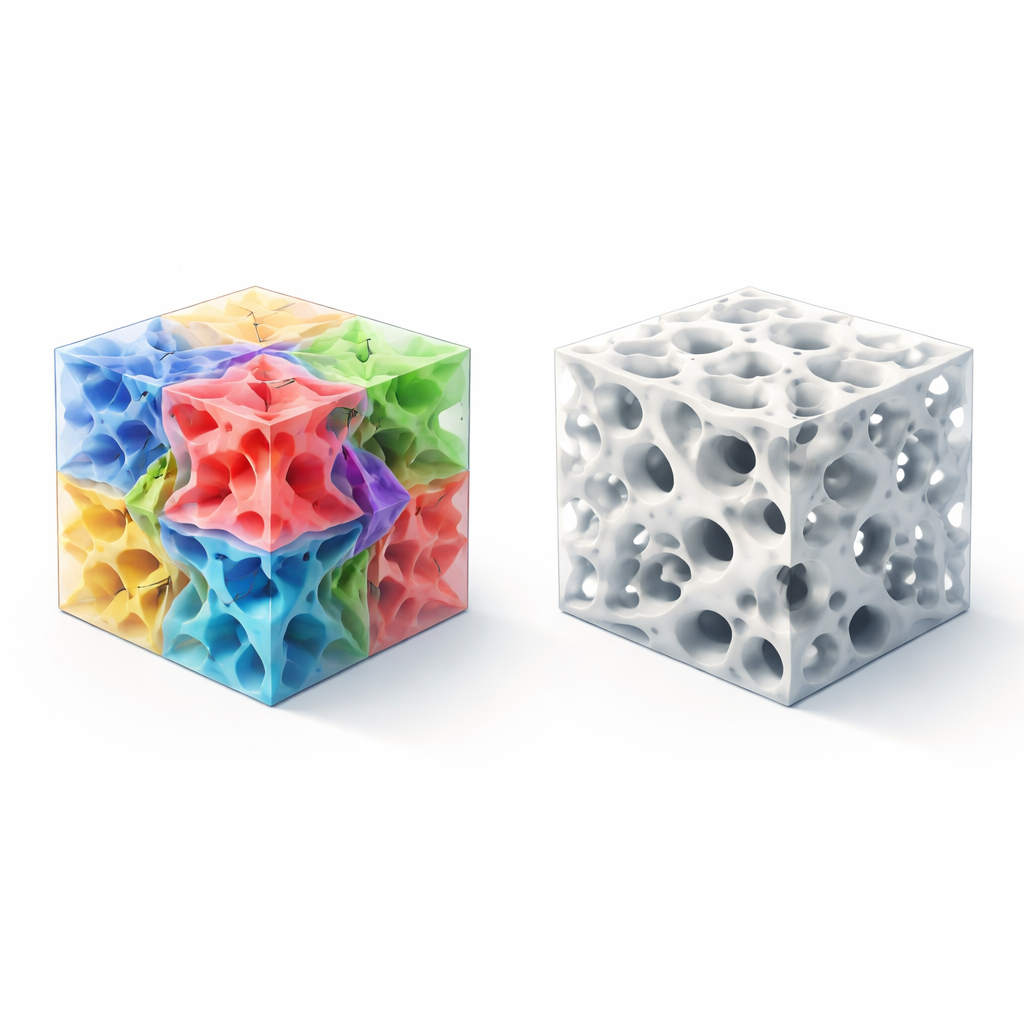
The authors focus on two routes to make stochastic cellular materials. The first uses triply periodic minimal surfaces (TPMS)—smooth, continuous surfaces that weave through space while keeping their mean curvature near zero. Famous examples include the “Diamond” and “Gyroid” shapes. By dividing a volume into many small sub‑regions and placing a TPMS cell in each one with a random rotation, shift and stretching, the team creates a polycrystal‑like “mosaic” of TPMS grains. The second route imitates a physical process called spinodal decomposition, where a uniform mixture spontaneously separates into two interlocking phases. Mathematically, this can be reproduced by adding many standing waves with random directions, yielding a sponge‑like network often called a Gaussian random field structure.
Simulating stiffness and heat flow
Instead of manufacturing every design, the researchers use detailed computer simulations (finite element analysis) to predict how these materials deform and how well they conduct heat. They study both sheet‑based designs, where the solid phase forms a continuous shell, and ligament‑based designs, where the solid forms struts. For each architecture, they virtually compress and shear the material along three axes to extract key elastic properties—Young’s modulus, shear modulus, bulk modulus, and Poisson’s ratio—as well as how directional (anisotropic) the response is. They also impose temperature differences to estimate thermal conductivity and compare all results to theoretical upper bounds set by classical homogenization theories.
Who wins: ordered or random?
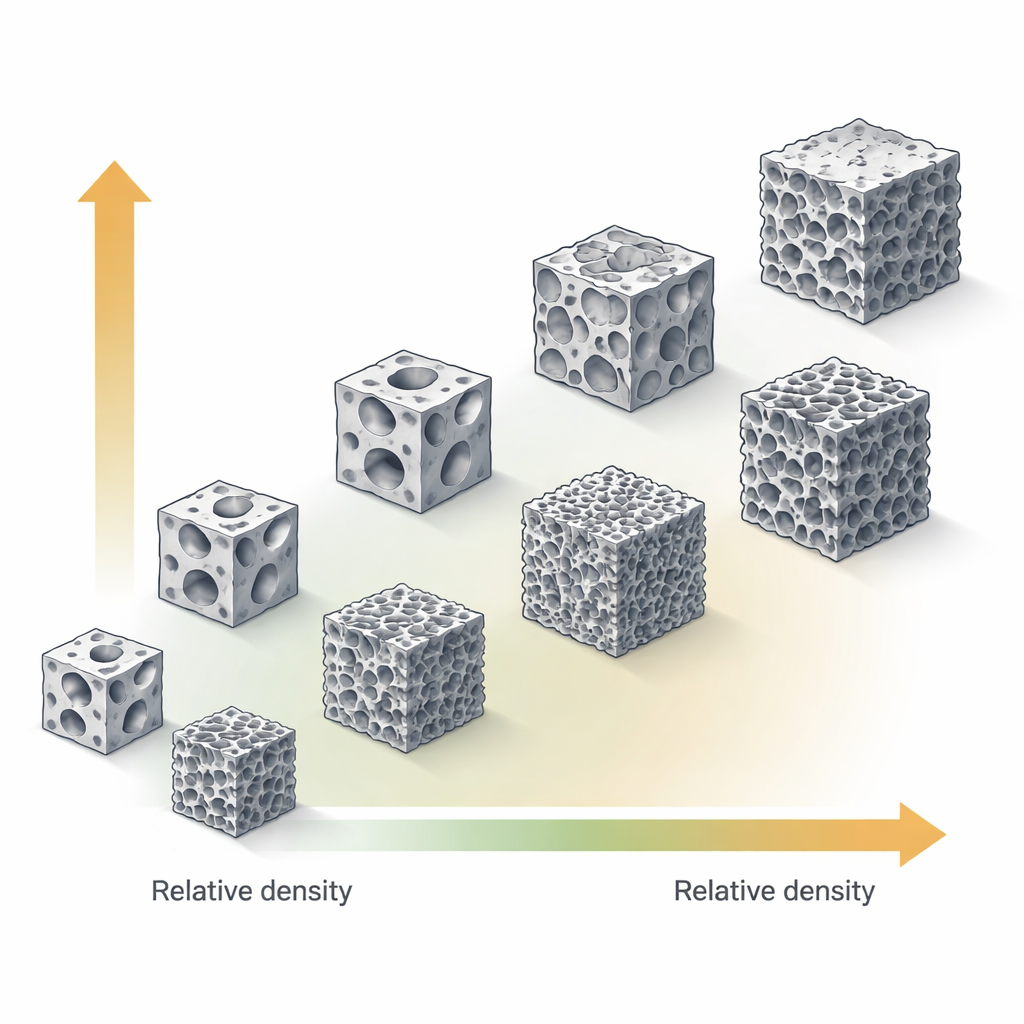
At low solid content (low relative density), perfectly periodic TPMS lattices are generally stiffer and conduct heat better than their stochastic counterparts, for both sheet‑ and ligament‑based versions. However, as the amount of solid increases, the gap closes. Stochastic sheet structures can match, and in some cases surpass, the stiffness of periodic lattices, while stochastic ligament structures eventually outperform periodic ones at higher densities. Across the board, sheet‑based designs are much stiffer and more conductive than ligament‑based ones at the same density. Crucially, the stochastic designs—especially those based on TPMS—tend to be far more isotropic: their stiffness and shear response are almost the same in every direction, which is valuable when loads are uncertain.
Choosing the right internal shape
Not all minimal surfaces are equal. Among the TPMS‑based stochastic designs studied, those built from the Fischer–Koch S topology offer the best combination of stiffness and heat conduction, often rivaling or exceeding the performance of the random spinodal (Gaussian random field) structures. Other TPMS choices, such as the FRD shape, are less favorable. This means designers can use TPMS‑based stochastic architectures as a tunable toolkit: by selecting the right surface and deciding whether to build sheets or ligaments, they can target specific mechanical and thermal properties while retaining the damage tolerance and near‑isotropic behavior of disordered materials.
What this means in everyday terms
For non‑specialists, the key message is that we can now “draw” the internal geometry of a solid almost at will, rather than accept what nature or traditional processing gives us. This study maps out how different labyrinth‑like patterns—ordered and random—translate into real‑world qualities like stiffness, toughness to defects, and ability to carry heat. It shows that carefully designed randomness, especially based on certain minimal surfaces, can deliver both robustness and high performance, offering practical guidelines for designing next‑generation lightweight components, medical implants and thermal management parts.
Citation: Abubaker, H.M., Al-Jamal, A.A., Barsoum, I. et al. Effective elastic properties and conductivity of minimal surface based stochastic and periodic metamaterials. Sci Rep 16, 7597 (2026). https://doi.org/10.1038/s41598-026-37948-3
Keywords: cellular metamaterials, triply periodic minimal surfaces, stochastic lattices, spinodal structures, thermal conductivity