Clear Sky Science · en
Prognostic value of nine inflammatory biomarkers for 30-day mortality in critically ill elderly patients with osteoporotic hip fracture
Why a broken hip can become life-threatening
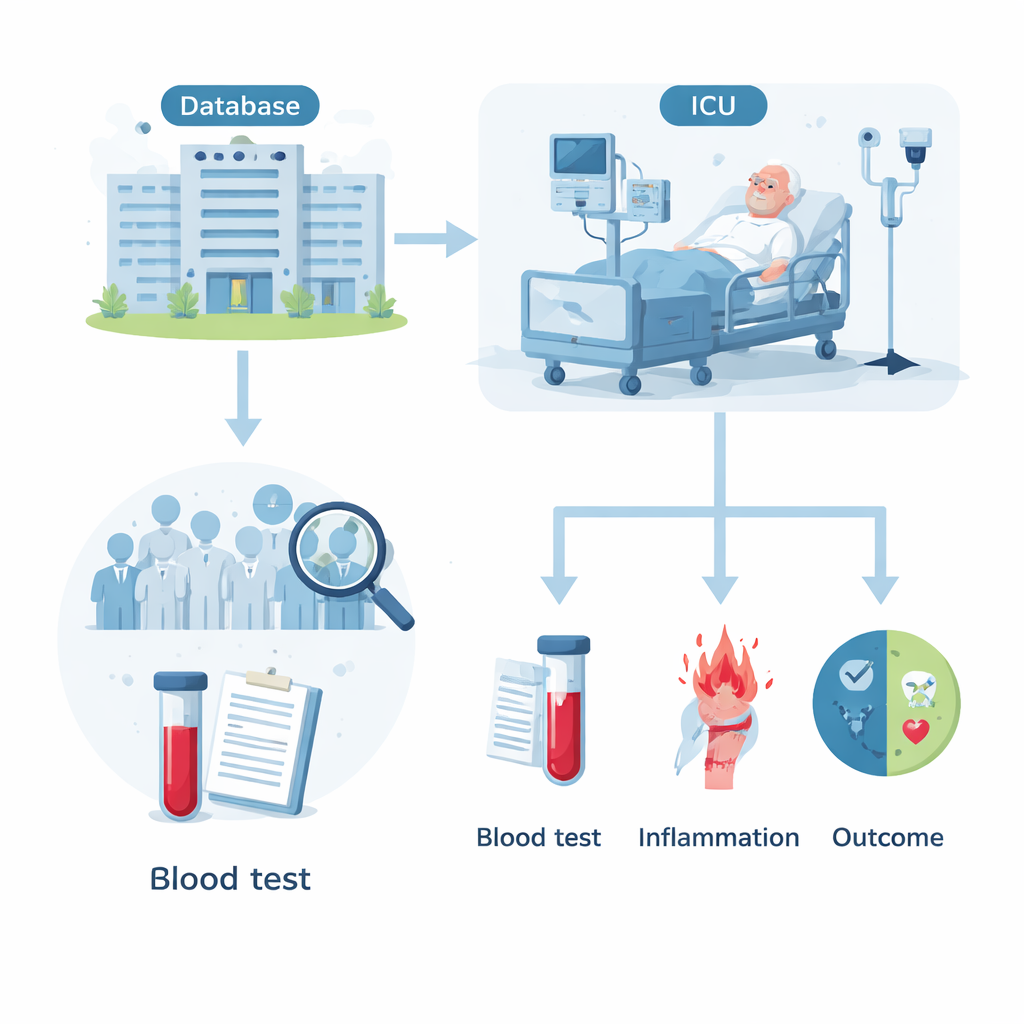
For many families, a grandparent’s broken hip is the start of a frightening journey through surgery, complications, and sometimes the intensive care unit (ICU). Doctors know that some older patients recover, while others, despite similar injuries, do not survive the first month. This study asks a deceptively simple question: can an ordinary blood test taken on the first day in the ICU flag which hip-fracture patients are in the most danger, so care teams can respond earlier and more aggressively?
A closer look at fragile hips in old age
Hip fractures caused by osteoporosis are among the most serious injuries faced by older adults. A minor fall can shatter weakened bone, leading to loss of independence and a sharply higher risk of death. As populations age worldwide, hip fractures are expected to exceed six million cases each year by 2050, most in people over 65. Those sick enough to require ICU care often arrive with severe inflammation, infections like sepsis, or failing organs. In this vulnerable group, even small complications can become deadly, so doctors urgently need fast, reliable ways to sort low-risk from high-risk patients as soon as they arrive.
Turning routine blood counts into warning signs
The researchers analyzed data from the large MIMIC-IV hospital database, focusing on 205 patients aged 65 and older who had both an osteoporotic hip fracture and an ICU stay longer than 24 hours. For each person, they pulled routine blood counts—levels of neutrophils, lymphocytes, monocytes, and platelets—taken around ICU admission. From these four ingredients they built nine simple ratios or products, such as the platelet-to-lymphocyte ratio (PLR) and neutrophil-to-lymphocyte ratio (NLR), which are thought to reflect how strongly the body is inflamed and how well the immune system is coping. They then tracked who died from any cause in the 30 days after entering the ICU.
Platelets and immune cells as a risk gauge
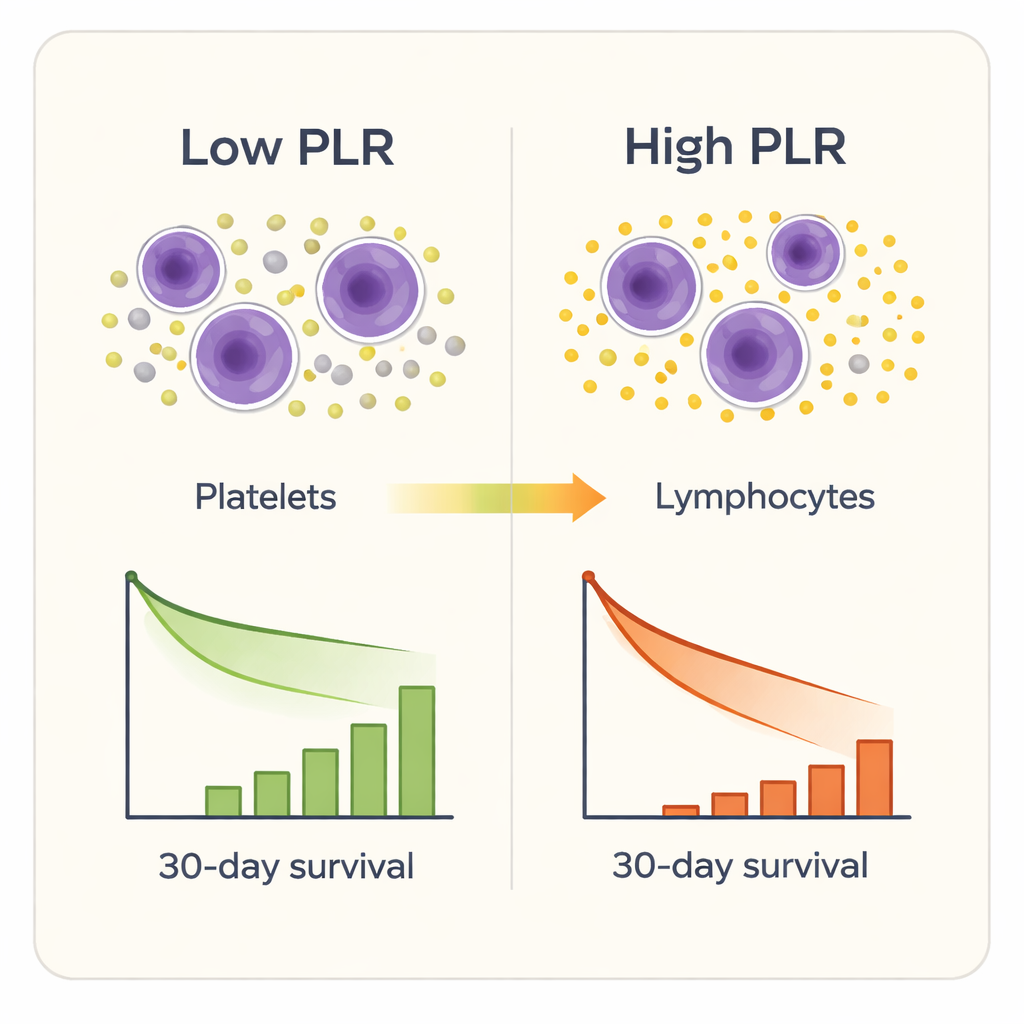
Seven of the nine inflammatory markers could distinguish survivors from non-survivors to some degree, but one stood out: the platelet-to-lymphocyte ratio. Patients with higher PLR values on admission were more likely to die within 30 days, even after accounting for age, sex, other illnesses, and established ICU severity scores. Statistical tests showed that PLR predicted short-term death more accurately than other composite markers and better than the raw counts of platelets or lymphocytes alone. When the researchers divided patients into four groups by PLR level, death rates rose steeply from about 2% in the lowest group to over one-third in the highest group. A more detailed analysis showed that the risk of death began to climb noticeably once PLR exceeded about 189, and rose sharply beyond roughly 302.
What this could mean at the bedside
Because PLR comes directly from a standard complete blood count, it is cheap, quick, and already available in most hospitals. In practice, an ICU team could calculate PLR as soon as an older hip-fracture patient arrives. Those with very high values might receive closer monitoring, more aggressive infection checks, earlier treatment to prevent blood clots, or faster responses to subtle signs of deterioration. PLR may also add information beyond traditional scoring systems by capturing the balance between overactive clotting platelets and weakened immune cells, a balance that may tip frail patients toward organ failure and poor recovery.
How firm are these findings, and what comes next?
This work has important caveats. It looked back at existing records from a single critical-care database, so it cannot prove that high PLR directly causes death, only that it travels alongside higher risk. PLR was measured only once, at admission, and the study included a relatively small number of ICU patients compared with the many older adults who break a hip but never need intensive care. Still, the results were consistent across many subgroups, including men and women and different age brackets. The authors conclude that PLR is a promising, low-cost signal of danger in critically ill elderly patients with osteoporotic hip fracture, and that people with a PLR above about 302 may belong to a particularly high-risk group. Confirming these findings in larger, prospective studies could pave the way for PLR-guided decision-making to save more lives after a broken hip.
Citation: Liu, ZJ., Li, Xm., Du, Z. et al. Prognostic value of nine inflammatory biomarkers for 30-day mortality in critically ill elderly patients with osteoporotic hip fracture. Sci Rep 16, 6930 (2026). https://doi.org/10.1038/s41598-026-37945-6
Keywords: osteoporotic hip fracture, elderly ICU patients, inflammation biomarker, platelet-to-lymphocyte ratio, 30-day mortality