Clear Sky Science · en
Mechanical performance of sutures exposed to natural extract-based mouthwashes
Why your mouthwash might matter after dental surgery
After a tooth is pulled or gum surgery is done, tiny stitches hold the wound together while it heals. Many patients are told to rinse with mouthwash to keep the area clean, but a natural question follows: could those rinses weaken the stitches and cause the wound to open? This study looked closely at that question for several plant-based mouthwashes, asking whether they are as gentle on common dental sutures as they are on the rest of the mouth.
Natural rinses under the microscope
The researchers focused on two natural ingredients already used in oral-care products. One, dipotassium glycyrrhizinate, comes from licorice root and is known for calming inflammation and fighting germs. The other, propolis, is a resin that honeybees collect from plants; it has a long history in folk medicine and has shown antibacterial and wound-healing properties. Because many patients and clinicians are interested in gentler alternatives to alcohol- or chlorhexidine-based rinses, the team wanted to see whether these herbal options would leave surgical stitches just as strong—or perhaps even stronger—than more traditional products.
How the stitches were tested
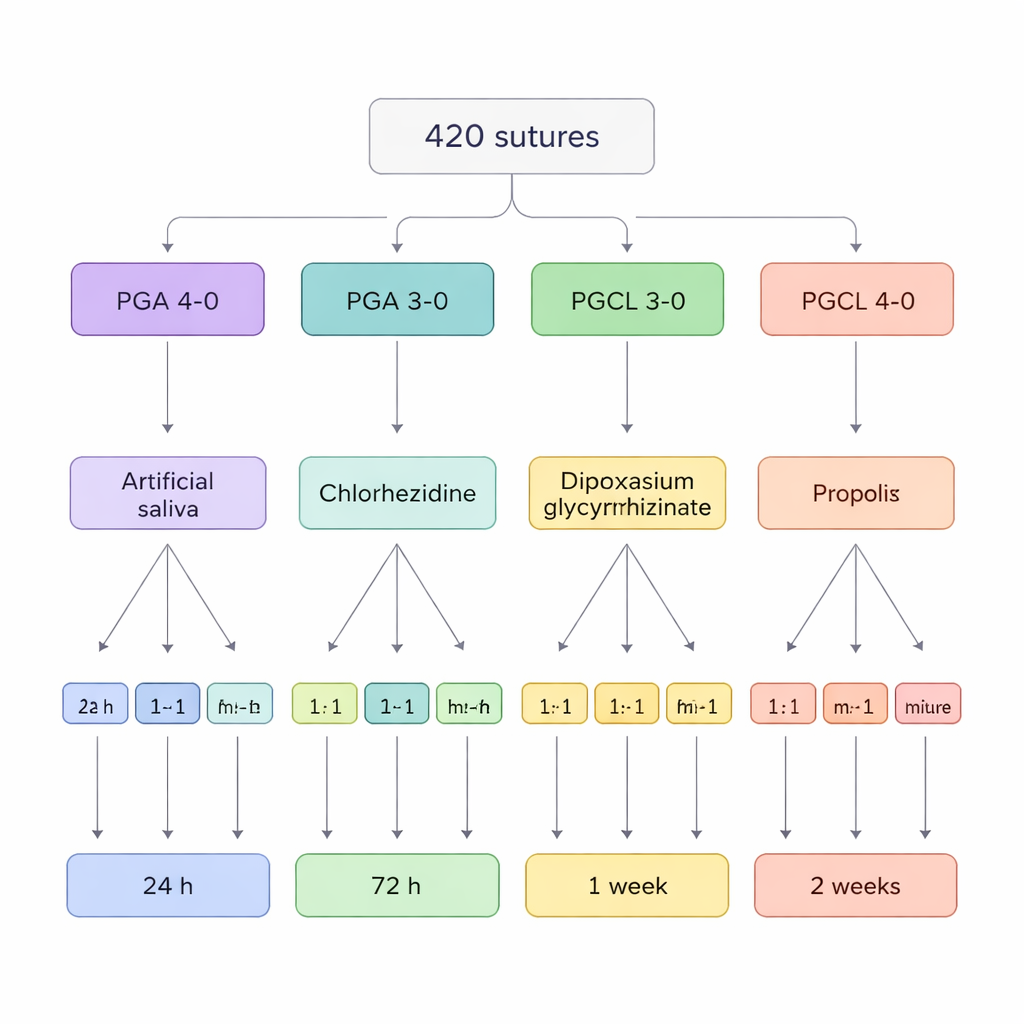
To answer this, the team prepared 420 pieces of commonly used absorbable dental sutures: a braided material called polyglactin (PGA) and a smooth single-strand material called poliglecaprone (PGCL), each in two thread thicknesses. The sutures were tied with a standard surgeon’s knot around a small rubber rod, much like they would be used in the mouth. They were then soaked in one of five liquids: artificial saliva, a standard chlorhexidine mouthwash, a 2% dipotassium glycyrrhizinate mouthwash, a 2% propolis mouthwash, or a 1:1 mix of the two herbal solutions. Each sample stayed in its solution for one of four periods—24 hours, 3 days, 1 week, or 2 weeks—to mimic the early healing phase after surgery.
Pulling until they snap
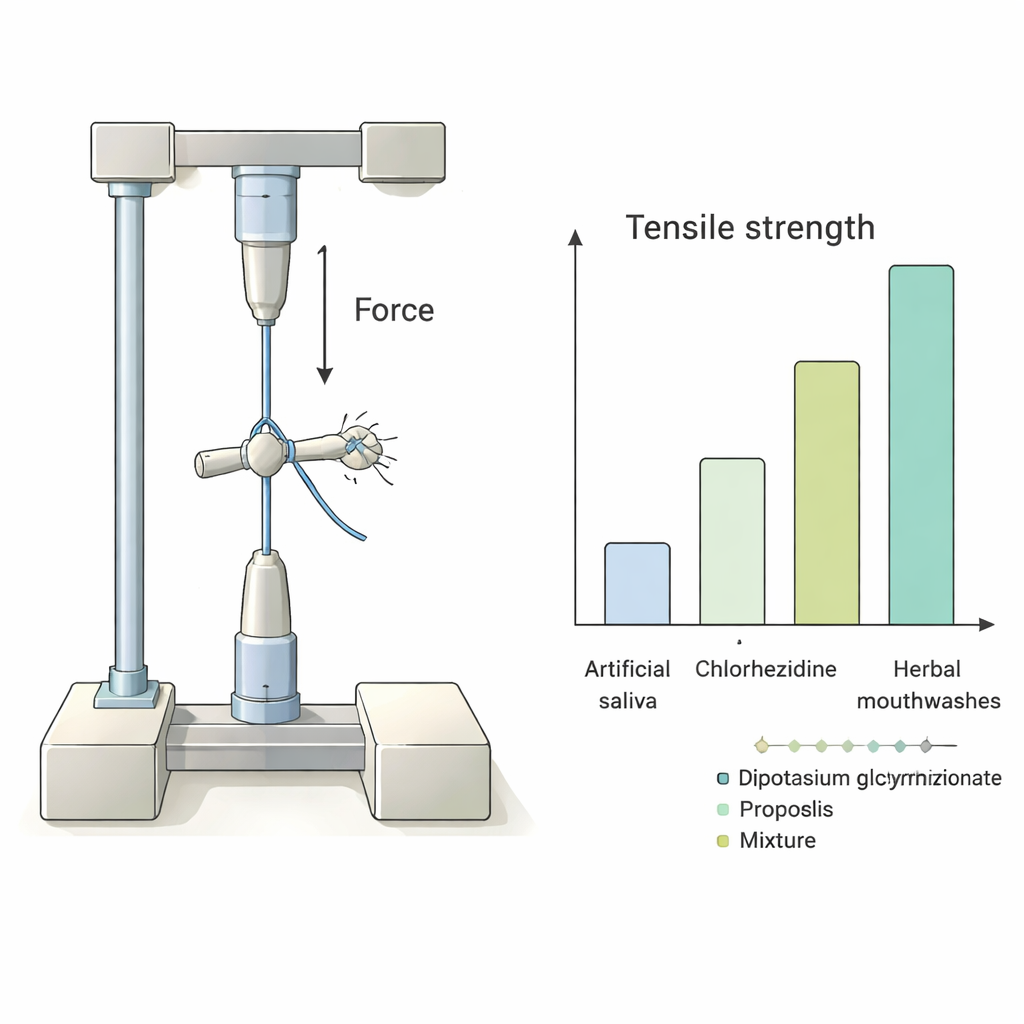
After soaking, each stitched loop was mounted in a universal testing machine, a device that pulls on the suture at a steady speed until it breaks. The machine recorded the maximum force the thread could withstand before snapping—its tensile strength—and the researchers also noted where the break happened: directly at the knot, near it, or in the middle of the strand. This helped them see not only how strong the material remained, but also whether different mouthwashes changed how the sutures tended to fail when stressed.
What the results revealed
Overall, the braided PGA sutures started out stronger and stayed stronger than the smoother PGCL sutures, regardless of what they were soaked in. The type of liquid did matter: artificial saliva usually left the threads with the lowest strength, while the herbal rinses and chlorhexidine tended to preserve higher strength values. Across all time points, the combined licorice–propolis rinse often produced the highest average strength readings, especially for the braided sutures, with propolis alone not far behind. However, differences among solutions were modest and not always statistically clear, particularly for the PGCL sutures. Importantly, how long the sutures were soaked—from one day up to two weeks—did not significantly change their strength under these test conditions.
Where and how they broke
Most sutures, regardless of rinse or material, broke at the knot, which is typically the weakest point in a tied thread. Some mid-strand breaks and slips were seen, especially in certain combinations of suture type and herbal rinse, but these patterns did not show a strong link to any particular mouthwash. In other words, while there were subtle differences in how the sutures failed, the kind of rinse did not reliably shift the breaking point in one clear direction.
What this means for patients
For people recovering from dental surgery, the key takeaway is reassuring: in this laboratory study, the licorice-based and propolis-based mouthwashes did not weaken the absorbable sutures tested. In some cases, they were linked with slightly better strength than artificial saliva or even chlorhexidine. Because these herbal rinses are also biocompatible and generally well tolerated, they appear to be promising, patient-friendly options for keeping the mouth clean after surgery without putting stitches at extra risk. The authors caution that real mouths are more complex than lab setups, so longer-term studies in actual patients are still needed, but the early evidence suggests that such natural mouthwashes can be both gentle and supportive during healing.
Citation: Alaqeely, R., AlQahtani, N., Alrobaish, S. et al. Mechanical performance of sutures exposed to natural extract-based mouthwashes. Sci Rep 16, 7573 (2026). https://doi.org/10.1038/s41598-026-37932-x
Keywords: dental sutures, herbal mouthwash, propolis, wound healing, tensile strength