Clear Sky Science · en
Mechanical performance of structural lightweight concrete with metallurgical coal aggregates
Turning Coal Waste into Building Blocks
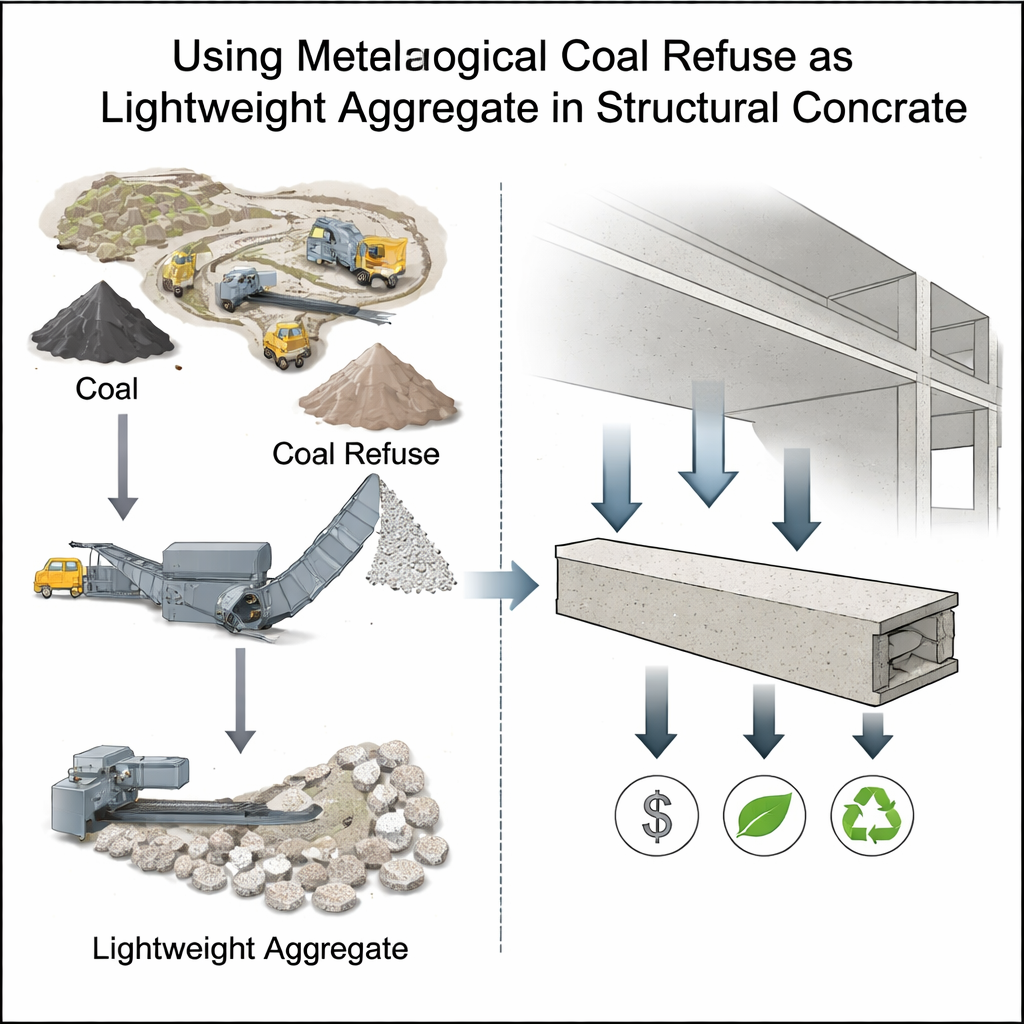
Modern cities rely on concrete, but making and moving all that material is heavy on both budgets and the planet. This study explores an unusual idea: using leftovers from steel-making coal mines—not for fuel, but as a lightweight ingredient in concrete. By turning metallurgical coal refuse into gravel-like particles, the researchers ask whether we can build safer, lighter structures while cutting costs and reusing an industrial waste that otherwise piles up in vast black hills.
Why Lighter Concrete Matters
Concrete is more rock than glue; 60–80% of its volume is made of aggregates such as sand and gravel. Swapping these stones for lighter materials can greatly reduce the “dead load” that buildings must carry, which in turn allows for slimmer columns, smaller foundations, and less reinforcing steel. Structural lightweight concrete has been used since Roman times and is common in bridges, tall buildings, and long-span roofs. In recent years, engineers have tried many industrial leftovers—like steel slag, plastic chips, and crop ashes—as substitutes for natural gravel. Metallurgical coal waste, produced when coal is mined and processed for steel-making, is abundant, porous, and much lighter than ordinary rock, making it a promising candidate.
From Coal Refuse to Concrete Mixes
The research team collected metallurgical coal waste from Egyptian quarries and crushed it into coarse aggregate. They then designed five concrete mixes in which this coal-based aggregate replaced normal gravel by 0%, 25%, 50%, 75%, or 100% by weight. All other ingredients—cement, sand, water, and mixing and curing conditions—were kept the same so that only the aggregate type varied. Before making the concrete, they measured the coal aggregate’s density, water absorption, and mineral content. It turned out to be extremely light, with about one-third the bulk density of normal gravel and much higher porosity, meaning it soaked up more water and contained a lot of carbon-rich material.
How the New Concrete Performed
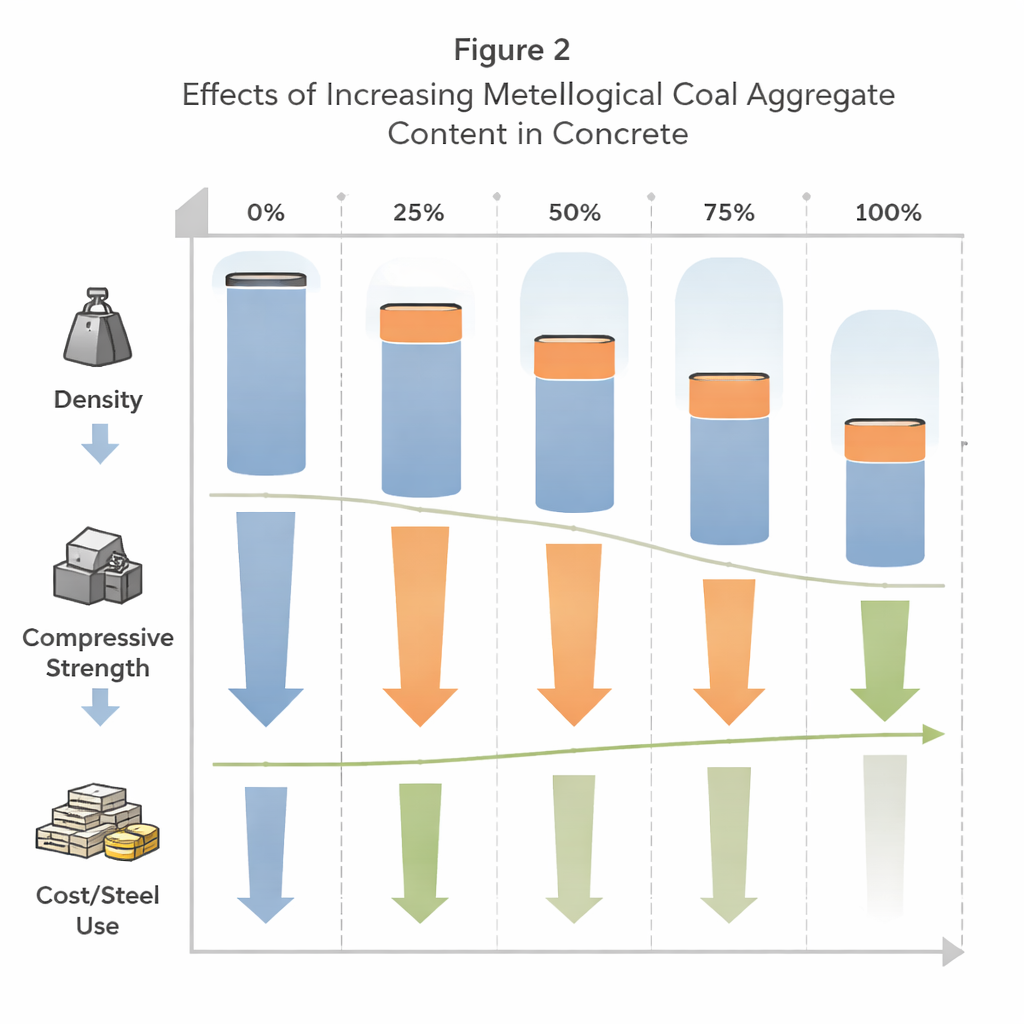
The fresh concrete mixes were first checked for workability, a practical measure of how easily a mix can be placed and compacted on a job site. As the coal content rose, the slump—a simple cone test for flow—dropped sharply, showing that the porous coal pieces were drinking in water and making the mix stiffer. After curing, the hardened concrete was tested for several key properties: weight, compressive strength (resistance to being crushed), flexural strength (bending resistance), and stiffness (modulus of elasticity). As expected, the more coal aggregate used, the lighter the concrete became: unit weight fell from about 2168 to 1642 kilograms per cubic meter, easily qualifying the mixes as structural lightweight concrete. But this weight reduction came at a cost. Compressive strength of cubes fell from 37.6 megapascals (MPa) at 0% coal to 20.7 MPa at 100% coal, while bending strength also declined. The internal structure of the coal particles and the weak bond between them and the cement paste introduced more tiny voids and microcracks, reducing the concrete’s load-carrying capacity and stiffness.
Heat, Fire, and Real-World Economics
Because buildings must withstand fires, the researchers also heated specimens with 0%, 25%, and 50% coal content to 200 °C, 400 °C, and 600 °C for two hours, then measured their remaining strength. All mixes lost strength as temperatures rose—up to about 40–43% at 600 °C—but still stayed within structural safety limits. This suggests that, despite its porous nature, coal-based lightweight concrete can survive realistic fire scenarios. The team then analyzed costs using a small building example with slabs, beams, and columns designed according to national codes. Since the lighter mixes reduce the dead load, they require less reinforcing steel. A mix with 75% coal cut steel usage by about 12% and reduced overall concrete cost slightly (around 23 Egyptian pounds per cubic meter) compared with normal concrete, while still meeting strength requirements.
What It Means for Future Buildings
For non-specialists, the bottom line is that coal mine waste—long viewed as an environmental nuisance—can be turned into a useful building material. When coal aggregate replaces 25–75% of natural gravel, the concrete becomes significantly lighter yet remains strong enough for many structural elements in multi‑story buildings, and it performs acceptably under high heat. At a full 100% replacement, the concrete is very light but no longer strong enough for main load‑bearing parts, making it better suited for non‑structural uses like partition walls or insulating blocks. Overall, the study shows that carefully designed mixes using metallurgical coal waste can help conserve natural stone resources, cut steel and transport demands, and give new life to an industrial by‑product—without compromising safety when used in the right parts of a structure.
Citation: Waleed, T., Rady, M., Mashhour, I.M. et al. Mechanical performance of structural lightweight concrete with metallurgical coal aggregates. Sci Rep 16, 7484 (2026). https://doi.org/10.1038/s41598-026-37929-6
Keywords: lightweight concrete, coal waste recycling, sustainable construction, structural performance, industrial byproducts