Clear Sky Science · en
Clinico-pathologic characteristics of sub-epithelial tumor (SET) like gastric cancers
Hidden Bumps Inside the Stomach
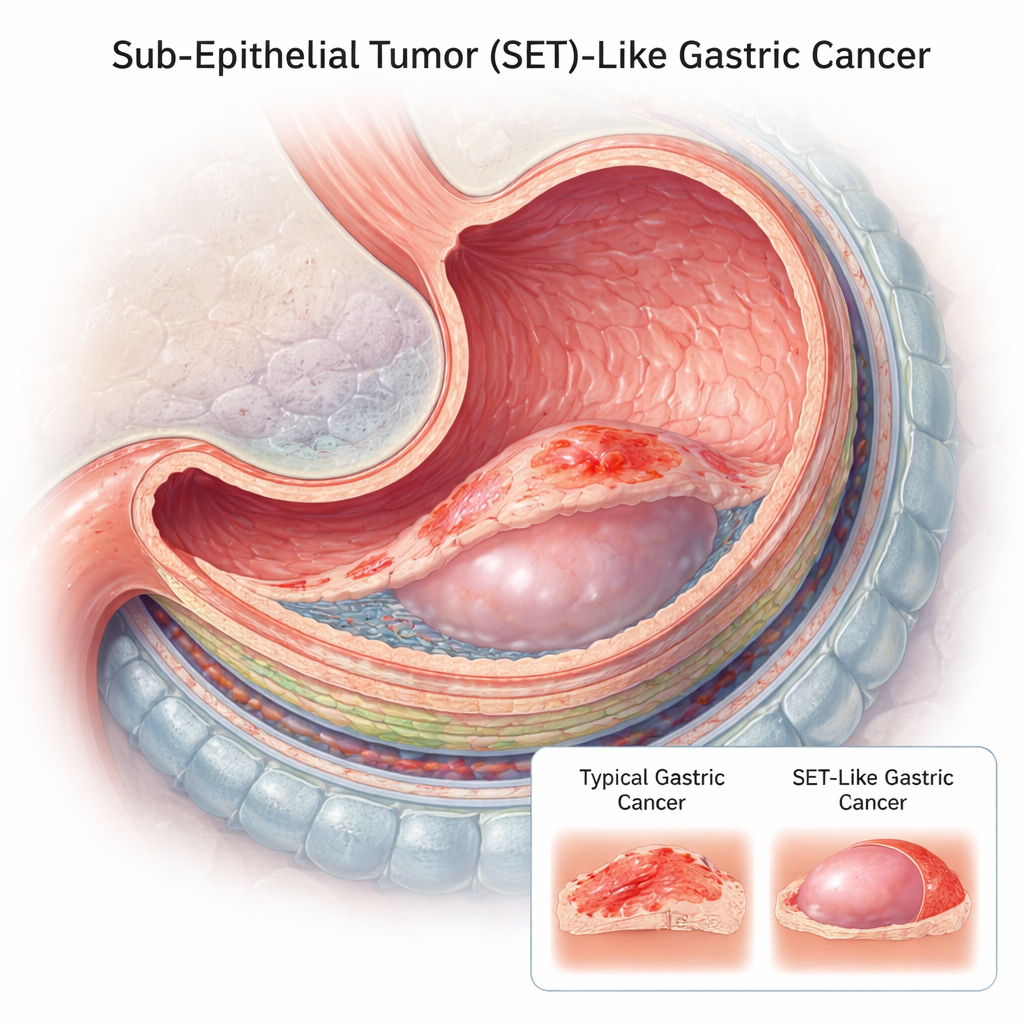
Most stomach cancers are found as obvious sores or flat patches on the lining of the stomach. But a small subset grow more like hidden lumps inside the wall, with only a tiny opening at the surface. These so‑called sub‑epithelial tumor (SET)–like gastric cancers can be hard to spot and easy to mistake for harmless bumps or ulcers. This study explores how often these elusive cancers appear, what makes them different, and why doctors may need to change how they look for and treat them.
When Cancer Looks Like a Lump, Not a Sore
Ordinary stomach cancers usually spread along the inner lining and then dig deeper. In contrast, SET‑like cancers burrow downward early, forming a rounded mass inside the stomach wall while leaving only a small area exposed on the surface. On endoscopy, they can resemble benign "subepithelial" tumors or even stubborn ulcers. Because the visible opening is small compared with the true size of the mass, biopsies from the surface may miss the cancer, which raises the risk of delayed diagnosis.
Taking a Closer Look at Real Patients
The researchers reviewed 380 stomach cancer cases treated at a single Korean hospital between 2020 and 2024, including both early and advanced cancers removed either surgically or by advanced endoscopic techniques. Using stored endoscopic images, two experienced specialists re‑examined each case and labeled tumors as SET‑like or not, based on how much of the tumor was exposed on the surface. They then compared age, tumor stage, and detailed laboratory markers, and also performed genetic tests looking for microsatellite instability (MSI), a sign that the cancer cells accumulate DNA errors more readily than normal cells.
Who Gets These Unusual Tumors?
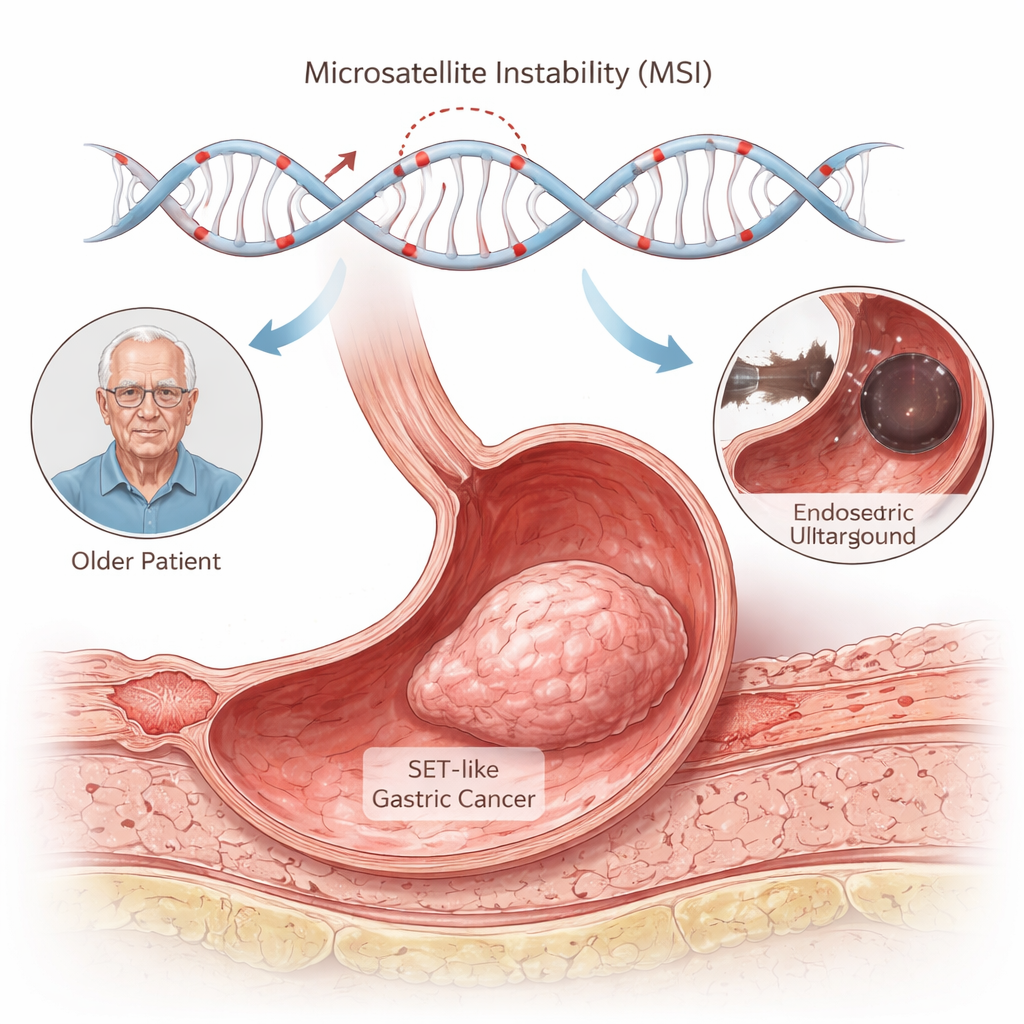
SET‑like cancers were uncommon but not vanishingly rare: they accounted for about 6% of all stomach cancers in this group (22 out of 380). Patients with SET‑like tumors tended to be older than those with more typical cancers. They were not more likely to smoke, drink, carry Helicobacter pylori infection, or have a particular tumor location. However, these hidden, lump‑like cancers were more often already in an advanced stage by the time they were found. That pattern supports the concern that their deceptive shape can delay accurate diagnosis, allowing more time for the disease to progress.
A Strong Link to DNA Repair Problems
The most striking finding was genetic. More than half of the SET‑like cancers showed microsatellite instability, a rate much higher than that seen in the other stomach cancers in the study. MSI‑positive tumors are already known to be more common in older patients and to have distinctive microscopic and endoscopic features. This work adds another clue: tumors with MSI status are significantly more likely to grow in a SET‑like pattern. The authors suggest that the fast‑growing behavior and altered biology of MSI‑positive cancers may encourage this inward, bulging growth within the stomach wall.
Special Cases and Missed Chances
SET‑like appearance also turned up in several unusual situations, such as rare virus‑related cancers, highly aggressive undifferentiated tumors, mixed gland and hormone‑producing cancers, and cancers arising near long‑standing cyst‑like changes in the stomach wall. Some patients had tumors that changed shape after ulcer medicines or chemotherapy, temporarily looking less threatening on the surface while continuing to grow underneath. Others had genetic syndromes that predispose them to cancer and seemed to favor rapid, lump‑forming growth. Together, these examples underscore how varied the pathways to a SET‑like appearance can be and how easily such lesions might be under‑recognized.
Why This Matters for Patients
For a lay reader, the key message is that some stomach cancers hide in plain sight, masquerading as harmless bumps or healing ulcers. These SET‑like cancers are more often advanced and frequently tied to DNA repair defects such as microsatellite instability, which may also make them candidates for modern immunotherapies. As use of high‑resolution endoscopy and endoscopic ultrasound expands, doctors are likely to detect more of these tricky tumors. The authors argue that clearer guidelines, repeated biopsies when suspicion remains, and careful follow‑up after treatment are urgently needed so that patients with this stealthy form of stomach cancer are not missed until it is too late.
Citation: Lim, N., Chung, W. Clinico-pathologic characteristics of sub-epithelial tumor (SET) like gastric cancers. Sci Rep 16, 6688 (2026). https://doi.org/10.1038/s41598-026-37928-7
Keywords: stomach cancer, subepithelial tumor, microsatellite instability, endoscopy, gastric tumor biology