Clear Sky Science · en
Gait dysfunction as an early marker of phenoconversion in REM sleep behavior disorder
Walk Clues Hidden in Our Everyday Steps
Many people act out their dreams at night, kicking or shouting in their sleep. This condition, called REM sleep behavior disorder, is more than just a bedroom curiosity: a large share of these people will later develop Parkinson’s disease or related brain disorders. This study asks a simple but powerful question: can careful measurement of the way such people walk—long before a diagnosis—reveal who is most likely to develop Parkinson’s-like disease in the near future?
Nighttime Dreams and Daytime Risks
Isolated REM sleep behavior disorder (iRBD) is a condition in which the usual paralysis of muscles during dream sleep fails, allowing vivid dreams to be “acted out.” Decades of research show that most people with iRBD eventually develop Parkinson’s disease, dementia with Lewy bodies, or multiple system atrophy—conditions linked by the same abnormal protein in the brain. Because future protective drugs are likely to work best before full-blown disease appears, doctors urgently need simple, low-cost ways to tell which iRBD patients are on the brink of this change. Gait—the pattern of how we walk—has emerged as a promising window into early brain changes.
Measuring Steps with a High-Tech Walkway
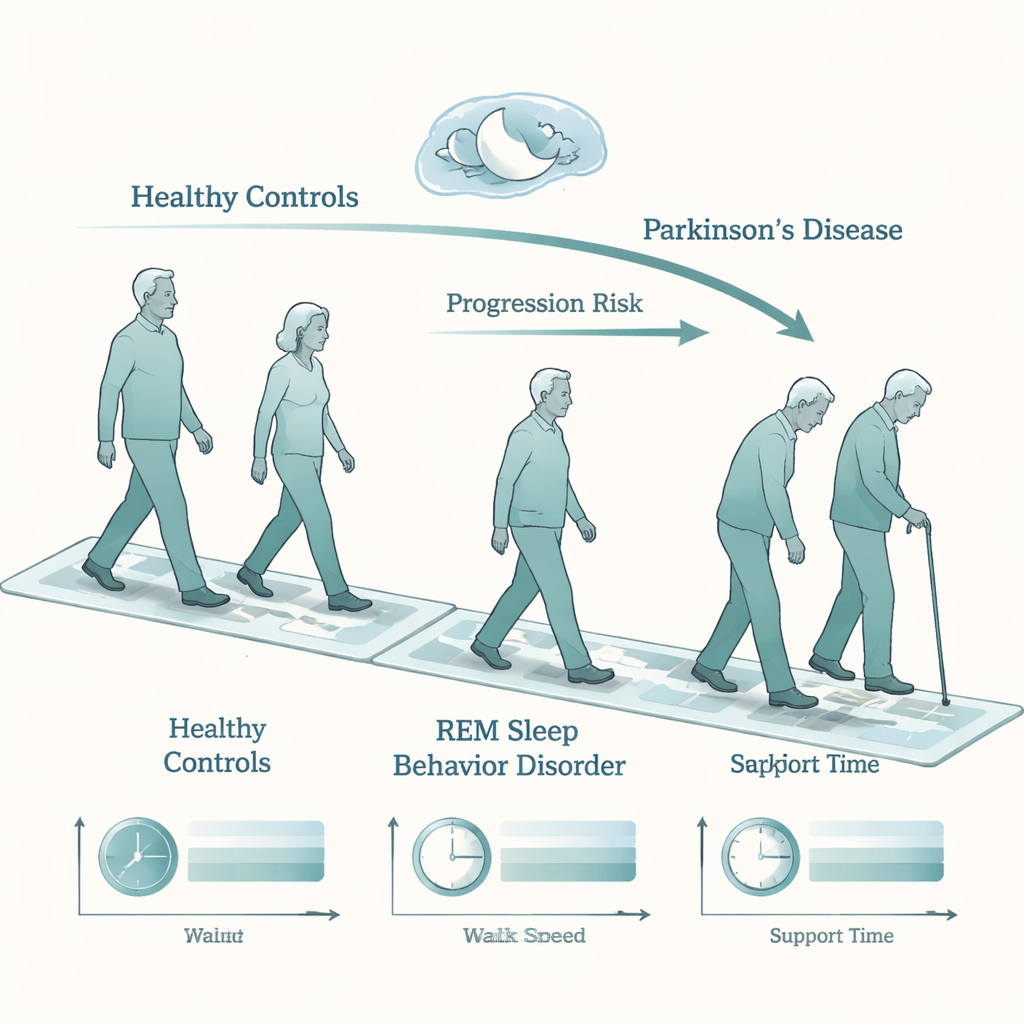
The researchers recruited three groups of older adults: 21 people with iRBD, 19 healthy controls, and 14 people with mild to moderate Parkinson’s disease. Everyone walked across a pressure-sensor walkway that recorded details such as speed, step length, and how long each foot spent on the ground. The team also measured how far participants could walk in two minutes along a corridor to gauge everyday walking endurance. Importantly, the iRBD group showed almost no obvious motor problems on standard neurological exams, making this a test of truly subtle changes in movement.
Early Warning Signs in Speed and Balance Time
When the researchers compared the three groups, the iRBD group already showed slower walking speed and poorer walking endurance than the healthy controls, even though they still looked nearly normal on routine tests. People with Parkinson’s disease were more impaired, with shorter steps, more steps taken to cover the same distance, and a different “rhythm” of walking. In particular, Parkinson’s patients spent less time balancing on one leg (single support) and more time with both feet on the ground (double support and overall stance), suggesting a cautious, stability-seeking style of walking.
Who Will Convert? Gait as a Crystal Ball
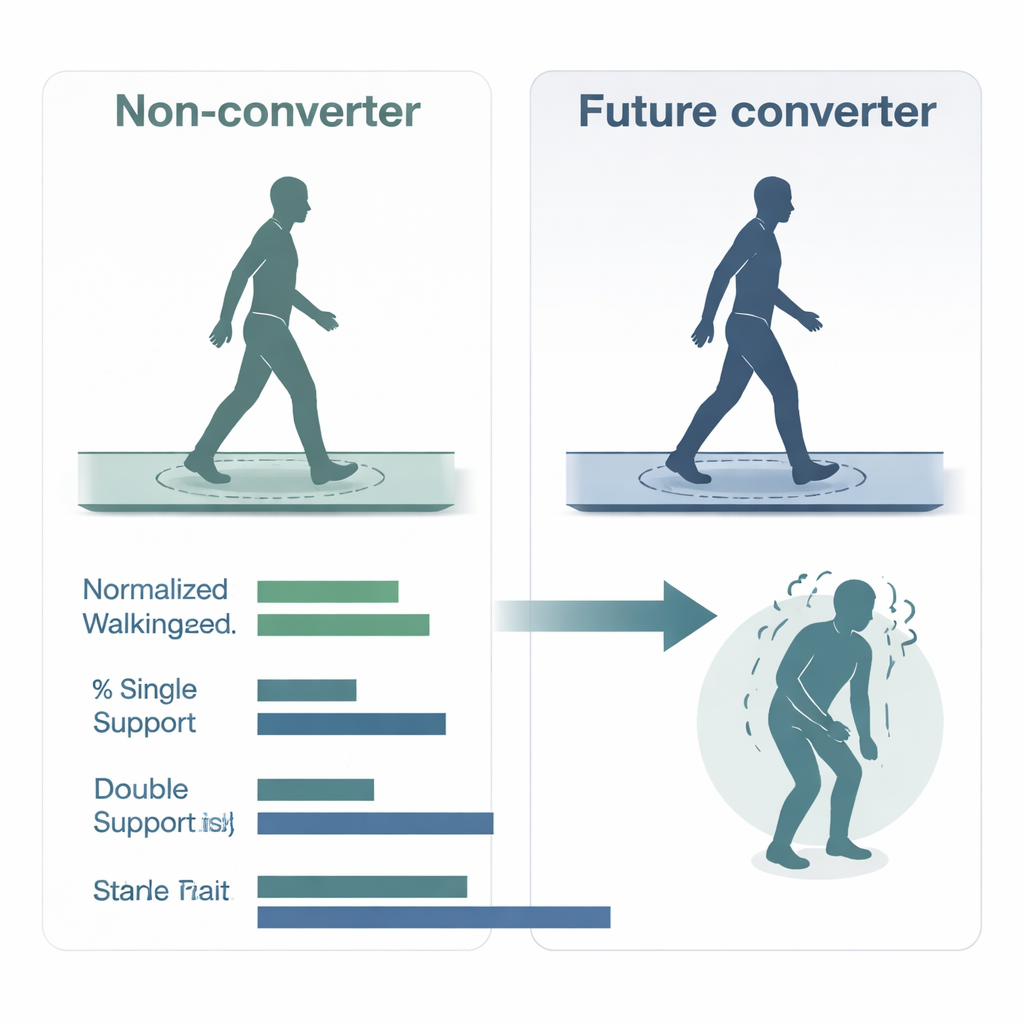
The key test came from following the iRBD group over several years after the initial gait measurement. On average, patients were tracked for almost five years after gait testing. Within about four years, 7 of 17 followed patients developed a full diagnosis of Parkinson’s disease or dementia with Lewy bodies. When the team looked back at their baseline gait recordings, clear differences emerged. Those who later converted had lower normalized walking speed and spent less of each step cycle balancing on one leg, with more time in overall stance, than those who remained free of diagnosed disease. Statistical models showed that these rhythm measures—especially single support time—could distinguish future converters with high sensitivity and specificity, and that lower single-support time was linked to a higher risk of conversion both in the medium term and up to roughly six years after testing.
What This Means for Patients and Future Treatments
For lay readers, the message is that subtle changes in the way a person with dream-enactment behavior walks—particularly how quickly they move and how confidently they balance on one leg during each step—may reveal who is closest to developing Parkinson’s-like disease. While this single-center study was relatively small and used a lab-based walkway rather than everyday wearable sensors, it shows that a short, objective walking test can pick up changes that standard clinical exams miss. If confirmed in larger, multi-center trials, gait analysis could become a practical tool to monitor people with iRBD, identify those at highest short-term risk, and enroll them early into trials of treatments aimed at slowing or preventing Parkinson’s disease.
Citation: Hermann, W., Sankutlu, A., Nabers, L. et al. Gait dysfunction as an early marker of phenoconversion in REM sleep behavior disorder. Sci Rep 16, 5614 (2026). https://doi.org/10.1038/s41598-026-37925-w
Keywords: REM sleep behavior disorder, Parkinson’s disease, gait analysis, early detection, neurodegeneration