Clear Sky Science · en
Research on surrounding rock control technology of roof cutting and pressure relieving for roadside filling in gob-side entry retaining of large mining height panel
Keeping Underground Tunnels Open and Safe
Deep underground coal mines depend on long tunnels to move people, machines, and coal. But once coal is removed, the rock above can shift and squeeze these tunnels, creating major safety risks and economic losses. This study focuses on a Chinese coal mine and asks a practical question: how can engineers design the mined-out area and supports so that a key tunnel can safely stay open for the next round of mining, rather than being abandoned and rebuilt from scratch?
Why Leaving One Tunnel Matters
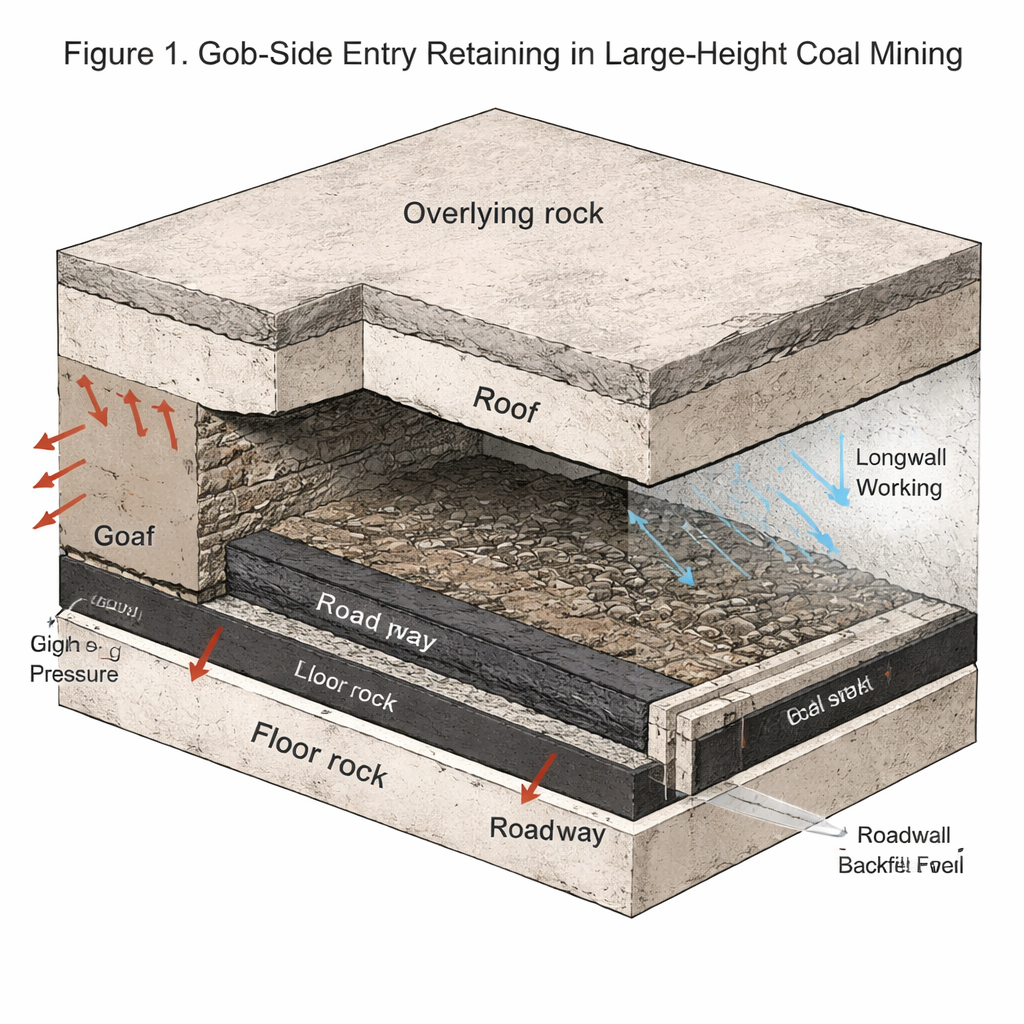
Modern coal mines often use very tall mining panels that remove thick layers of coal in a single pass, boosting production but also greatly disturbing the surrounding rock. Traditionally, miners leave a thick block of untouched coal as a pillar to protect nearby tunnels. That pillar, however, locks valuable coal underground and forces extra tunneling. A technique called gob-side entry retaining offers a smarter option: keep a tunnel right beside the collapsed mined-out zone (the “gob”) and replace the coal pillar with a specially built roadside wall. If this tunnel can remain stable, the mine recovers more coal, cuts development costs, and improves overall efficiency.
When the Rock and Wall Cannot Cope
The authors analyze what goes wrong when engineers rely on the roadside wall alone. In high, wide panels, the overlying rock layers bend and break over a larger span, generating powerful, shifting pressures. The narrow wall must absorb much of this load. If the wall is strong but too rigid, extreme stress can build inside it, causing cracking or splitting. If it is weaker, it can bulge and compress the tunnel space, squeezing the roof and sides inward. In other cases, a strong wall combined with a weak roof causes the rock above the tunnel to shear and drop, leading to local roof falls. In short, simply building a wall beside the gob is not enough to match the violent movement of rock above a thickly mined seam.
Cutting the Roof to Tame the Load
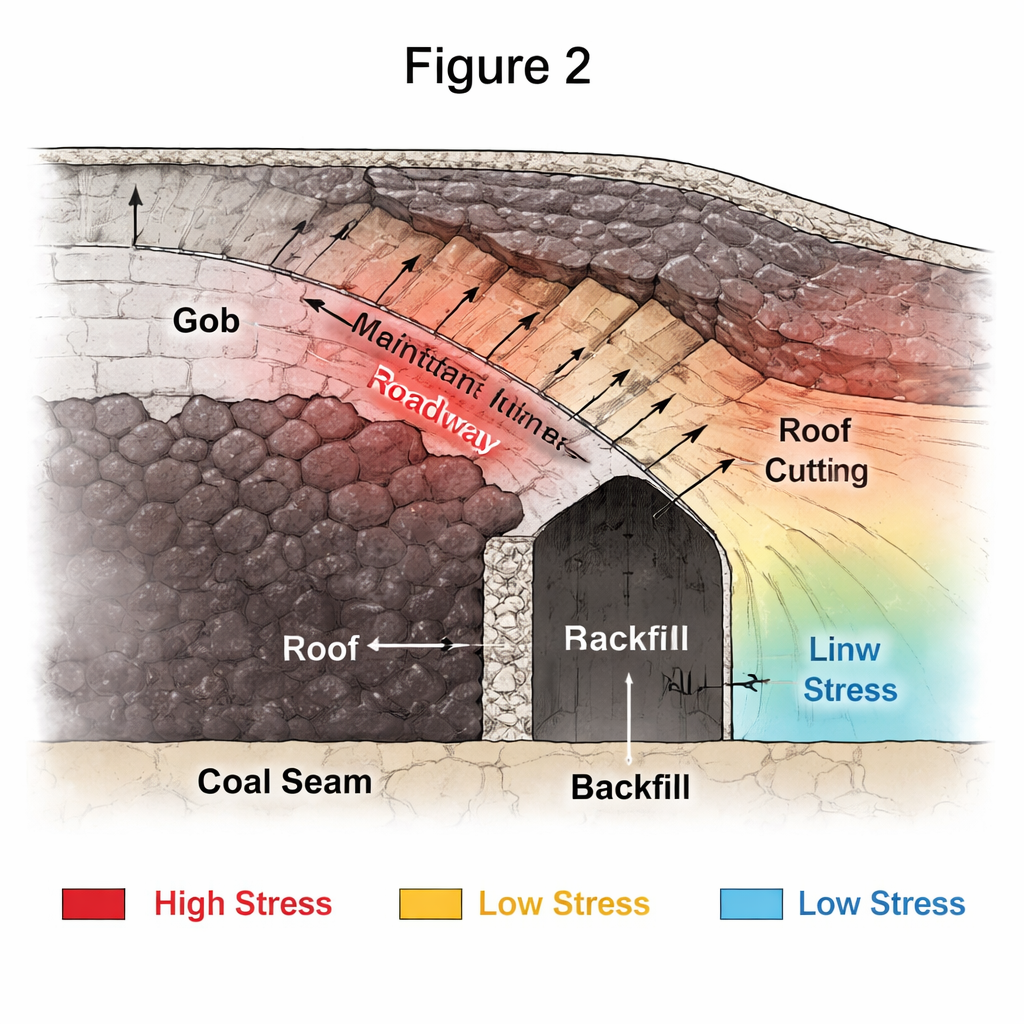
To tackle this problem, the researchers promote a combined approach they call “enhanced support plus roof cutting pressure relief.” The idea is to proactively cut a sloping slit through the hard rock above the tunnel, on the gob side. This cut weakens the connection between the tunnel roof and key rock layers, guiding the overlying rock to break and cave toward the mined-out side rather than hanging over the roadway like a giant stiff beam. At the same time, the tunnel itself is fortified with a dense pattern of rock bolts, steel cables, hydraulic supports, and a concrete roadside wall that can bear load yet allow some controlled movement.
Finding the Sweet Spot with Virtual Testing
Using three-dimensional computer simulations calibrated to the real mine (the 2507 working face), the team varied three design parameters: how high the roof cut extends, the angle of the cut, and the width of the roadside wall. They tracked a quantity called deviatoric stress—a combined measure of how intensely the rock is being distorted—to see where the rock was most likely to fail. The simulations showed that a roof cut of about 15 meters, reaching roughly 70 percent of the main roof layer, significantly lowered stress around the tunnel. A cut angle of 15 degrees produced a balanced sharing of load between the solid coal side and the roadside wall, promoting orderly caving of rock into the gob instead of dangerous hanging blocks. For the wall, widths of 0.5 to 1.0 meters left it too weak, causing severe deformation, while a width of about 1.5 meters gave the best blend of strength and adaptability.
Proof from Real-World Monitoring
The optimized design was then tested in the mine. Instruments measured roof movement, forces in the anchor cables, and pressure on the concrete wall as the mining face advanced and the gob-side tunnel was left behind. Roof sag on the roof-cutting side stayed under about 120 millimeters, and cable loads and wall pressures rose to peaks and then leveled off below their design limits. This behavior showed that the roof cut successfully reduced the load carried directly by the tunnel and that the strengthened supports were working together, rather than being overloaded or failing suddenly.
What This Means for Safer, Smarter Mining
For non-specialists, the takeaway is that careful “pre-breaking” of hard rock above a tunnel, combined with robust but flexible support, can keep essential underground roadways open even when huge slices of coal are removed nearby. By choosing the right cut height, cut angle, and wall width, engineers can steer how the rock breaks and how the load is shared. In this case, a 15-meter-high, 15-degree roof cut and a 1.5-meter roadside wall created a stable, reusable tunnel beside the gob. That means more coal recovered, fewer new tunnels to drive, and a safer working environment for miners operating deep underground.
Citation: Weiyong, L., Shengjun, L., Yaohui, S. et al. Research on surrounding rock control technology of roof cutting and pressure relieving for roadside filling in gob-side entry retaining of large mining height panel. Sci Rep 16, 6698 (2026). https://doi.org/10.1038/s41598-026-37916-x
Keywords: coal mining, rock support, roof cutting, gob-side entry, underground stability