Clear Sky Science · en
Aeroponic root leachate (ARL)-induced hatching as a sustainable strategy for the management of Globodera rostochiensis in potato (Solanum tuberosum L.)
Turning Waste into a Tool for Healthier Potatoes
Potato farmers around the world face a hidden underground enemy: tiny worms that damage roots and slash yields. At the same time, modern high-tech potato nurseries throw away thousands of liters of nutrient solution used to mist plant roots. This study brings those two problems together and asks a simple question with big consequences: can this discarded liquid be reused to trick the worms into destroying themselves, cutting both crop losses and farming’s environmental footprint?
The Hidden Pest Beneath Potato Fields
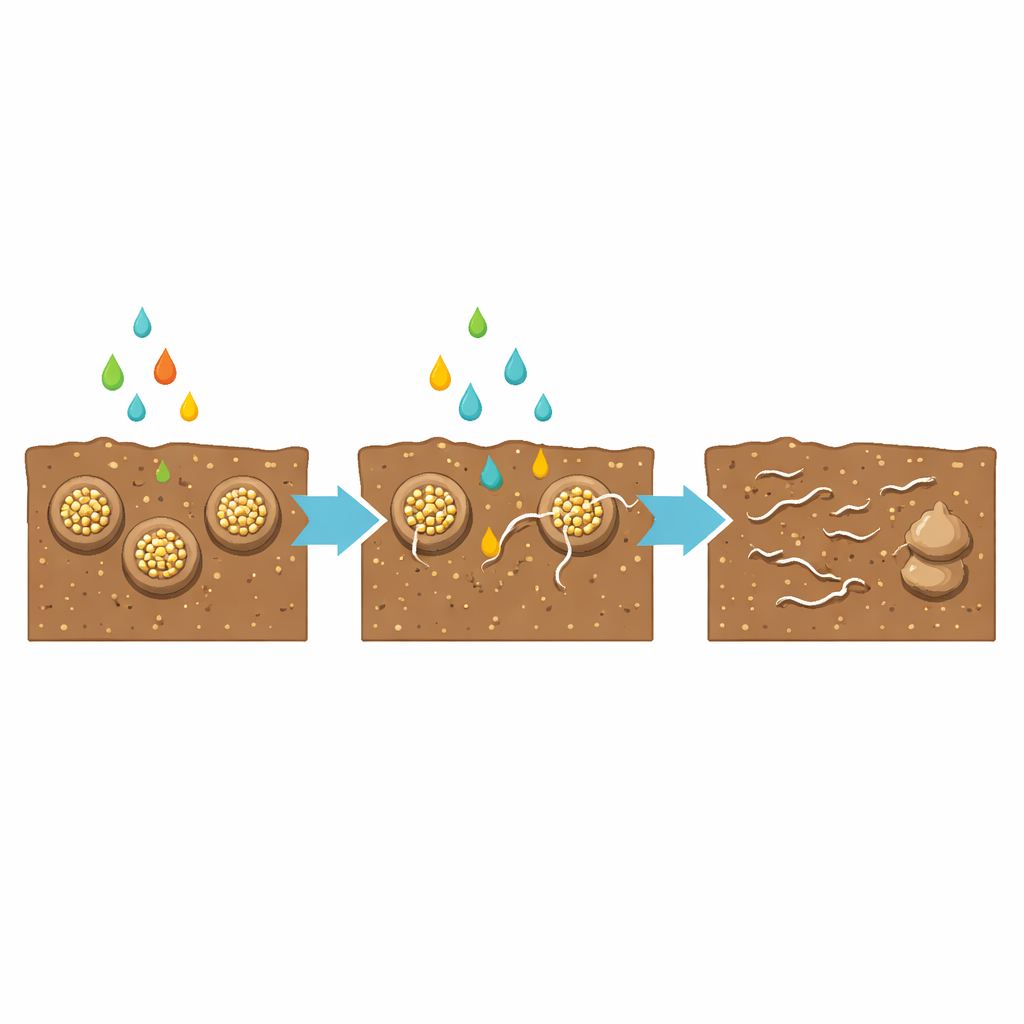
Potato cyst nematodes are microscopic roundworms that form tough, lemon-shaped cysts packed with eggs that can survive in soil for decades. Once the eggs hatch, the young worms must quickly find a potato root to feed on, or they die. Traditionally, farmers rely on chemical pesticides or crop rotations to keep these pests in check, but chemicals can pollute soil and water, and rotations alone often fail because the cysts are so long-lived. A safer way to manage these worms is to trigger a wave of hatching when there are no potato plants around, so the young nematodes starve instead of attacking the crop.
A New Use for Aeroponic Potato Nurseries
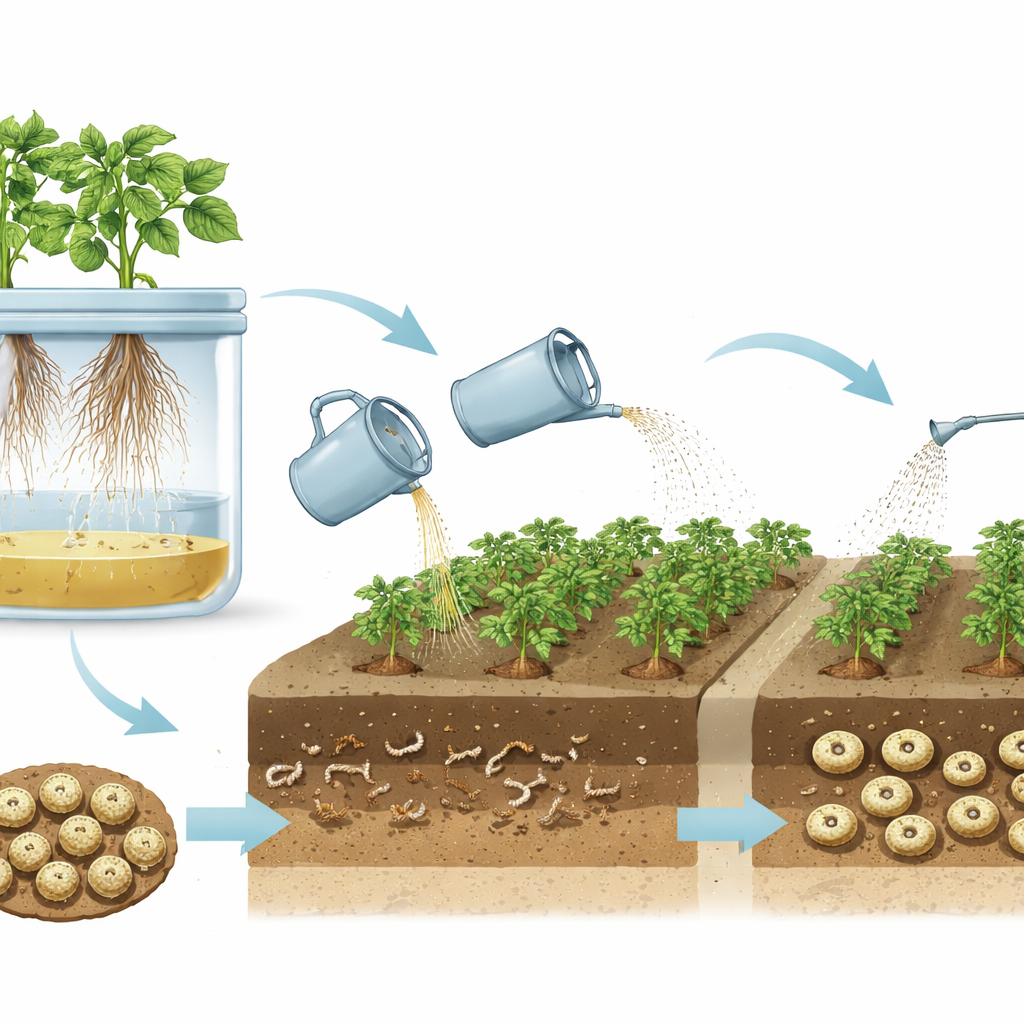
In aeroponic systems, potato plants grow with their roots hanging in air inside a closed box while a fine mist delivers nutrients. The leftover nutrient solution, known here as aeroponic root leachate, carries natural chemicals released by the roots and is usually discarded as waste. The researchers collected this liquid from 30-day-old aeroponic potato plants and compared its effects with traditional root exudates obtained by soaking soil-grown potato roots in water. They tested these liquids in the lab, in pots under glasshouse conditions, and in real fields to see whether they could reliably provoke hatching of cyst nematodes in the absence of a host plant.
Forcing the Worms to Hatch at the Wrong Time
Laboratory tests showed that aeroponic root leachate from 30-day-old plants was particularly powerful, triggering about four times more young nematodes to hatch than the conventional root exudate. Surprisingly, a diluted version—about half-strength—worked best, suggesting that the worms respond most strongly to a moderate signal rather than a concentrated one. When this liquid was poured onto soil in pots containing cysts but no potato plants, the number of living eggs per cyst dropped by nearly a third, while pots treated with plain water showed only tiny changes. In field trials over three years, plots repeatedly drenched with diluted aeroponic leachate showed large and consistent drops in both the number of cysts and the viable eggs inside them compared with untreated plots.
What Is Inside the Leachate and How Stable Is It?
To understand why the aeroponic leachate works so well, the team examined its contents and durability. They measured plant nutrients and found that most were present at low levels, suggesting the liquid would not overload soils. Chemical analysis confirmed the presence of two known potato compounds, often associated with natural bitterness, that are also known to stimulate nematode hatching. However, the leachate caused even more hatching than those purified compounds alone, implying that additional, still-unidentified substances are helping to drive the effect. Heating the leachate by boiling or autoclaving reduced its power, while cool storage in a refrigerator preserved most of its activity for months, pointing to heat-sensitive natural ingredients.
Lower Costs and a Smaller Environmental Footprint
The researchers also compared this leachate-based approach with conventional potato farming in terms of money, energy, and climate impact. Because the leachate is a by-product of seed potato production, using it requires little extra input beyond collection, storage, and field application. Calculations suggested that farmers using this strategy could slightly lower their production costs and reduce energy use, carbon inputs, and greenhouse gas emissions per hectare. In other words, turning waste leachate into a biological pest-control tool not only helps suppress a stubborn underground pest but also nudges potato farming toward a cleaner, more circular system.
A Gentle but Effective Way to Protect Potato Harvests
In everyday terms, this work shows that water drained from high-tech potato nurseries can be recycled to trick harmful soil worms into hatching when there is nothing for them to eat. Over time, this "suicide hatching" weakens nematode populations, making future crops safer without heavy reliance on synthetic chemicals. If refined and scaled up, this strategy could give farmers, especially in vulnerable mountain regions, a practical way to protect potato yields, reduce pollution, and make better use of resources that were once treated as waste.
Citation: Bairwa, A., Buckseth, T., Dipta, B. et al. Aeroponic root leachate (ARL)-induced hatching as a sustainable strategy for the management of Globodera rostochiensis in potato (Solanum tuberosum L.). Sci Rep 16, 8325 (2026). https://doi.org/10.1038/s41598-026-37908-x
Keywords: potato cyst nematode, aeroponics, biological pest control, root exudates, sustainable agriculture