Clear Sky Science · en
A lightweight YOLOv8n-based method for human abnormal posture detection
Why spotting unusual body positions matters
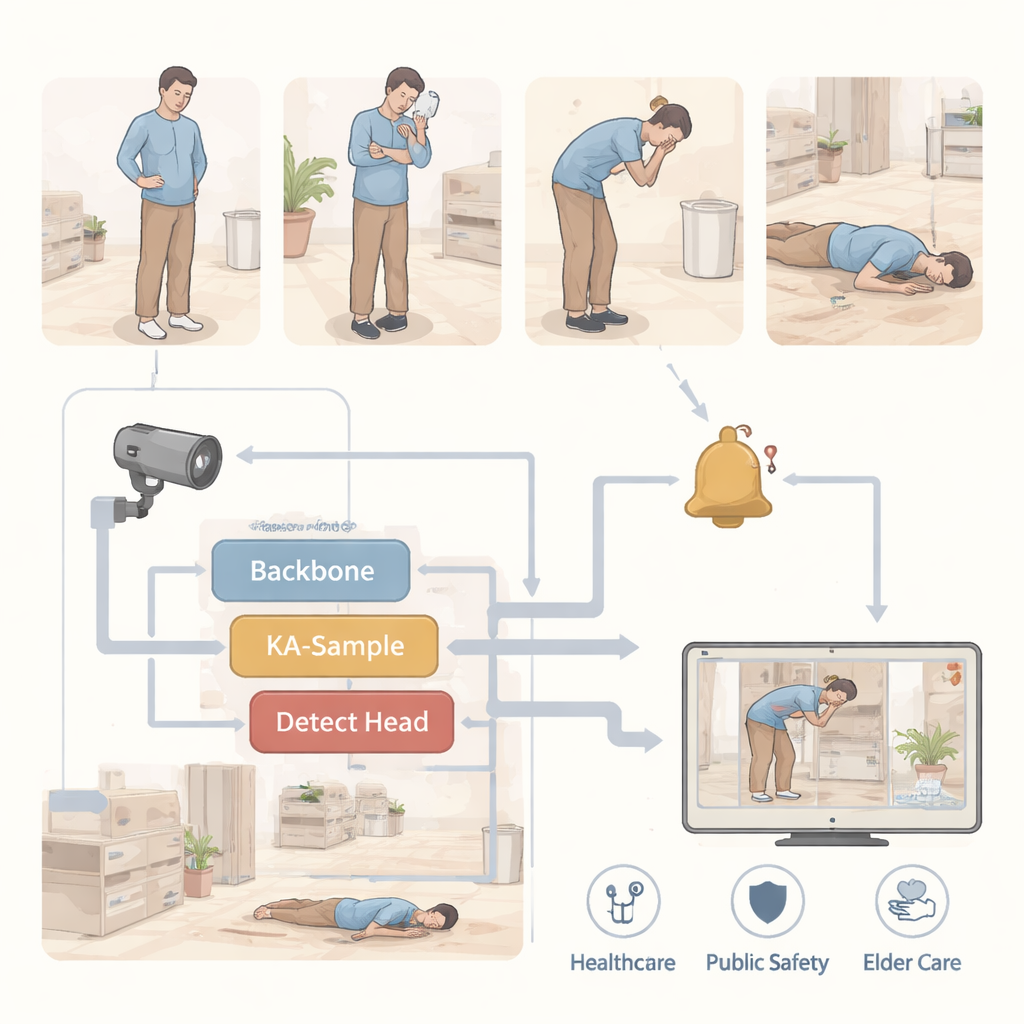
Falls, sudden chest pain, or someone collapsing in a hallway often unfold in seconds, and if no one is nearby, help may arrive too late. This paper presents a compact artificial intelligence system that can watch ordinary video from security or care‑home cameras and automatically flag dangerous, abnormal postures in real time. By making the software both accurate and lightweight, the researchers aim to bring reliable fall and health‑event detection to everyday devices, from hospital monitors to low‑cost cameras in seniors’ homes.
From simple cameras to smarter watchfulness
Modern monitoring systems already use computer vision to detect people and track their movements, but unusual postures are especially hard to spot. A person can look very different when standing, clutching their chest, vomiting, or lying on the floor, and these events are brief, varied, and often partly hidden by furniture or poor lighting. Existing algorithms can be quite accurate, but they are often bulky and slow, demanding powerful hardware and careful tuning. The authors focus on making detection both fast and frugal with computing resources so that it can run on common graphics cards or even embedded devices without sacrificing reliability.
A leaner brain for recognizing risky poses
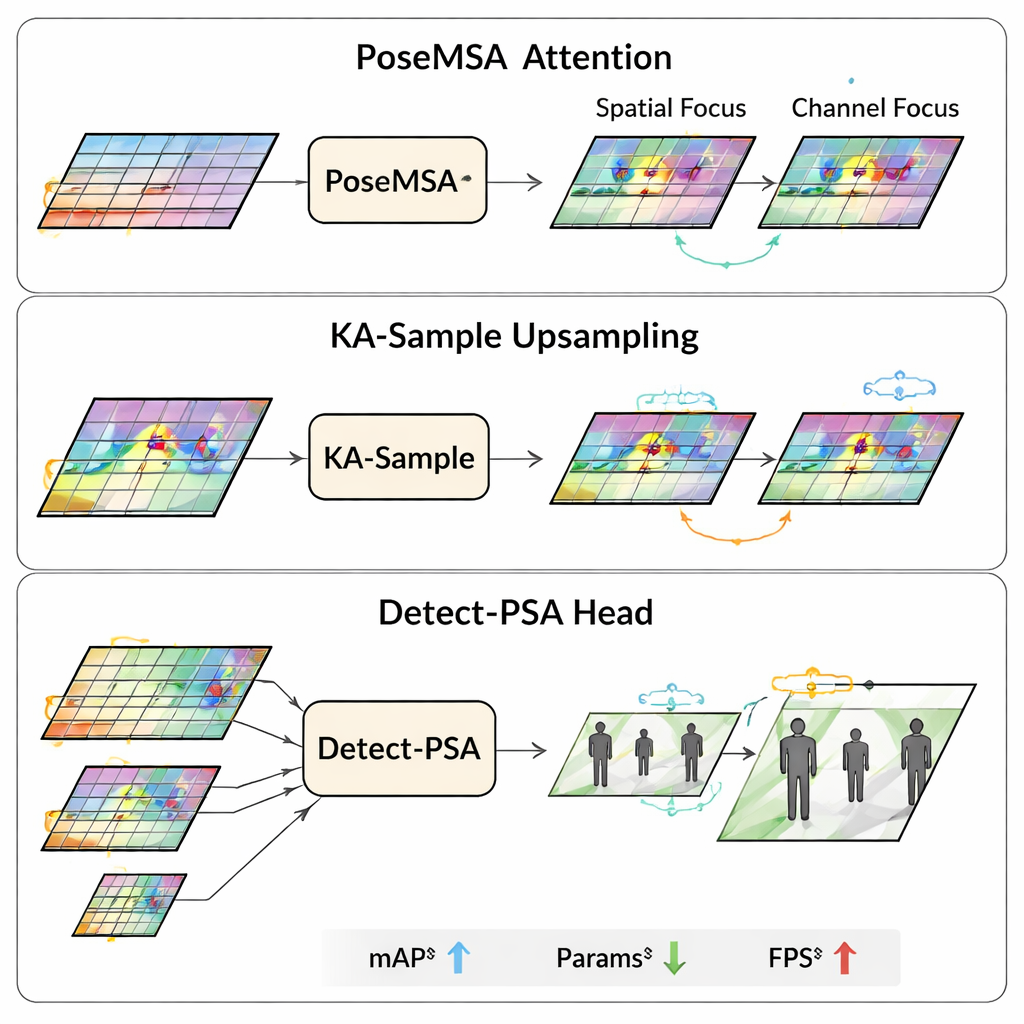
The core of the work is an improved version of a popular object‑detection model called YOLOv8n. The researchers build a lighter, more focused variant they call PSD‑YOLOv8n. First, they add a new attention module, PoseMSA, which helps the network concentrate on the most informative parts of a person’s body while ignoring cluttered backgrounds. It does this with streamlined operations that mimic looking both across the image and through the different layers of features, boosting the signals that matter for posture while keeping the number of calculations low. Second, they redesign how the model “zooms back in” on details using a KA‑Sample upsampling block, which learns to sharpen areas around key body points—like the head, torso, and limbs—so that twisted or collapsed poses stand out more clearly.
Sharper boxes and clearer decisions
Recognizing that abnormal postures often blur into their surroundings—think of a person sprawled partly under a table—the authors also overhaul the final decision stage, known as the detection head. Their Detect‑PSA module blends information from multiple scales and applies a probability‑based way of drawing bounding boxes. Instead of guessing a single hard edge for where a person begins and ends, the system represents each side of the box as a small distribution of likely positions and then averages them. This approach makes the outlines more stable when limbs are foreshortened, occluded, or stretched along the floor, leading to boxes that more closely match human‑drawn ground truth in challenging scenes.
Putting the system to the test
To see how well their design works in practice, the team created a dedicated image collection, the SSHDataset, built from multi‑angle indoor videos showing people in four states: normal, chest pain, vomiting, and fall. After careful hand‑labeling and data augmentation, they trained PSD‑YOLOv8n and a range of rival models under identical settings. On standard accuracy measures, their method reached a detection score of 97.8% at a common overlap threshold and maintained strong performance even under stricter criteria. At the same time, it used only about two million parameters and a 4.5‑megabyte weight file—roughly a third fewer parameters and over one‑third less computation than the original YOLOv8n—while running at more than 80 frames per second. Tests on an independent public fall‑detection dataset showed that the gains carried over to new data, with particularly strong improvements for spotting actual falls.
What this means for everyday safety
In plain terms, the study delivers a compact digital “lifeguard” that can watch live video and reliably notice when someone’s body position signals trouble. By carefully reworking how the model focuses on body regions, rebuilds fine details, and draws boxes around people, the authors achieve a rare combination of high accuracy, speed, and small size. Such a system could be embedded in hospital monitors, smart home hubs, or public‑space cameras to trigger timely alerts for falls or sudden distress, even in cluttered rooms and under varied lighting. As the approach is further refined and extended to longer video sequences and new environments, it may underpin a new generation of quiet, always‑on guardians that help keep vulnerable people safer without demanding constant human supervision.
Citation: Li, G., Zhang, J., Ji, Q. et al. A lightweight YOLOv8n-based method for human abnormal posture detection. Sci Rep 16, 7222 (2026). https://doi.org/10.1038/s41598-026-37903-2
Keywords: fall detection, human posture, computer vision, lightweight AI, elderly care