Clear Sky Science · en
Knowledge, attitudes, preventive practices, and associated factors of cutaneous leishmaniasis among adults of Kandahar city, Afghanistan
Why this skin disease matters to everyday life
In Kandahar, Afghanistan, a tiny night-biting insect leaves many people with open sores that can scar for life. This condition, called cutaneous leishmaniasis, does not just mark the skin; it can damage confidence, limit social life, and strain already poor families. The study in this article asks a simple but powerful question: how much do ordinary adults in Kandahar know about this disease, how do they feel about it, and what are they actually doing to protect themselves?
Taking the pulse of a city at risk
To answer these questions, researchers went house to house in three districts of Kandahar city between March and August 2024. They interviewed 2,044 adults, both men and women, all permanent residents. The team used a structured questionnaire to capture basic background information, test people’s understanding of the disease, gauge their attitudes, and record what prevention steps they took in daily life. Rather than laboratory tests, the focus was on real-world behavior and beliefs, because these shape whether people seek care and follow preventive advice.
What people know about the disease
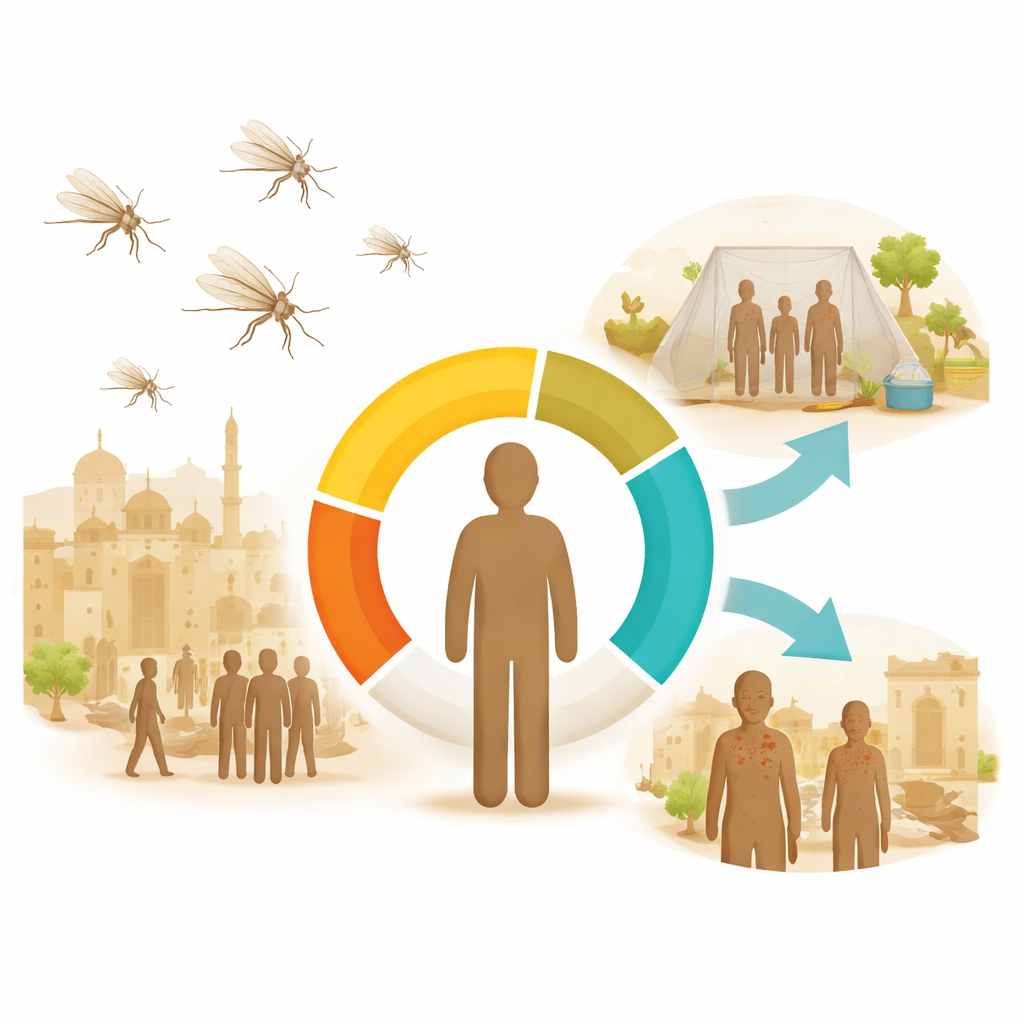
The survey revealed that most residents had heard of cutaneous leishmaniasis, and more than a third had a family member who had been infected. Yet deep understanding was rare. Only about one in four adults reached the threshold the researchers defined as "good" knowledge. Many could not identify typical skin lesions in photos, and only a small minority knew that tiny sandflies spread the disease. Fewer than one in three respondents realized that cutaneous leishmaniasis is serious, can be prevented, and can be cured. Poor knowledge was especially common among men, people without paid work, those who could not read or write, and those from families already affected by the disease.
Feelings, beliefs, and everyday habits
Attitudes were also troubling. Nearly six in ten adults scored as having a negative outlook toward the disease. While many agreed it was a problem in their area and believed treatment was possible, large groups also held incorrect or unhelpful beliefs. For example, many thought the disease was passed directly from person to person or saw it as a spiritual problem rather than a health issue. Most did not feel well informed and did not see late treatment as something that could lead to disability. People over 40 years old and those from middle- or higher-income families were especially likely to have negative attitudes, suggesting that wealth alone does not protect against misinformation.
Protection that is partial and uneven
When it came to prevention, habits were mixed. About seven in ten people reported using bed nets, and more than half said they disposed of household garbage properly, both of which can reduce contact with sandflies. However, very few used insect repellent, only about a third reported recent indoor spraying of insecticide, and almost nobody had ever taken part in organized control campaigns. Overall, only a third of adults showed good preventive practice. Poor prevention was more common among older adults, those who were illiterate, and people living in smaller families, hinting that both education and social support may play a role in daily protection.
What this means for health and policy
Taken together, the findings show that in a city where cutaneous leishmaniasis is common, most adults lack clear knowledge, hold many misconceptions, and only partly use measures that could protect them. The authors argue that health education in Kandahar needs to be greatly strengthened and carefully targeted, especially toward men, older adults, people who cannot read, and low-income households. By improving understanding of how sandflies spread the disease, when they bite, and how simple steps such as proper net use, cleaner surroundings, and indoor spraying can help, public health workers could reduce new infections and the lifelong scars they leave behind. In plain terms, better information and practical support could turn a widely accepted burden into a preventable problem.
Citation: Rahimi, B.A., Bakhtialy, K., Rahimi, A.F. et al. Knowledge, attitudes, preventive practices, and associated factors of cutaneous leishmaniasis among adults of Kandahar city, Afghanistan. Sci Rep 16, 8605 (2026). https://doi.org/10.1038/s41598-026-37902-3
Keywords: cutaneous leishmaniasis, Kandahar, health education, vector-borne disease, Afghanistan