Clear Sky Science · en
Effect of nano-silica and sisal fibre on the mechanical and durability properties of concrete
Why this new kind of concrete matters
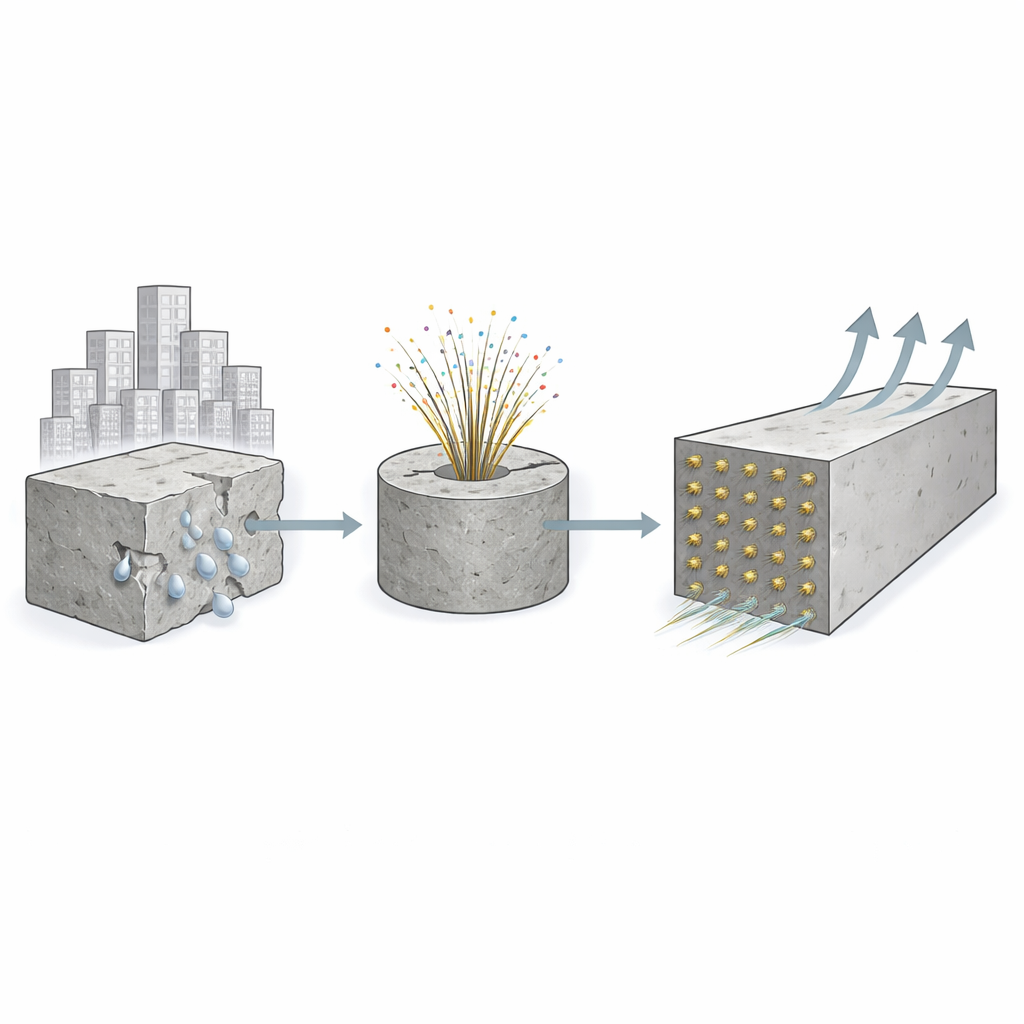
Concrete is everywhere: in our homes, roads, bridges, and schools. But it can crack, wear down under harsh weather, and its production has a big environmental cost. This study explores a way to make concrete tougher, longer lasting, and slightly greener by blending a plant-based fiber from sisal leaves with ultra-fine mineral particles called nano-silica. Together, they create a concrete that resists cracking and chemical attack better than ordinary mixes, offering a pathway to more durable and eco-conscious buildings.
From brittle blocks to tougher mixes
Conventional concrete is excellent at bearing weight but poor at handling tension, which is why cracks form over time. Engineers often add steel bars to help, but there is growing interest in improving the concrete itself using fibers and tiny mineral additives. In this research, the authors combined sisal fibers—a natural material derived from an agave-like plant—with nano-silica, whose particles are thousands of times smaller than a grain of sand. The goal was to see whether this pairing could improve both the strength and the durability of concrete without significantly increasing cost or complexity.
What was added and how it was tested
The team made a standard concrete mix and then modified it by replacing 3% of the cement with nano-silica and adding 1.5% sisal fiber by weight. They kept the fiber amount the same but changed its length: short (6 mm), medium (12 mm), and long (18 mm). In total, they cast around 90 specimens to measure compressive, tensile, and bending strength, and 48 more to study durability, including resistance to acid attack and penetration of harmful chloride salts. Samples were cured in water and tested at different ages, up to 28 days, using standard engineering procedures to ensure consistent and statistically reliable results.
Stronger concrete from the inside out
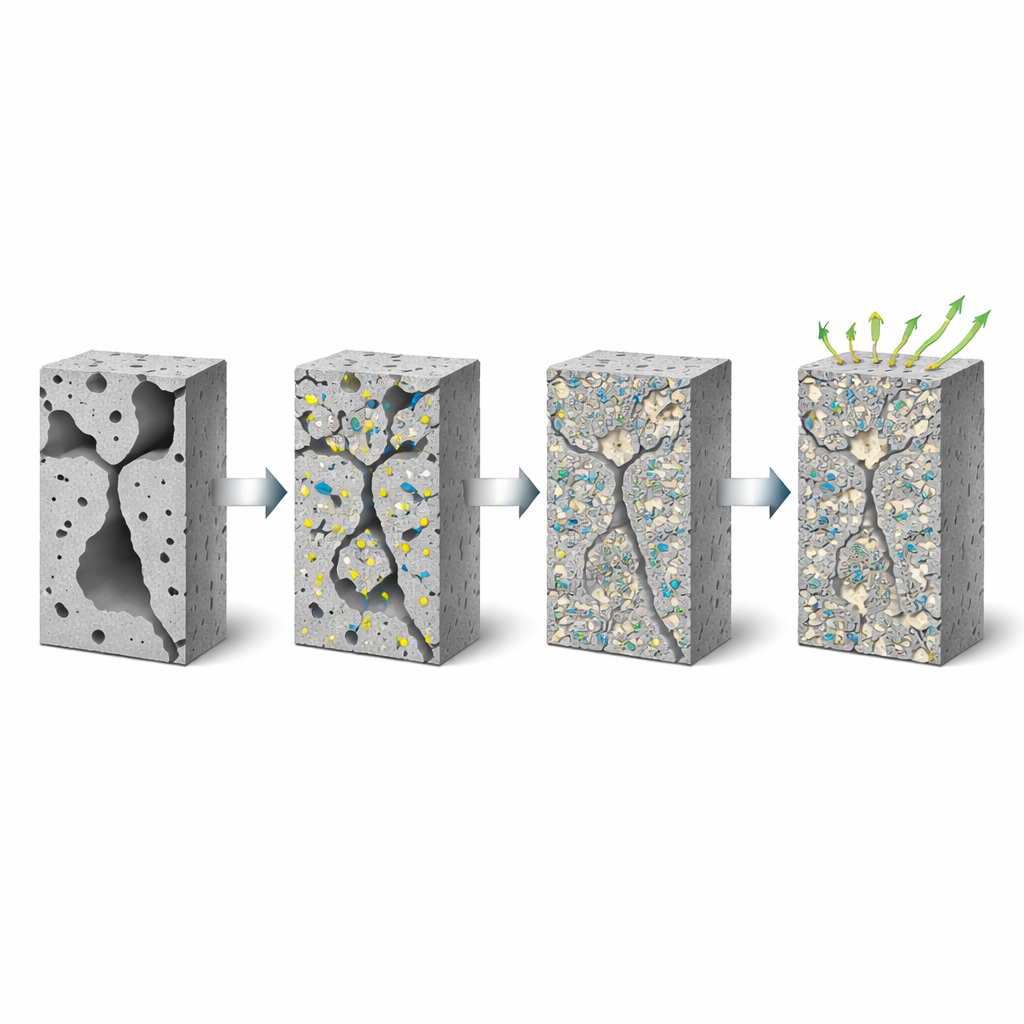
The results showed that not all fibers are equal: the medium-length sisal fibers (12 mm) combined with nano-silica gave the best overall mechanical performance. Compared with plain concrete, this mix gained about 7.8% more compressive strength, 16.8% more tensile strength, and 19.2% more bending strength. The researchers explain this by how the ingredients interact. Nano-silica particles are so small that they fill gaps between cement grains and react with them, creating a denser internal structure with fewer pores. At the same time, the sisal fibers act like tiny bridges across developing cracks, helping the concrete stretch slightly instead of breaking suddenly. Medium-length fibers were long enough to bridge cracks effectively but short enough to stay well distributed, avoiding clumping that can weaken the mix.
Fighting acids, salts, and slow decay
Durability tests looked at some of the most damaging conditions real structures face: acidic environments and exposure to chloride salts, which can eventually corrode steel reinforcement. Concrete made with nano-silica and the longest sisal fibers (18 mm) lost less weight and strength when soaked in hydrochloric and sulfuric acid than ordinary concrete did. It also allowed less electrical charge to pass through in a standard chloride penetration test, indicating that fewer aggressive ions could enter the material. The longer fibers appear to be especially helpful at holding the material together as acids try to eat away at it, while the nano-silica reduces the number of pathways that chemicals can use to travel inward.
What this means for future buildings
For everyday readers, the takeaway is that concrete doesn’t have to be a simple grey, crack-prone material. By blending plant fibers with extremely fine mineral particles, engineers can produce mixes that are modestly stronger and noticeably more resistant to harsh environments, while slightly reducing cement content and associated emissions. The study suggests that a combination of 3% nano-silica and 1.5% sisal fiber—especially with 12 mm fibers for strength and 18 mm fibers for durability—could be useful for non-structural and semi-structural elements where crack control and long service life are important. In the long run, such innovations could help cities build infrastructure that lasts longer, needs fewer repairs, and relies more on renewable, plant-based ingredients.
Citation: Shanmugam, K., Deivasigamani, V., Arunvivek, G.K. et al. Effect of nano-silica and sisal fibre on the mechanical and durability properties of concrete. Sci Rep 16, 8212 (2026). https://doi.org/10.1038/s41598-026-37901-4
Keywords: sustainable concrete, nano-silica, natural fibers, durable materials, civil engineering