Clear Sky Science · en
Morphological diversity of pollen and spores in a human-impacted highland forest–agriculture mosaic in northern Thailand
Hidden Clues in Dusty Forest Soils
Imagine being able to read the history and make-up of a landscape not from trees or flowers you can see, but from microscopic grains buried in the soil. This study does exactly that in a highland area of northern Thailand where mountain forests now mingle with farm fields. By closely examining pollen and spores preserved in a shallow slice of soil, the researchers build a detailed visual guide that can help future scientists trace how tropical ecosystems respond to logging, farming, and restoration.
A Mountain Park Under Pressure
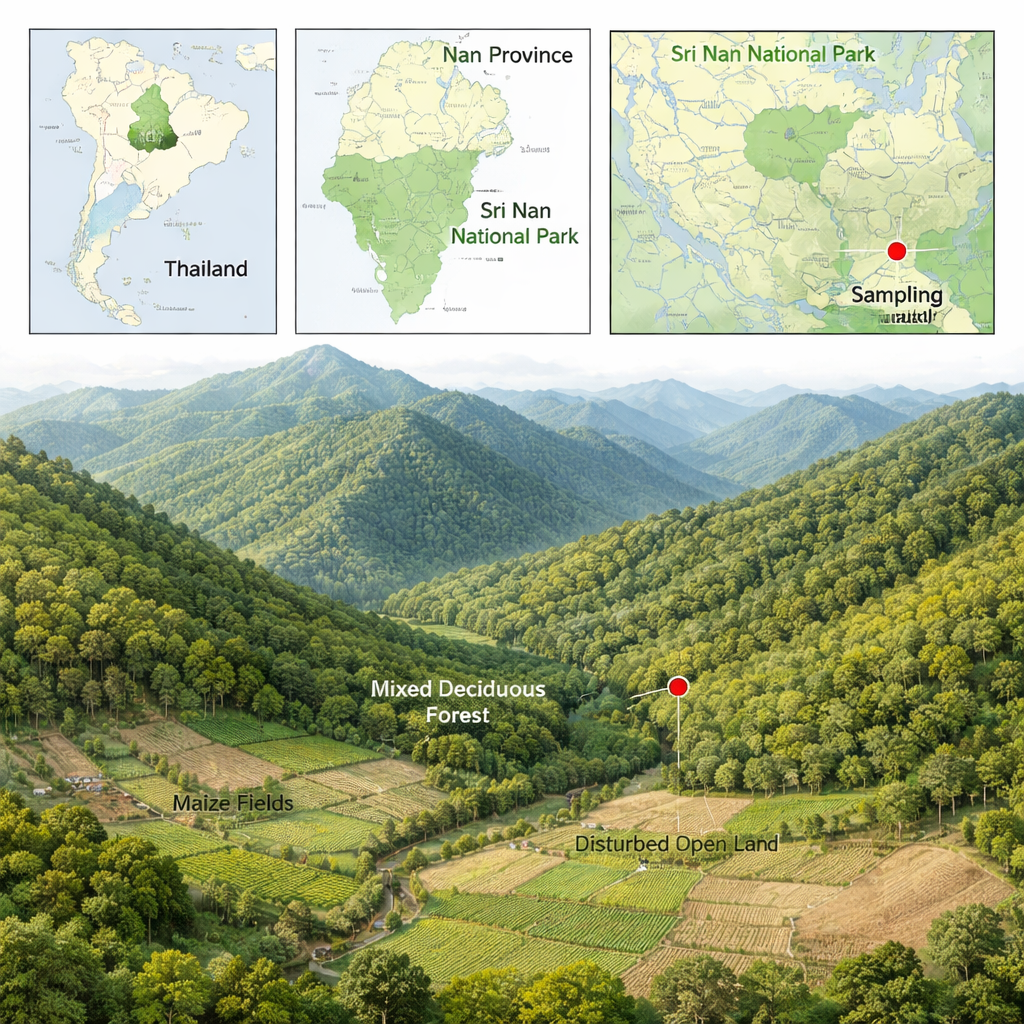
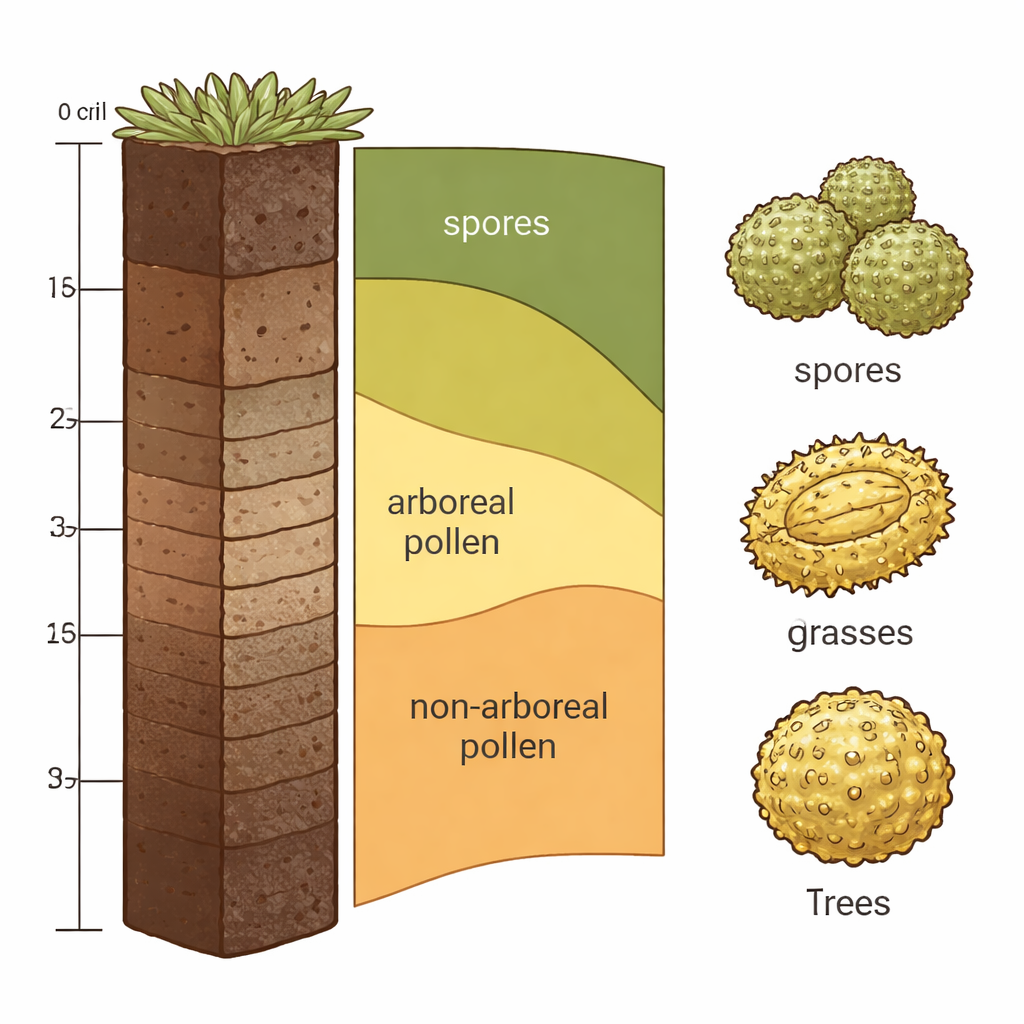
The work takes place in Sri Nan National Park, a rugged region of steep ridges and valleys that feeds one of Thailand’s major river systems. Once dominated by a mix of evergreen and deciduous forests, parts of this landscape have been heavily reshaped by people, especially through maize fields and rubber plantations. The team focused on a former mixed deciduous forest patch that, as of 2024, had been converted into maize cultivation. From this disturbed site, they collected a 30‑centimeter column of soil, sampling it every 3 centimeters to capture a fine-grained picture of what tiny plant remains have been accumulating near the surface.
Microscopic Hunting Without Harsh Chemicals
To study these grains, the scientists used a gentle, acid‑free laboratory method designed to keep delicate shapes and surface details intact. Soil samples were treated with mild solutions and density separation to remove unwanted material while preserving the pollen and spores. The cleaned residues were then mounted on microscope slides and examined at high magnification. Instead of forcing every grain into a formal species name, the researchers carefully grouped them into “morphotypes” based on simple traits such as size, symmetry, the number and shape of openings, and the texture of the outer wall. They then matched these morphotypes to known plant families and genera using specialized atlases and online image libraries.
Ferns, Grasses, and Scattered Trees
The shallow soil turned out to be rich in microscopic life traces. In total, the team identified pollen and spores from 37 plant families, including ferns and their relatives, conifers, and many flowering plants. Spores from ferns and other spore‑forming plants made up about 43 percent of all finds, confirming that these groups can dominate microscopic records in humid tropical soils. Grains from herbs and grasses, including maize, were also abundant, reflecting open ground, disturbed sites, and farmland around the sampling point. In contrast, tree pollen from forest species was consistently rare and scattered, even though nearby hillslopes still support patches of woodland. This mix of many spores, plentiful herb pollen, and only modest tree pollen paints a picture of a patchy, human‑affected mosaic rather than an intact, closed forest.
What Soil Layers Can and Cannot Tell Us
Although the grains were counted at different depths, the authors stress that this thin soil column should not be read as a neat timeline of past vegetation. In tropical soils, roots, animals, and repeated wetting and drying can shuffle particles up and down, while fragile grains decay faster than tougher ones. As a result, the vertical pattern mainly shows which types of plants contribute material to the soil over an unknown span of time, not a year‑by‑year story of forest loss or recovery. The real value of the profile lies in documenting which microscopic forms appear in such a disturbed mountain setting, and how they look under standardized, gentle preparation.
A Visual Field Guide for Future Eco‑Detectives
By assembling over one hundred clearly described morphotypes backed by sharp microscope images, this study creates a regional picture book for pollen and spores from human‑impacted highland landscapes in Southeast Asia. Researchers working on topics as varied as forest restoration, archaeology, climate history, and even automated image recognition can now compare their own samples to this reference set with greater confidence. For a lay reader, the takeaway is that the dust underfoot holds a durable fingerprint of the plants that share, and have shaped, a place. Making that fingerprint easier to read helps scientists better understand how tropical forests respond to farming and other pressures, and how they might be guided toward recovery.
Citation: Sattraburut, T., Vongvassana, S., Phutthai, T. et al. Morphological diversity of pollen and spores in a human-impacted highland forest–agriculture mosaic in northern Thailand. Sci Rep 16, 6794 (2026). https://doi.org/10.1038/s41598-026-37899-9
Keywords: pollen, spores, tropical forests, land-use change, palynology