Clear Sky Science · en
Influence of soil-structure interaction and ground motion parameters on the seismic vulnerability of RC buildings
When the Ground and Building Move Together
Earthquakes do not just shake buildings; they shake the ground that holds them up. This study looks at what happens when the soil under a mid-rise concrete building is allowed to move and deform during an earthquake, instead of being treated as a perfectly solid base. By exploring how different types of soil and different kinds of shaking change the way a building sways and cracks, the work helps explain why some structures are far more at risk than others, even when they follow the same design rules.
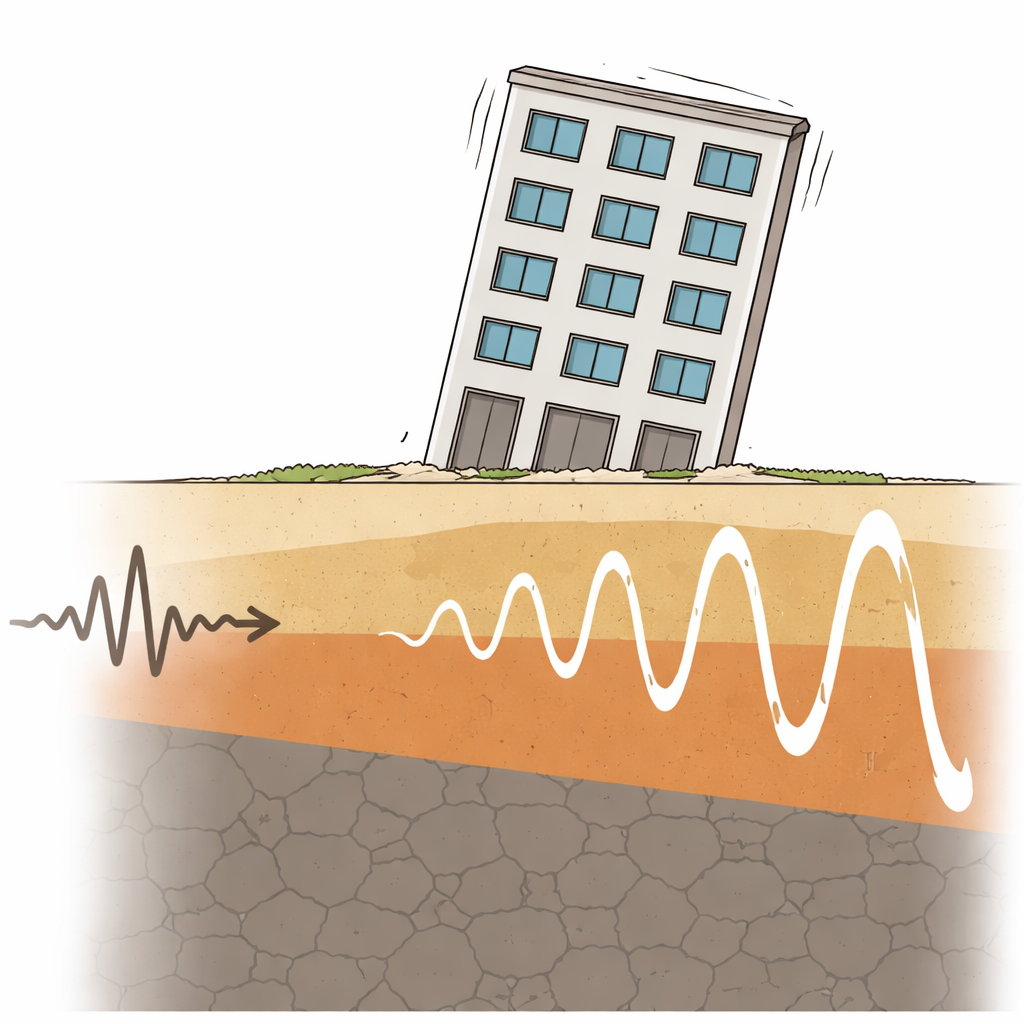
The Hidden Role of the Ground Beneath Us
Many building calculations quietly assume that the foundation sits on rock that hardly moves. That shortcut can work on very hard ground, but it breaks down on soft layers of sand and clay, which are common in cities worldwide. In such settings, the building and the soil behave as a coupled system: as the structure sways, it pushes on the ground; the ground deforms and pushes back. This back-and-forth, known as soil–structure interaction, can stretch the building’s natural rhythm of motion and change how much it drifts from side to side during an earthquake.
A Virtual Building on Layers of Sand and Clay
The authors built a detailed three-dimensional computer model of a typical five-story reinforced concrete frame resting on shallow footings. The soil profile beneath it was split into an upper layer of dense sand and a lower, thicker layer of soft clay over bedrock about 50 meters down. Sophisticated soil models were used so that dense sand could stiffen or soften realistically at small strains, while clay was treated with a simpler strength-based description. The model was first checked against known tests on footings and beams to ensure that it reproduced realistic settlements, bending, and soil bearing strength before any earthquake motions were applied.
How Earthquake Shaking Changes with Soil and Distance
To probe seismic behavior, the researchers ran hundreds of simulated earthquakes through the soil–building system. They selected real ground motions recorded both far from faults and very close to them. Far-field earthquakes tend to produce longer, more rounded shaking, whereas near-fault events can generate sharp pulses that push a building strongly in one direction. All motions were gradually scaled in strength, and for each case the model tracked how much each story of the structure drifted sideways, a direct indicator of potential cracking and damage.
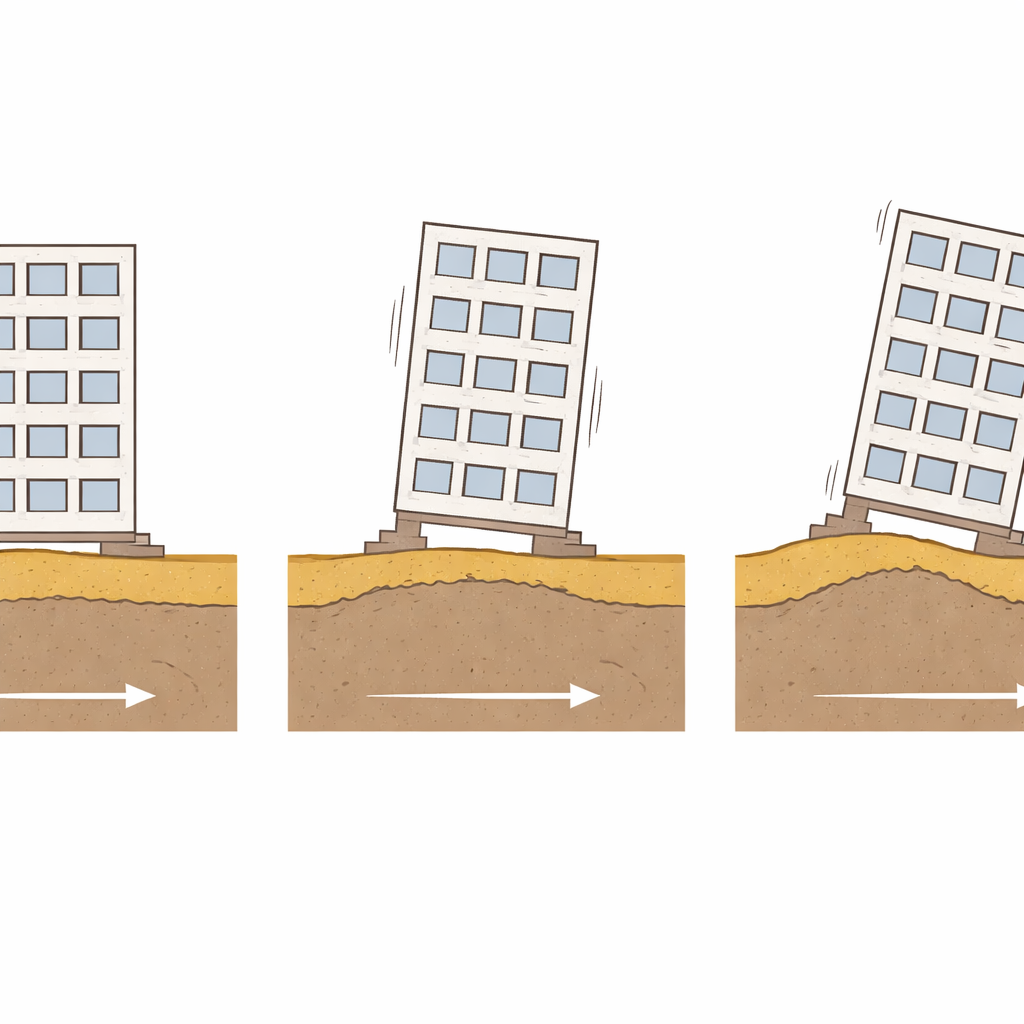
More Flexibility, More Drift, More Damage Risk
When the soil beneath the building was allowed to deform, the overall system became more flexible and its natural period lengthened, especially when underlain by soft clay. That extra flexibility led to larger sideways displacements and interstory drifts than in an idealized “fixed base” case. Under vertical loads alone, the soil–building system settled about three times more than the rigid-base model. Under earthquake loading, lateral drifts in the interacting soil–building system grew to five to seven times those of the fixed base, with soft clay and flexible foundations amplifying the motion most strongly. When the team converted these drifts into so-called fragility curves—which show the chance that a structure will reach slight, moderate, extensive, or complete damage at a given shaking level—they found a clear pattern: combining soft soil, foundation flexibility, and near-fault pulses pushed the building into severe damage at lower shaking intensities than any other scenario.
What This Means for Safer Cities
For a design-level earthquake, the modeled building was almost twice as likely to suffer complete damage when both soil–structure interaction and near-fault shaking were present, compared with a similar building on a rigid base shaken by far-field motions. Put simply, the ground is not just a passive platform; it actively shapes how a building responds and how soon it may fail. The study shows that realistic soil behavior and local earthquake characteristics must be built into modern seismic design and risk assessments, especially for mid-rise concrete buildings on soft ground near active faults.
Citation: Debnath, P., Das, T. & Choudhury, D. Influence of soil-structure interaction and ground motion parameters on the seismic vulnerability of RC buildings. Sci Rep 16, 9400 (2026). https://doi.org/10.1038/s41598-026-37898-w
Keywords: soil-structure interaction, seismic vulnerability, reinforced concrete buildings, near-fault earthquakes, fragility curves