Clear Sky Science · en
Air quality prediction model based on deep learning hybrid framework
Why cleaner air forecasts matter to you
When smog blankets a city, people suddenly have to make practical choices: Is it safe to jog outside, send children to school, or keep factories running? Those decisions depend on how well we can predict tiny pollution particles called PM2.5, which are small enough to lodge deep in the lungs. This study introduces a new computer model that uses recent advances in artificial intelligence to predict PM2.5 levels in Chinese cities more accurately and more quickly than many existing tools, potentially giving the public and policymakers earlier, more reliable warnings.
From smoky skies to smart data
Air pollution has become a persistent health threat in many urban areas, especially in northern China, where high PM2.5 levels are linked to respiratory and cardiovascular diseases. Cities now operate dense networks of monitoring stations that track PM2.5, other pollutants, and local weather every hour. Traditional prediction methods rely on simplified mathematics or handcrafted physical models, which struggle with the messy, nonlinear reality of swirling winds, temperature shifts, and human activity. In contrast, the new approach, called CBLA, lets the data “speak for itself” by training modern neural networks on several years of observations from Beijing and Guangzhou.
How the new forecasting engine works
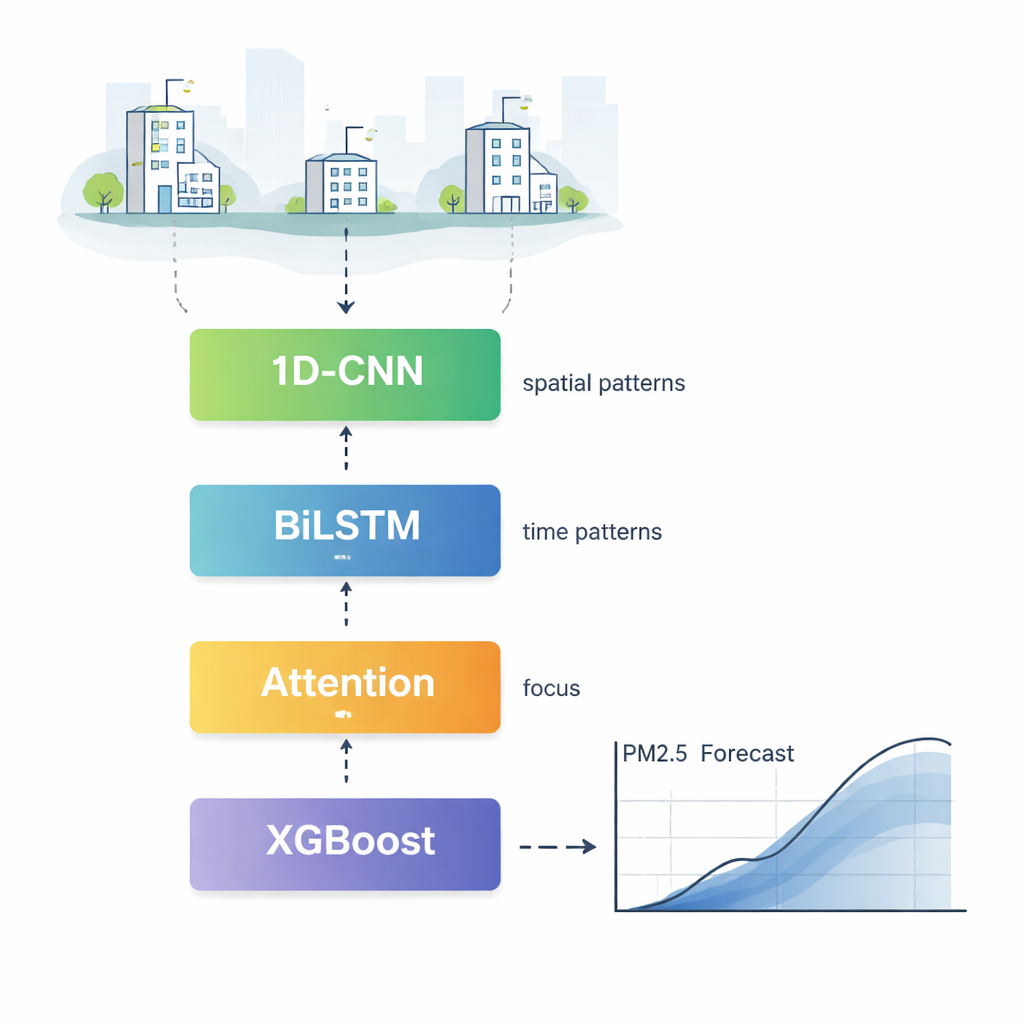
CBLA acts like a layered team of specialists that study pollution data from different angles before voting on a final forecast. First, a component known as a one‑dimensional convolutional network scans measurements from many monitoring stations to pick out patterns that repeat across space, such as how smoke tends to spread from one neighborhood to another. Next, a bidirectional memory network reads pollution histories forward and backward in time, learning how today’s levels depend on both recent and slightly older conditions. An attention mechanism then highlights the most influential hours and features, allowing the model to focus more on, say, yesterday’s sharp spike and strong winds rather than distant, less relevant readings.
Adding weather to sharpen the picture
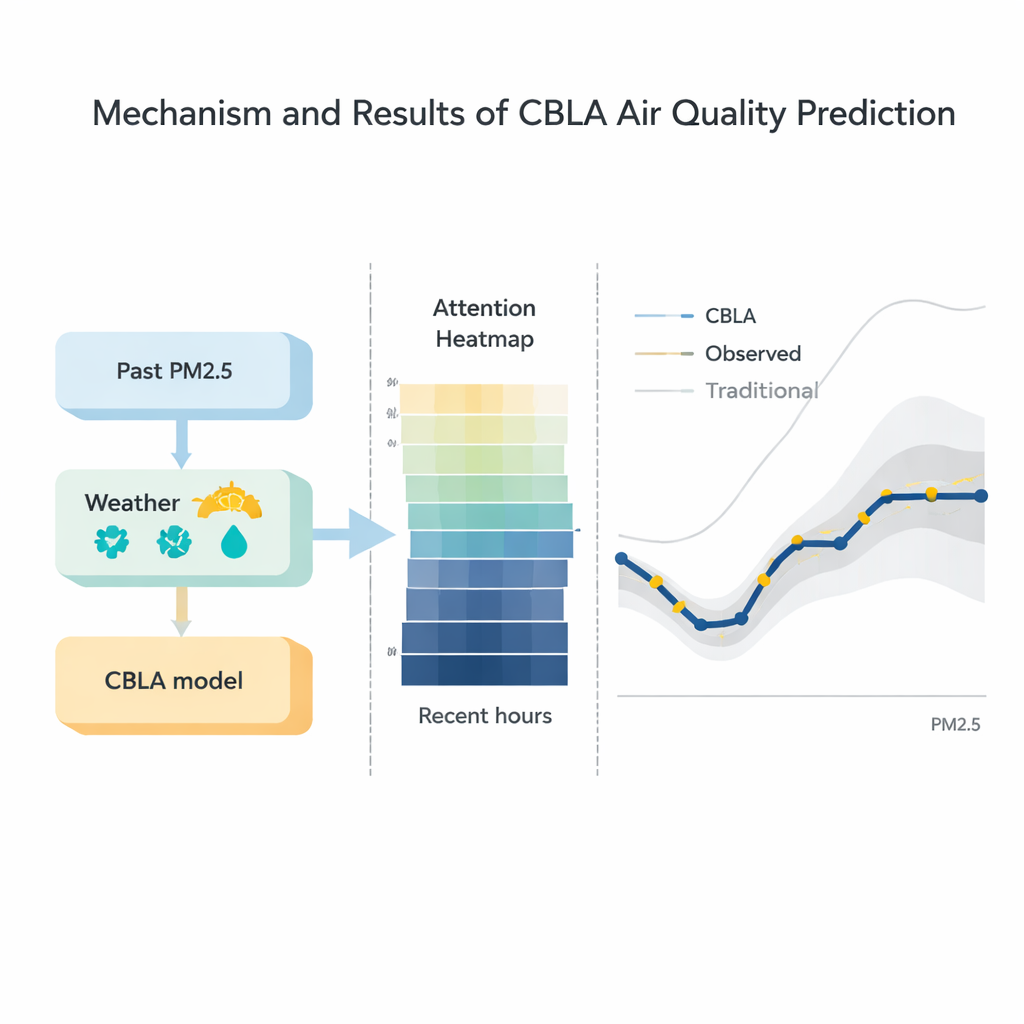
Pollution does not move in isolation; it rides on changing weather. To fold this information in cleanly, the authors add a second stage that feeds both the preliminary neural‑network forecast and detailed meteorological data—such as wind speed, humidity, and temperature—into a powerful tree‑based algorithm called XGBoost. This stage behaves like an experienced forecaster cross‑checking the initial guess against current weather, nudging the prediction up or down. Tests show that this combination reduces typical prediction errors and improves how closely the model’s output follows real‑world measurements, especially during sudden pollution build‑ups and clear‑out events.
Testing against rival models
The researchers compared CBLA with a wide range of alternatives, from classic techniques like regression and ARIMA time‑series models to sophisticated deep‑learning hybrids that combine graph networks and transformers. Across three real datasets, CBLA consistently produced the lowest average error and the tightest fit to observed PM2.5 levels. Importantly, it achieved accuracy comparable to some of the most advanced modern models while requiring only about one‑third of their training time on standard hardware. Visualizations of the attention mechanism revealed that the model naturally gives greatest weight to the most recent few hours of data and to physically meaningful factors such as wind speed and past PM2.5 levels, offering a window into how its decisions align with meteorological intuition.
What this means for everyday life
In practical terms, the study shows that carefully combining several AI techniques can yield a pollution forecasting tool that is not only more accurate but also faster and easier to interpret. City managers could use such a model to trigger health advisories, adjust traffic restrictions, or pre‑emptively scale back industrial activity hours before dangerous smog peaks. For residents, better forecasts mean clearer guidance on when to wear masks, run air purifiers, or keep children indoors. While the work focuses on Chinese cities and PM2.5, the same framework could be adapted to other regions and pollutants, pointing toward a future in which data‑driven forecasts help millions breathe a little easier.
Citation: Yin, C., Li, W., Li, T. et al. Air quality prediction model based on deep learning hybrid framework. Sci Rep 16, 7084 (2026). https://doi.org/10.1038/s41598-026-37896-y
Keywords: air quality prediction, PM2.5, deep learning, urban pollution, meteorology