Clear Sky Science · en
Comparison of multi-planar and sagittal-plane stepping machines for walking and balance restoration in chronic stroke: a randomized control trial (RCT)
Why this matters for stroke survivors and families
After a stroke, many people struggle to walk steadily and fear falling, even years later. This study asks a practical question that concerns patients, caregivers, and therapists alike: which common rehab machine does a better job at restoring balance and confident walking—a standard elliptical trainer or a newer stair‑climbing style machine called the Pinnacle Trainer? By directly comparing these options in a controlled trial, the researchers provide evidence that can guide safer, more effective exercise choices in stroke recovery.
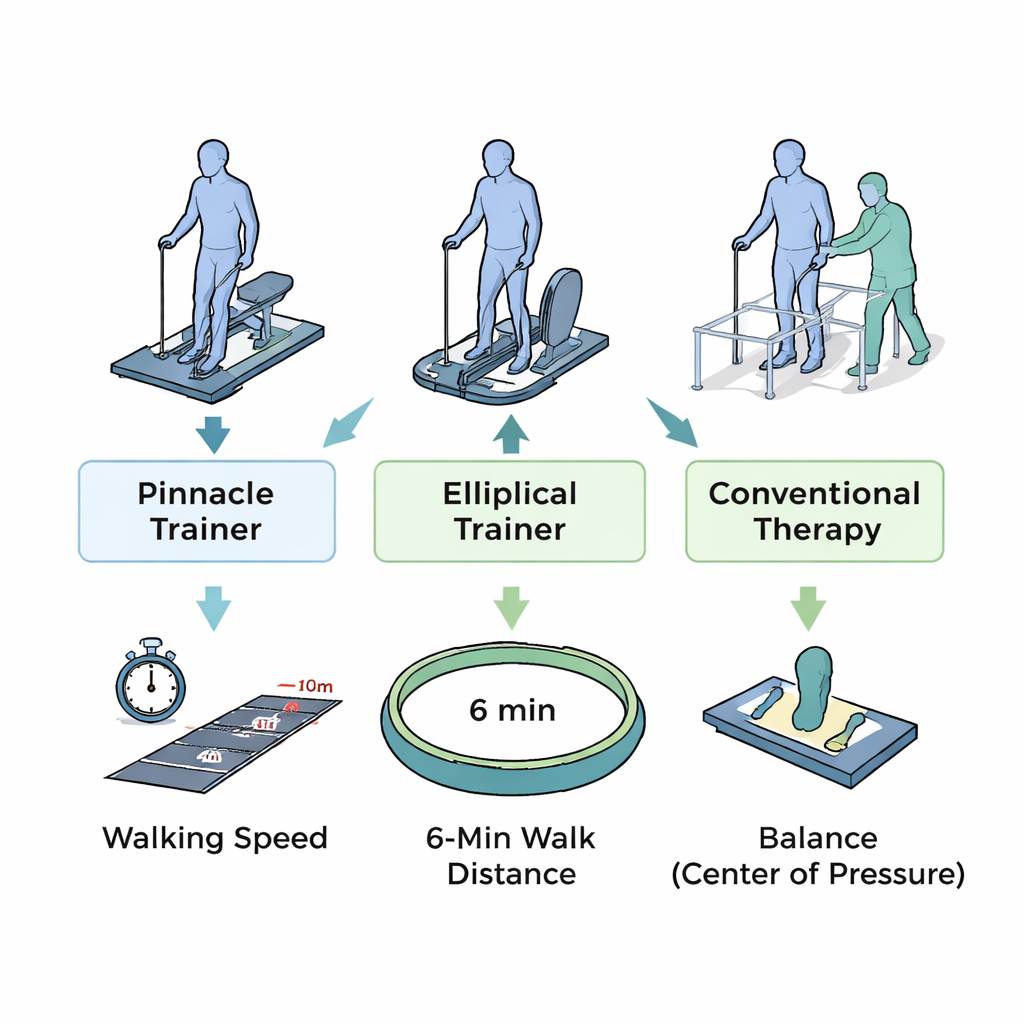
Two different machines with two different movement styles
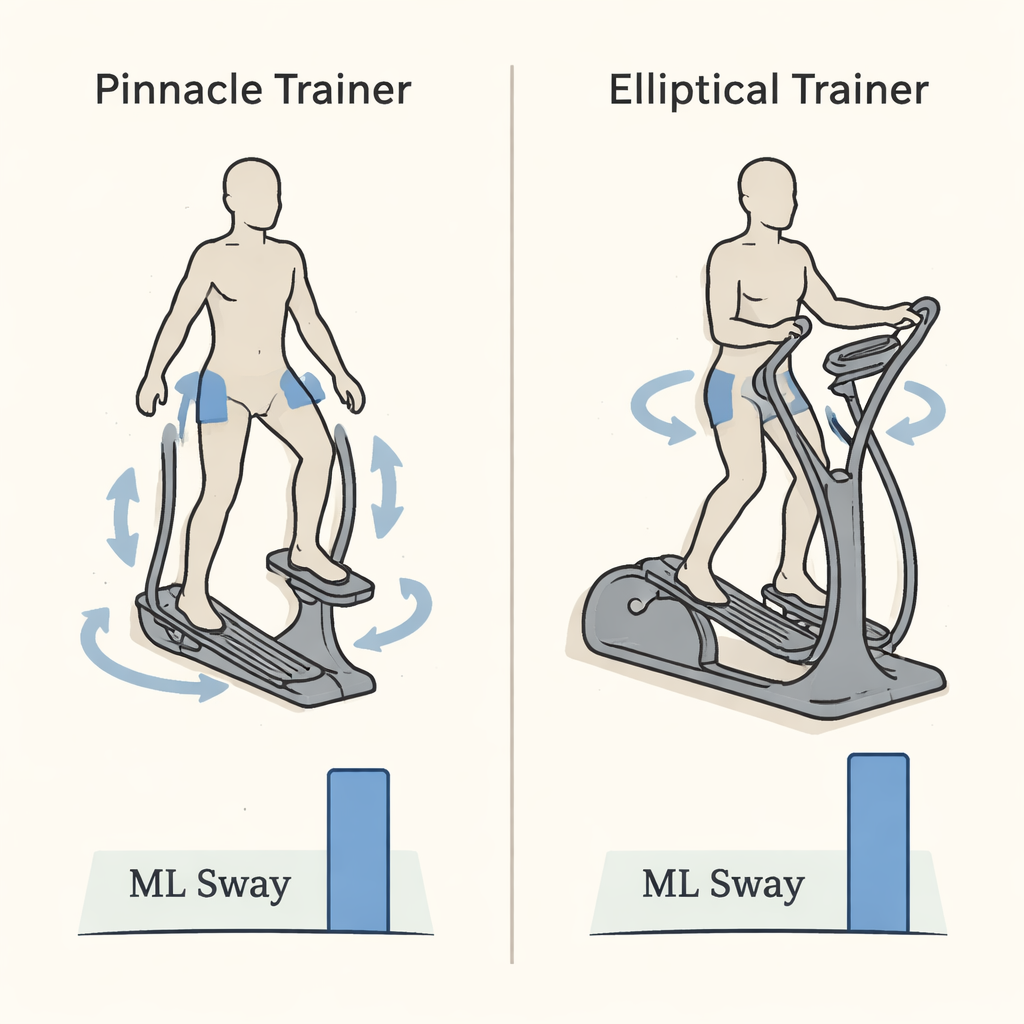
The two exercise machines may look similar in a gym, but they challenge the body in very different ways. The elliptical trainer moves the feet in a smooth, forward‑and‑back oval path that imitates walking with low impact on the joints. The Pinnacle Trainer, by contrast, asks users to step not only up and down like a stair climber, but also slightly side to side. This sideways component demands more control from the muscles around the hips that help keep the body from tipping, especially the muscles on the outer side of the hips that stabilize the pelvis. Because stroke often weakens these stabilizing muscles and shifts weight off the affected leg, the team suspected that the Pinnacle’s multi‑directional motion might better retrain balance than the elliptical’s straight‑ahead path.
How the study was carried out
The researchers recruited 36 adults living with chronic stroke—on average more than two years after the event—who could walk but still had lingering movement problems. Participants were randomly placed into three groups: one trained on the Pinnacle Trainer plus standard therapy, one trained on the elliptical plus standard therapy, and a control group received only standard therapy such as overground walking and traditional exercises. Training lasted eight weeks, three times per week, with about 30 minutes of stepping on the assigned machine followed by 30 minutes of conventional therapy. The machines were set to low resistance, and therapists focused on correct, safe movement rather than intense workouts, gradually increasing the number of steps as participants’ control improved.
Measuring walking and balance in real‑world tasks
To see how much people improved, the team used tests that mirror everyday challenges. Walking ability was tracked with a six‑minute walk (how far you can go in six minutes) and a ten‑meter walk (how fast you can safely cover ten meters). Balance was probed in a tougher situation: stepping over a small obstacle while standing on a force plate that recorded how much the body’s center of pressure swayed forward‑back and side‑to‑side. Larger sway, especially sideways, signals poorer stability and a higher risk of losing balance. Importantly, the therapists and biomechanist doing these measurements did not know which training each participant had received, helping to keep the results unbiased.
What improved—and what improved the most
Across all three groups, people walked farther and faster after eight weeks. Even the control group, which did not use a machine, gained walking speed and endurance, showing that structured, repeated practice still helps in the chronic phase of stroke recovery. However, when the researchers looked at balance, clear differences emerged. Only those who trained on the Pinnacle Trainer showed a marked reduction in sideways sway when stepping over an obstacle, a sign of better lateral stability. The elliptical group did not match this improvement and in fact showed the least reduction in side‑to‑side sway. More participants in the Pinnacle group also achieved a change in six‑minute walking distance large enough to be considered clinically meaningful, suggesting that the benefits were not just statistically detectable but also noticeable in daily life.
What this means for choosing rehab exercise
For people living with chronic stroke, the study suggests that both traditional therapy and stepping‑based machines can help maintain or improve walking over time. But when it comes to regaining steadier balance—especially the ability to control the body side‑to‑side, which is crucial for preventing falls—the Pinnacle Trainer appears to offer an edge over a standard elliptical. Its added sideways motion likely forces the brain and hip muscles to relearn how to support the body over the weaker leg. While larger studies are still needed, these findings support using multi‑directional stepping devices, when available and medically appropriate, as a targeted way to rebuild confidence and safety in walking after stroke.
Citation: You, YL., Lin, CF., Kuan, TS. et al. Comparison of multi-planar and sagittal-plane stepping machines for walking and balance restoration in chronic stroke: a randomized control trial (RCT). Sci Rep 16, 7769 (2026). https://doi.org/10.1038/s41598-026-37893-1
Keywords: stroke rehabilitation, balance training, elliptical trainer, gait recovery, fall prevention