Clear Sky Science · en
Public acceptance for genetic engineering techniques: the role of food values-based information
Why this research matters for your dinner table
As climate change, population growth, and rising food prices put pressure on our plates, scientists are turning to new genetic engineering tools to grow crops that waste less, withstand harsh weather, and provide better nutrition. Yet many shoppers remain wary of foods produced with these techniques. This study asks a practical question: if we explain such foods in terms of everyday values people already care about—like safety, waste reduction, or protecting the environment—are consumers more willing to accept them and even pay a bit more?
Food technology meets everyday concerns
The researchers focused on foods developed with modern genetic engineering techniques, such as gene editing. These methods can make crops more resistant to pests, less likely to spoil, or more tolerant of drought and heat. In Europe, and especially in Italy, public debates about these technologies are intense, and many people see them as risky or unnatural. Instead of arguing about the science alone, the authors explored whether talking about concrete benefits that connect to familiar food values could change how people feel about these products.
A large survey with everyday foods
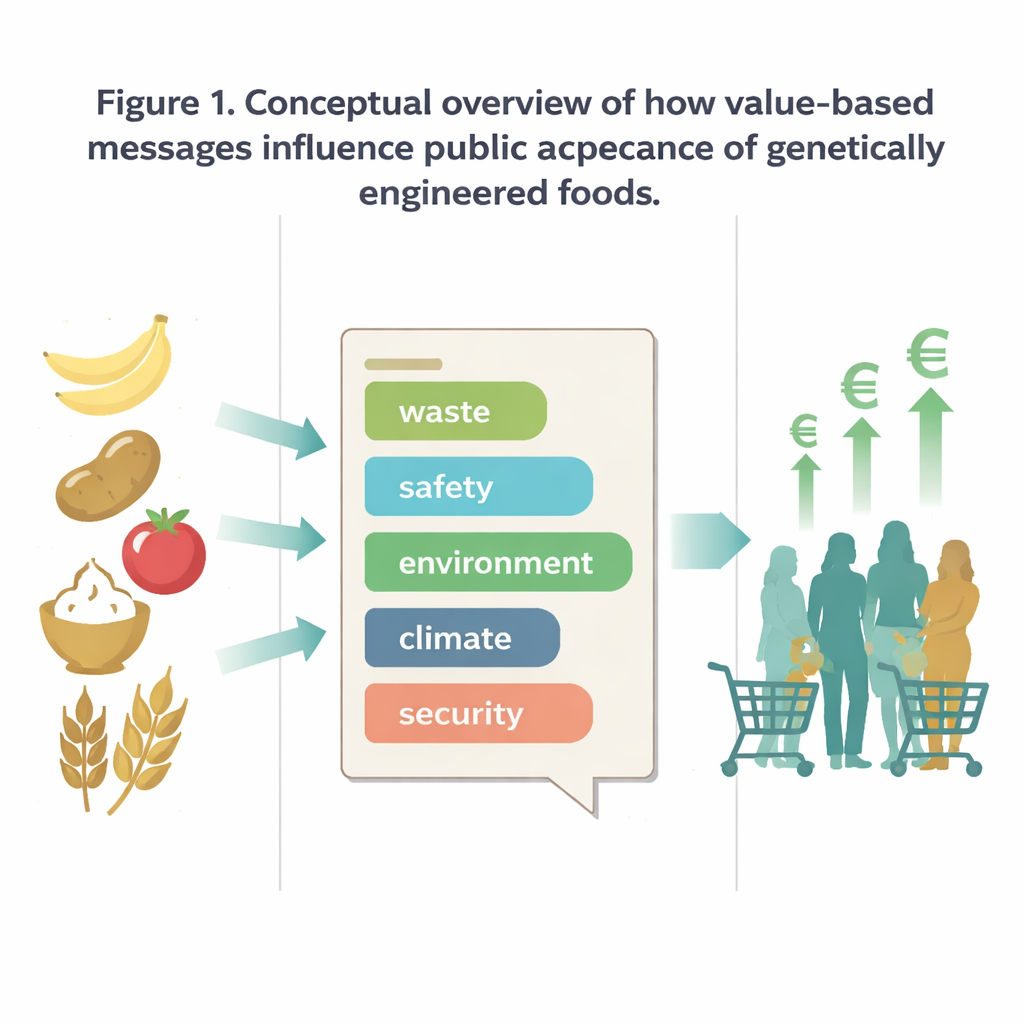
The team surveyed 1,000 Italian adults in an online experiment. Everyone answered questions about five common foods—bananas, potatoes, tomatoes, rice, and wheat—described as produced with genetic engineering. Half of the participants (the control group) saw only a neutral description of each engineered product. The other half (the treatment group) saw the same description plus an extra sentence linking the product to a specific food value. For example, bananas that do not brown were framed as reducing food waste, potatoes that form less acrylamide when cooked were linked to food safety, tomatoes needing fewer fungicides to environmental impact, drought-tolerant rice to climate change, and higher-protein wheat to global food security.
Measuring how much people would actually pay
Instead of simply asking if participants liked or disliked these foods, the study used a step-by-step price list to estimate how much each person would be willing to pay per kilogram. Starting from “free” and moving up in small price steps, respondents chose whether they would still buy the product. This allowed the researchers to calculate a willingness-to-pay range for each person and compare averages between those who saw value-based messages and those who did not. Advanced statistical models were then used to account for differences between individuals and to test how gender, age, income, and education might shape responses.
Food values can move the needle
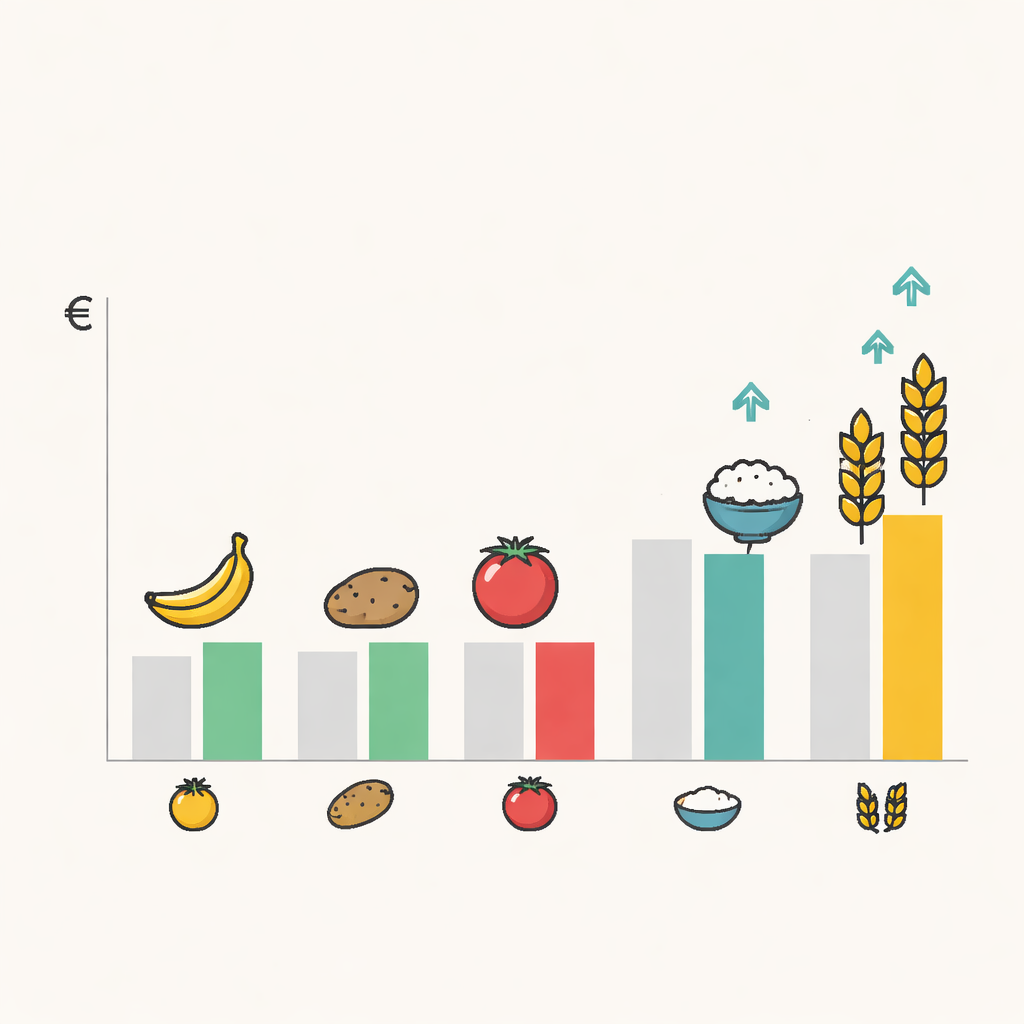
Across all five products, messages tied to food values increased what people were willing to pay for genetically engineered foods. On average, those who received value-based information accepted clearly higher prices than those who saw only neutral descriptions. The strongest boosts appeared when wheat was framed as supporting global food security and when bananas were linked to reducing food waste: in these cases, average willingness to pay roughly doubled compared with the control group. Frames based on food safety, environmental impact, and climate change also raised willingness to pay, though somewhat less strongly. The study further found that income and gender shaped how people reacted: higher-income participants generally paid more overall but were less strongly swayed by the messages, and women often started from equal or higher support but reacted less to value-based framing than men.
What this means for shoppers and policy
The findings suggest that resistance to genetically engineered foods is not fixed. Many consumers become more open when they understand how specific products might reduce waste, improve safety, protect the environment, help farmers adapt to climate change, or enhance food security. Rather than focusing only on technical details or abstract assurances, clear communication that connects new food technologies to widely shared values can help bridge the gap between scientific innovation and public trust. For everyday shoppers, this means that future labels and information campaigns may tell more value-centered stories about why a genetically engineered food exists—and how it could serve both personal and societal goals.
Citation: Selvaggi, R., Yagi, K., Pappalardo, G. et al. Public acceptance for genetic engineering techniques: the role of food values-based information. Sci Rep 16, 7083 (2026). https://doi.org/10.1038/s41598-026-37892-2
Keywords: genetically engineered food, consumer acceptance, food values, willingness to pay, science communication