Clear Sky Science · en
Characterization and dynamics of lignocellulosic components, enzyme activities and microbial populations in diverse crop residues during decomposition
Why leftover stalks and stems matter
After every harvest, farmers are left with mountains of stalks, leaves and pods. These crop residues can either be burned—adding to air pollution—or returned to the soil, where they can feed the next crop. But not all residues rot at the same speed. This study asks a practical question with big implications for food production and climate: how do different kinds of crop leftovers break down in soil, and what does that mean for when nutrients become available to plants?
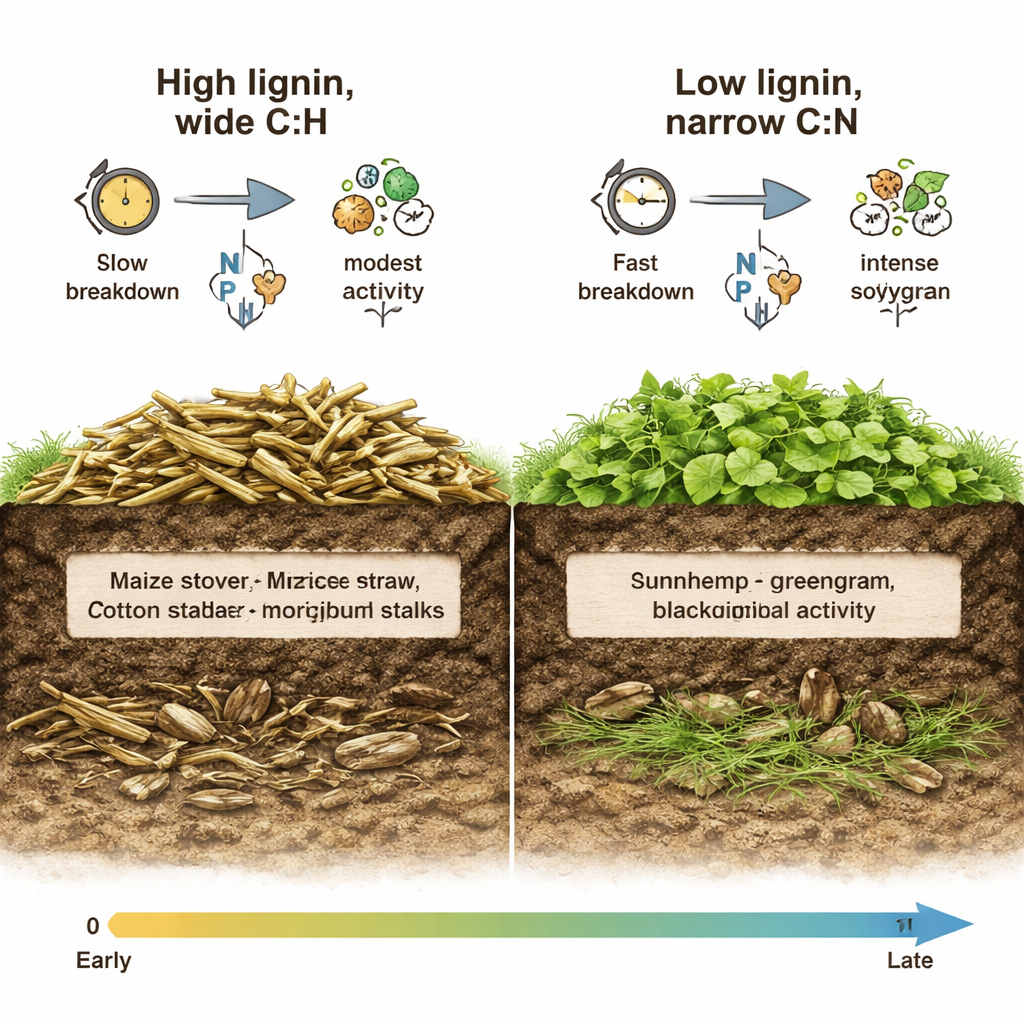
Different plant leftovers, different ingredients
The researchers compared nine common crop residues, including cereal stalks like maize, rice and sorghum, and legume residues such as sunhemp, greengram, blackgram and soybean. They measured key “ingredients” inside the plant material—cellulose and hemicellulose (the more easily used plant fibers), lignin (the tough, woody part), proteins, nitrogen and plant chemicals called phenols. Legume residues turned out to be rich in protein and nitrogen and low in lignin and phenols, while cereal and stalk residues showed the opposite pattern: high in lignin, wide carbon‑to‑nitrogen (C:N) ratios and more phenols. These starting differences set the stage for how quickly each residue would decompose.
Following the breakdown over four months
To watch decomposition unfold, the team buried small mesh bags filled with each residue in the same sandy soil under controlled temperature and moisture. Over 120 days, they repeatedly dug up the bags and tracked how much lignin, cellulose, hemicellulose, proteins and phenols remained. They also measured soil enzymes that cut up plant material—cellulase and xylanase for fibrous carbohydrates, and laccase and lignin peroxidase for tougher woody components. At the same time, they counted bacteria, fungi and actinomycetes (a group of filament‑forming microbes) living around the residue.
Fast rotters versus slow burners
Legume residues behaved like fast‑burning kindling. Sunhemp, greengram, blackgram and soybean lost proteins and fibrous carbohydrates rapidly, with more than half of their cellulose and hemicellulose gone within 60 days. Their surrounding soil showed early spikes in enzyme activities and surges in bacteria and fungi. In contrast, lignin‑rich residues such as redgram stalks, maize stover, rice straw, cotton stalks and sorghum stover decomposed slowly. Lignin, cellulose and hemicellulose declined more gradually, and enzyme activity and microbial populations rose later and stayed active up to 120 days. Across all residues, the easiest components to remove were proteins and hemicellulose, followed by cellulose, while lignin was the slowest to break down.
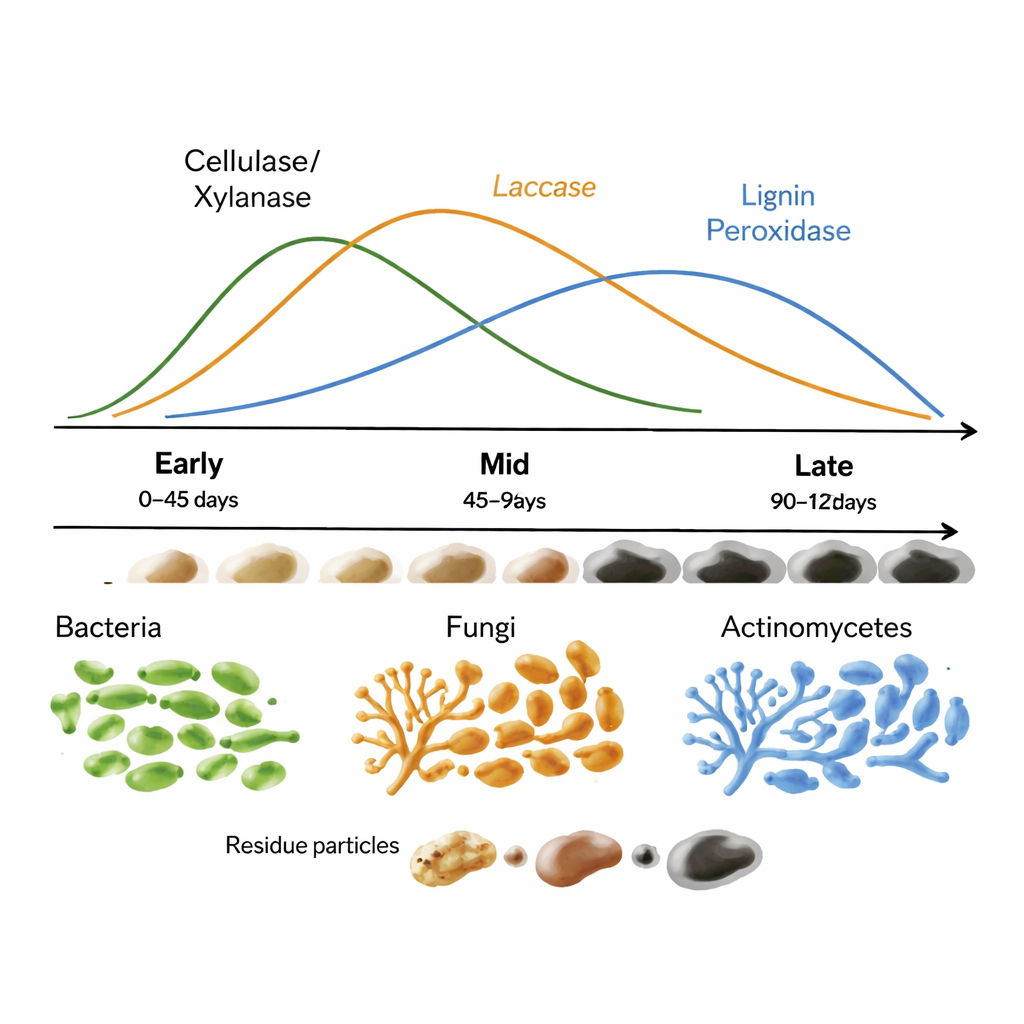
Microbes and enzymes follow the chemistry
The study showed that soil microbes and their enzymes closely “track” residue quality. Nitrogen‑rich, low‑lignin residues triggered strong early bursts of cellulase and xylanase and supported large bacterial and fungal populations shortly after incorporation. Tougher, high‑lignin residues delayed this response; their enzyme activity and microbial numbers grew more slowly and peaked later, but persisted longer as the woody material gradually yielded. Total phenols dipped at first as some compounds were used or transformed, then rose again as more complex bound forms were released from lignin, matching shifts in laccase and lignin peroxidase activity. Statistical analyses confirmed that nitrogen content, lignin level and phenol content were the main levers controlling the timing and strength of microbial and enzyme responses.
What this means for farmers and the environment
For a non‑specialist, the takeaway is straightforward: the “recipe” of crop residues determines how quickly they feed the soil. Soft, nitrogen‑rich legume residues decompose fast and release nutrients within about a month or two, while woody, carbon‑heavy stalks break down slowly over three months or more. The authors suggest that high C:N residues like maize, rice and redgram stalks should be incorporated at least 90 days before planting, whereas legume residues can be added about 30 days ahead. Mixing fast and slow residues can smooth nutrient release, reduce the risk of temporary nutrient tie‑up, and offer a practical alternative to residue burning. Though this work was done in one soil type under controlled conditions, it points to a simple rule: managing what is left after harvest—with its balance of soft and tough plant material—can be a powerful tool for building healthier, more fertile soils.
Citation: Reddy, P.N., Kumari, J.A., Mounika, C. et al. Characterization and dynamics of lignocellulosic components, enzyme activities and microbial populations in diverse crop residues during decomposition. Sci Rep 16, 6560 (2026). https://doi.org/10.1038/s41598-026-37886-0
Keywords: crop residue decomposition, soil microorganisms, lignin and cellulose, nutrient cycling, sustainable residue management