Clear Sky Science · en
Harary index of the zero divisor graph of upper triangular matrices
Why distance in abstract networks matters
At first glance, a paper about “zero-divisor graphs of upper triangular matrices” sounds far removed from everyday life. Yet the ideas behind it are the same ones that help engineers design resilient communication networks and chemists predict how molecules behave. This study looks at how to assign a single number—the Harary index—to a special kind of network built from matrices, and shows how that number captures how tightly connected the network is. Understanding such connectivity in a precise, mathematical way underpins modern cryptography, error‑tolerant systems and even some models of complex chemical structures.
From algebraic rules to pictures of connections
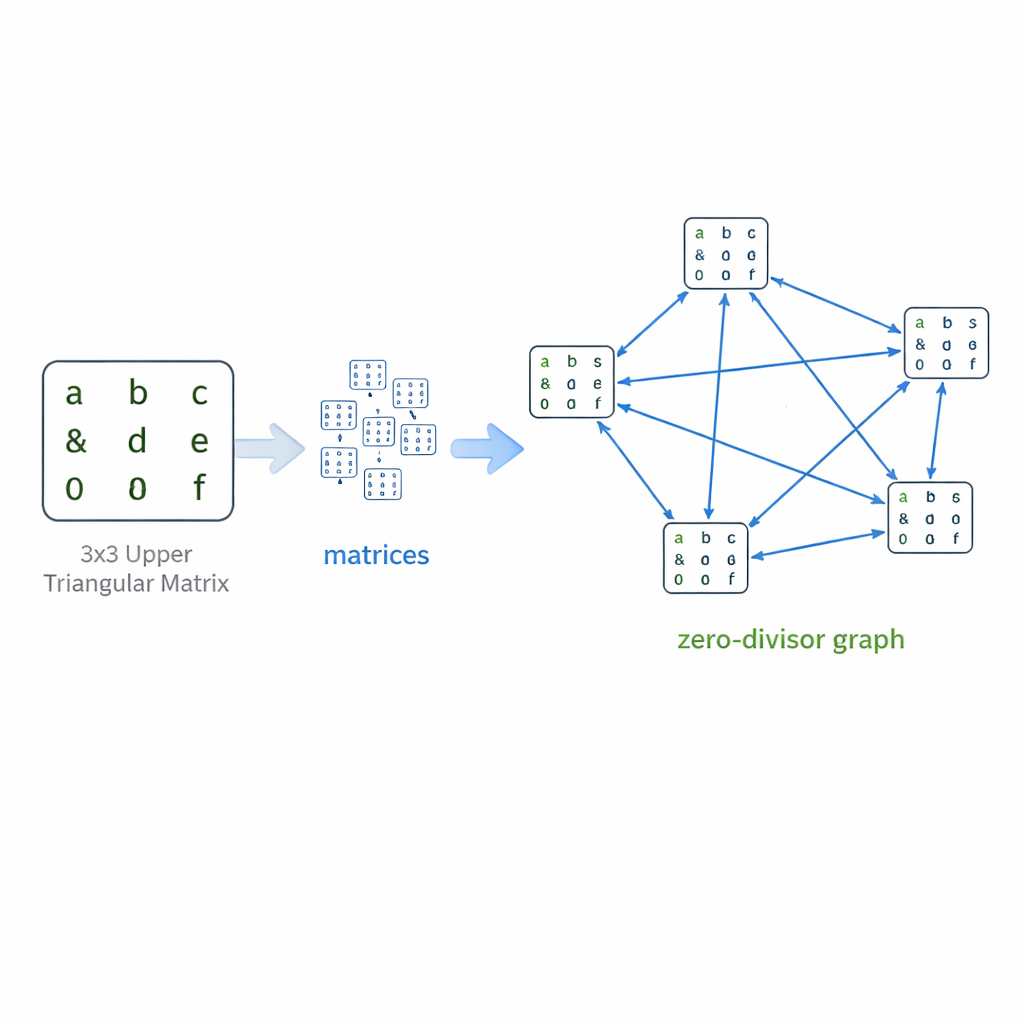
Many algebraic objects, such as rings of numbers or matrices, can be visualized as networks. In a zero‑divisor graph, each node represents an element that can turn another non‑zero element into zero when multiplied with it. Two elements are linked whenever their product is zero. This paper focuses on matrices that are upper triangular—that is, everything below the main diagonal is zero—and whose entries come from the simple two‑symbol number system Z2 (with values 0 and 1). Even this stripped‑down setting produces a surprisingly rich network of interactions between matrices.
Measuring closeness with the Harary index
To compare different networks, mathematicians use numerical summaries called topological indices. The Harary index is one of these: it is obtained by looking at every pair of nodes in a connected graph, measuring how many steps apart they are, and adding up the reciprocals of those distances. Pairs that are directly connected contribute more to the total than pairs that are far apart or not connected at all. In chemistry, this number has been used to relate molecular structure to properties like boiling point. Here, the authors bring the same idea into a purely algebraic setting, applying the Harary index to zero‑divisor graphs built from upper triangular matrices.
Building networks from simple matrices
The authors first examine all upper triangular 2×2 and 3×3 matrices over Z2. For 2×2 matrices there are eight possibilities, seven of which are non‑zero and participate in zero‑divisor relationships. These relationships form a small zero‑divisor graph already studied in earlier work. For 3×3 upper triangular matrices, there are 64 possibilities; discarding the all‑zero matrix leaves 63 candidates. Each such matrix can be thought of as a node in a network, and edges are drawn according to how their products behave. Because matrix multiplication need not commute—that is, AB can be zero even when BA is not—the authors distinguish between directed and undirected versions of the resulting graphs.
Directed versus undirected connectivity
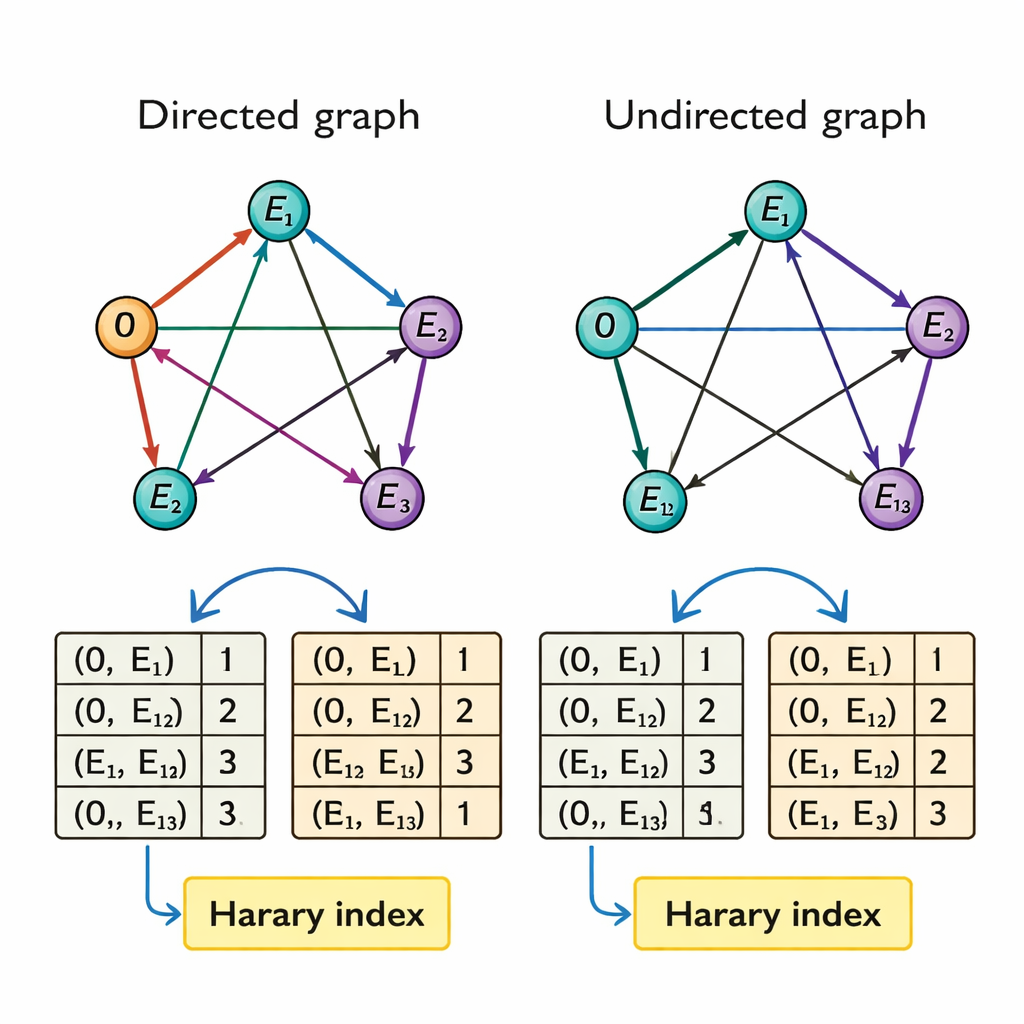
In the directed zero‑divisor graph, an arrow is drawn from one matrix to another when their product in that order is zero. This directionality makes the network more intricate, reflecting the non‑commutative nature of matrix multiplication. The authors compute the Harary index for a small directed graph from 2×2 matrices explicitly, obtaining a value of 7/2. For the much larger 3×3 case, listing all pairwise distances would be unwieldy, so they organize distances into detailed tables and then express the Harary index in a compact combinatorial formula involving binomial coefficients. They also show that as one moves to larger matrices or to rings with more elements, the Harary index must exceed a certain lower bound, capturing the fact that the overall connectivity cannot drop below a specific level.
When multiplication becomes two‑way
The authors also isolate those 3×3 matrices that interact in a fully symmetric way: if matrix Pi multiplied by Pj is zero, then Pj multiplied by Pi is also zero. Restricting attention to these commutative zero divisors produces an undirected zero‑divisor graph. For this graph, where edges do not carry direction, the team again calculates the Harary index. They derive a second neat formula, this time reflecting the shorter and more symmetric paths that arise when every zero‑product relation goes both ways. A similar lower bound is proved, illustrating how the index behaves as the network grows in size or complexity.
What this tells us about structure
To a non‑specialist, the key message is that a single numerical measure—the Harary index—can encode subtle information about how elements in an algebraic system are linked. In the case of upper triangular matrices over Z2, directed and undirected zero‑divisor graphs turn out to have different Harary indices, mirroring the difference between one‑way and two‑way interactions. Because such indices are already useful for assessing robustness in cryptographic networks and for correlating molecular structure with physical properties, these results pave the way for analyzing more complicated matrix rings and related graphs. Future work, as the authors suggest, could extend this framework to larger matrices, other number systems and complementary constructions called cozero‑divisor graphs, deepening the bridge between abstract algebra and practical network design.
Citation: Alshanqiti, O., Sharma, S. & Bhat, V.K. Harary index of the zero divisor graph of upper triangular matrices. Sci Rep 16, 7239 (2026). https://doi.org/10.1038/s41598-026-37880-6
Keywords: zero divisor graph, Harary index, upper triangular matrices, graph invariants, algebraic networks