Clear Sky Science · en
Next-generation compact antenna for robust defense and CubeSat communication
Smaller antennas for a more connected world
From secure military radios to shoebox-sized CubeSats circling Earth, modern communication systems are under pressure to send more data using less space, power, and hardware. This article reports a new palm‑nail–sized antenna that can handle a very wide range of radio frequencies at once, while staying efficient and robust when mounted on compact platforms like small satellites. For readers, it shows how clever shaping of bits of metal on a circuit board can quietly unlock next‑generation wireless links that we increasingly rely on but rarely see.

Why wideband in a tiny package matters
Today’s defense and satellite missions must juggle radar, secure data links, navigation, and 5G‑style services, often all from the same vehicle. Each of these typically uses different slices of the radio spectrum, stretching from a few to many billions of cycles per second. Traditional antennas either work well over a narrow band or grow bulky when asked to cover more. The team behind this work set out to break that compromise by creating a single, compact antenna that covers a huge span of frequencies—3.4 to 14 gigahertz—while still fitting on a 10 by 12 millimeter circuit board, small enough to sit comfortably on a fingertip.
Turning patterns into performance
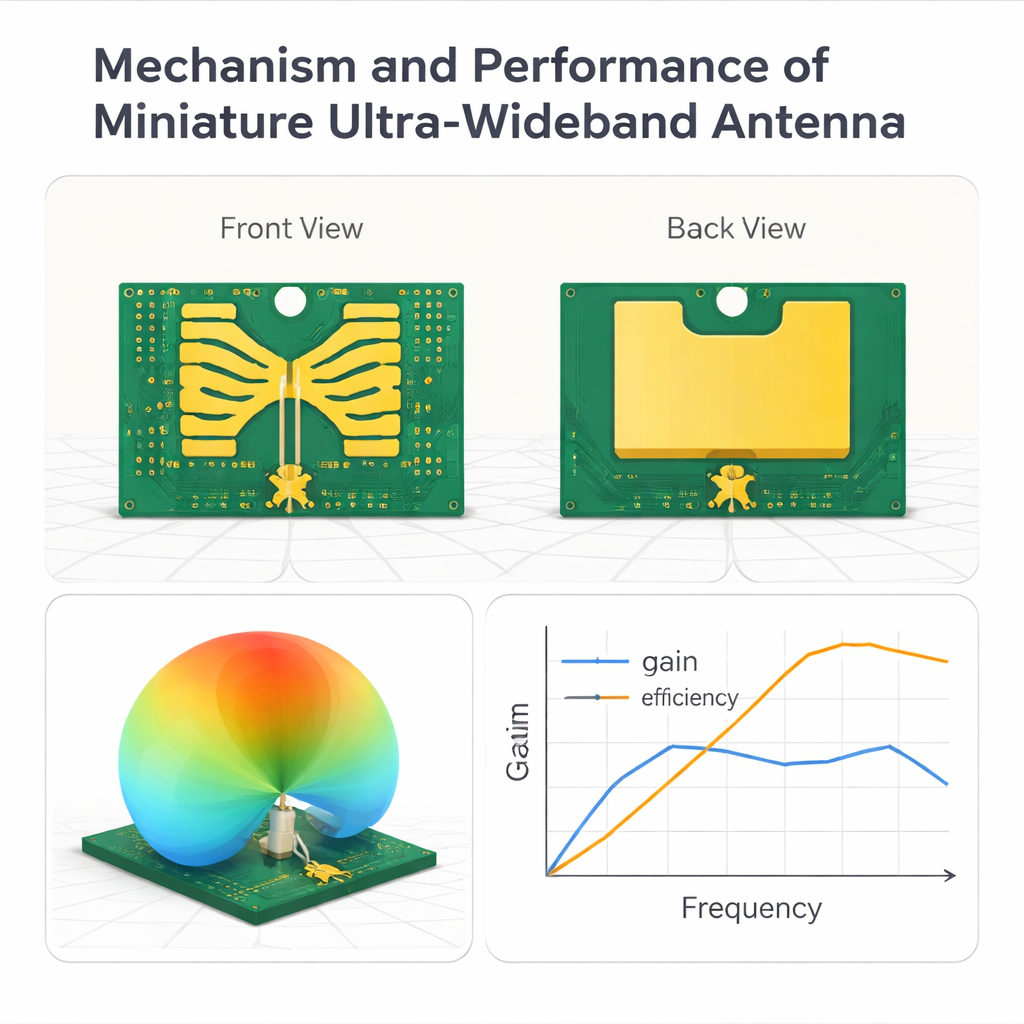
The researchers used a standard circuit material called FR4, commonly found in electronics, and carefully sculpted copper patterns on its front and back surfaces. Instead of a simple metal patch, they arranged nine tiny circular patches in a diamond shape, added small rectangular “wings,” and carved a semicircular stub and slots into the ground plane on the back. These flourishes are not decorative: each extra curve and cut subtly changes how electric currents flow, allowing the antenna to support many resonant paths. By systematically evolving the design through six stages—simulating, tweaking, and re‑simulating—they arrived at a geometry that keeps signals well matched over an ultra‑wide range without making the hardware any thicker.
From computer screen to lab measurements
The proposed design was first optimized in electromagnetic simulation software and then turned into real hardware using standard printed‑circuit fabrication techniques. In the lab, the team measured how much of an incoming signal the antenna reflects back—a quantity known as return loss—and how it radiates energy into space. Placed inside a radio‑quiet anechoic chamber and connected to a vector network analyzer, the tiny antenna showed strong agreement with the simulations: return loss stayed better than minus 10 decibels from 3.4 to 14 gigahertz, with deep dips around key bands, indicating that most of the power is radiated rather than wasted. Radiation patterns measured at 5 and 8 gigahertz were nearly omnidirectional with very low unwanted polarization, meaning the antenna broadcasts cleanly in many directions, a crucial feature for spinning or tumbling satellites.
Built for harsh platforms like CubeSats
Small satellites and compact defense devices often mount antennas directly on metal panels, which can distort performance. To handle this, the authors deliberately kept the antenna’s electrical size small and introduced a “defected” ground pattern that suppresses excess surface currents. Simulations and analysis show that even when attached to a metallic CubeSat wall, any shifts in frequency or efficiency stay modest because the operating band is so wide. Across the band, the device maintains a peak gain of about 4.56 decibels and a radiation efficiency around 83 percent—competitive with or better than many larger antennas reported in recent literature, yet in a much smaller footprint.
What this means for future networks
In plain terms, this work demonstrates that a cleverly patterned sliver of copper on a standard circuit board can act as a “one‑for‑many” antenna, covering major communication bands used in S‑, C‑, and X‑bands as well as emerging 5G and beyond‑5G systems. Its mix of wide coverage, stable radiation, and tiny size makes it particularly attractive for defense radios that must resist interference and for CubeSat missions where every cubic millimeter and milliwatt counts. As wireless systems continue to push into higher frequencies and more crowded spectra, antennas like this one offer a practical route to packing more capability into ever smaller, more agile platforms.
Citation: Yadav, S.V., Yadav, M.V., Raghavendra, S. et al. Next-generation compact antenna for robust defense and CubeSat communication. Sci Rep 16, 7596 (2026). https://doi.org/10.1038/s41598-026-37874-4
Keywords: ultra-wideband antenna, CubeSat communication, defense wireless systems, compact RF hardware, 5G satellite links