Clear Sky Science · en
Reduced chick performance makes supernormal clutches maladaptive in a shorebird
Why having more eggs isn’t always better
It might seem obvious that a bird laying more eggs would raise more chicks, but evolution doesn’t always reward bigger families. This study on the Common Ringed Plover, a small Arctic shorebird, shows that adding just one extra egg to an otherwise normal nest can actually make things worse for the chicks and for the parents’ overall success.
Bird families and nature’s balancing act
For decades, biologists have wondered why many birds stick to the same clutch size—the number of eggs in a nest—even when they are physically capable of laying more. In shorebirds such as plovers and sandpipers, four eggs per nest is almost a rule, whether the birds breed by the sea or inland. One long-standing idea, called the incubation limitation hypothesis, proposes that parents simply cannot keep more eggs at the right temperature. If eggs get even a little too cool, embryos may grow more slowly, hatch later, or emerge as weaker chicks that struggle to survive.
Putting an extra egg to the test
To test this idea in the wild, the researchers worked in Arctic Norway with Common Ringed Plovers. They found pairs whose nests naturally contained four eggs. In half of these nests they quietly added a fifth, artificial egg made of modeling clay that heats up and cools down like a real one, turning these into so-called supernormal clutches. The other half were left at the natural four eggs and served as controls. Tiny temperature loggers, careful nest checks, and repeated measurements of eggs and chicks allowed the team to track how incubation, hatching, and chick development differed between the two groups. 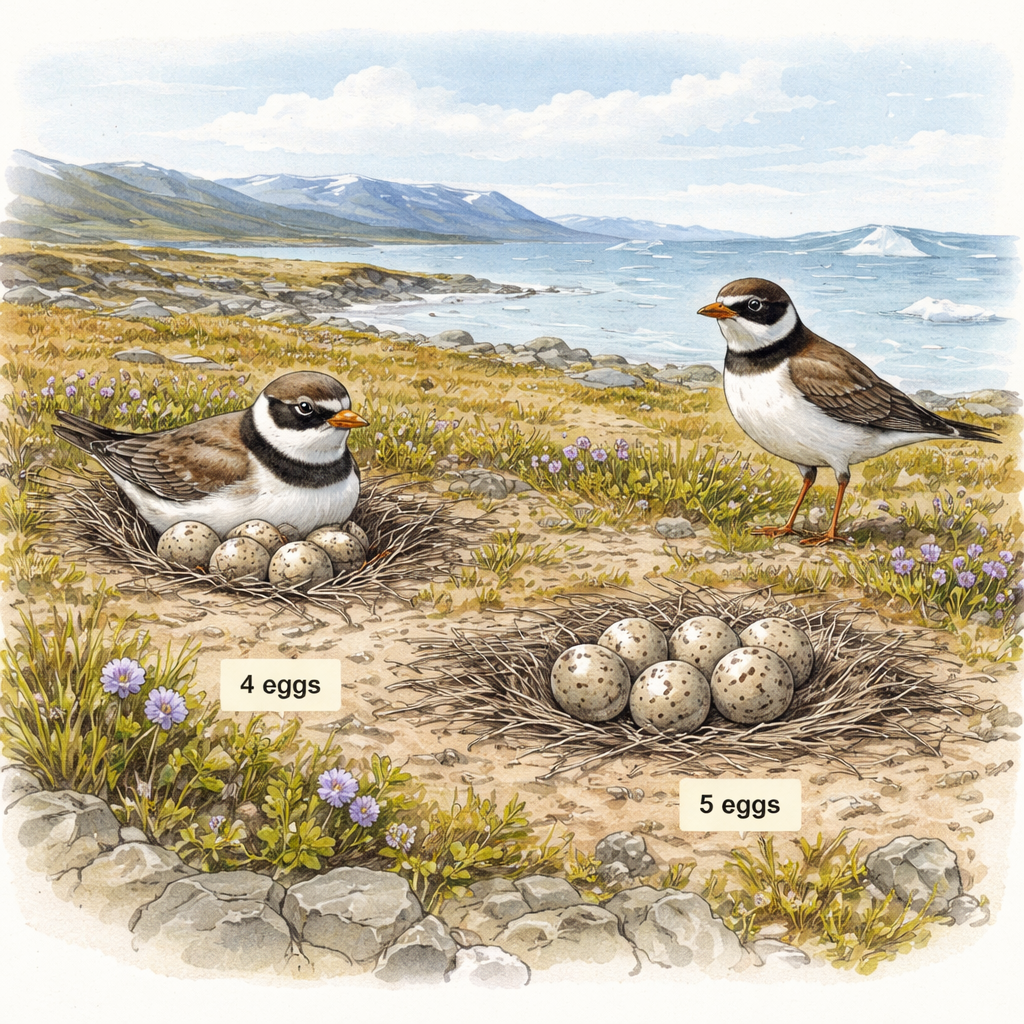
Slower hatching and smaller newborns
Nests with five eggs took about three days longer to hatch than those with four, and the chicks emerged over a wider time window, rather than all within a few hours. The eggs in enlarged clutches also lost mass more slowly, a sign that the embryos were developing at a reduced pace. When the chicks finally hatched, those from five-egg nests were lighter and had smaller heads and legs than their counterparts from normal nests, even after accounting for differences in egg size. This pattern matches what would be expected if the parents could not keep all five eggs consistently warm, causing embryos to use energy less efficiently and leaving less yolk to fuel the first days of life.
Early life struggles and higher chick losses
The disadvantages did not end at hatching. Throughout their first two weeks, chicks from enlarged clutches stayed lighter and had shorter legs than chicks from four-egg nests; they never caught up in size. Yet their growth rate—the speed at which they added mass and bone—was similar, meaning that starting small meant staying small. Habitat also mattered: chicks reared along beaches and shorelines grew faster than those in inland tundra, probably because food was easier to find. Most strikingly, chicks from five-egg nests were about three and a half times more likely to die in their first 10 days. When the researchers combined all stages—from eggs surviving in the nest to chicks surviving their first days on the ground—they found that any small advantage of having an extra egg at hatching disappeared. Ten days after hatching, the overall reproductive payoff of the larger clutches was roughly one third lower than that of normal clutches. 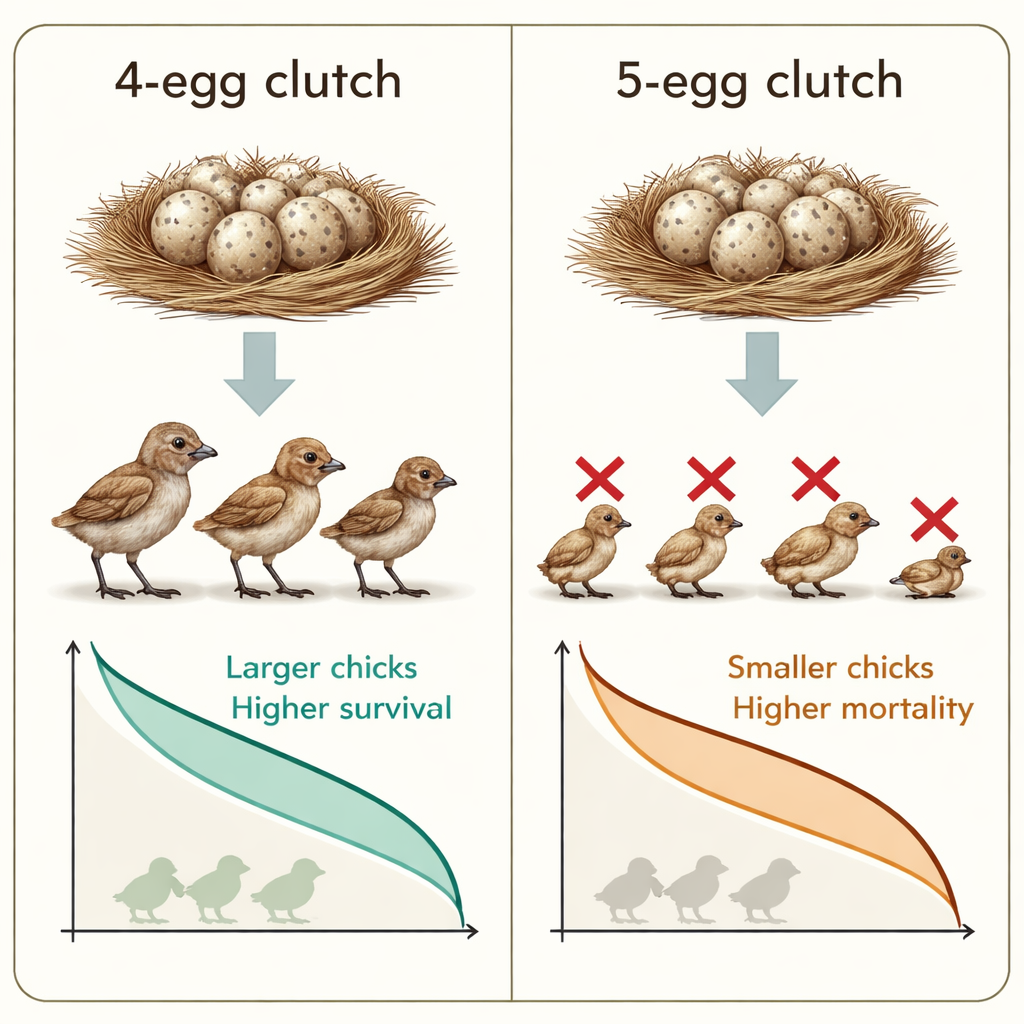
What this means for shorebirds and beyond
The study shows that, for these plovers, more eggs do not equal more surviving chicks. Instead, the extra egg stretches the parents’ ability to incubate effectively, producing smaller, less robust chicks that die more often. Because forming each egg is costly for the female, laying a fifth egg is, on balance, a poor investment. These findings support the idea that the physical limits of keeping eggs warm help fix clutch size at four in many shorebirds. They also highlight how subtle changes during incubation can echo into chick growth and survival, reminding us that evolution shapes not just how many young animals are born, but how well they are prepared for the challenges of early life.
Citation: Heggøy, O., Wanders, K. & Lislevand, T. Reduced chick performance makes supernormal clutches maladaptive in a shorebird. Sci Rep 16, 7305 (2026). https://doi.org/10.1038/s41598-026-37872-6
Keywords: shorebirds, clutch size, bird incubation, chick survival, life-history evolution